Best Way to Apply for Jobs in 2026: The System That Works
The best way to apply for jobs in 2026: target roles you match, tailor your resume, apply early, follow up with one human message, and track everything.


The best way to apply for jobs in 2026 is to find a role you genuinely match, tailor your resume to the job description, apply through the company's own careers page, and follow up with a short human message within 24 hours. Most job seekers skip at least two of those four steps, and that gap is what separates months of silence from interviews within two weeks.
The Best Way to Apply for Jobs: 5 Core Steps
- Target one specific role type before you start searching, so every later step gets sharper.
- Tailor your resume to each job description (headline, summary, skills, and your top bullets).
- Apply through the company's own careers page within 24-48 hours of the posting going live.
- Send a short follow-up message to a real person at the company, not just the application portal.
- Track every application and follow up again after 3-5 business days.
The market backs this up. U.S. job applications per open role have more than doubled since spring 2022. LinkedIn research published in January 2026 found that 65% of people say finding a job has become more challenging, and 93% of recruiters plan to increase their use of AI this year. The volume of competition went up, the tools employers use to screen got smarter, and the old "send your resume everywhere" approach now actively hurts you because it signals that you didn't do the work to figure out fit.
Tailoring isn't a soft suggestion. Jobscan's analysis of over 2.5 million applications found that candidates whose resume job titles matched the posting had a 10.6x higher interview rate, which is why every step in this system starts with fit, not volume. Before you apply to any role, you'll run it through a 10-point fit check (explained in full below) so you only spend time on applications where you can genuinely compete.
We work with over 1.1 million job seekers across AIApply's platform, and the pattern we see in searches that work is consistent: targeted roles, tailored materials, an early submission, one human signal after applying, and systematic tracking. That five-step loop accounts for most of the variance between "months of silence" and "interviews within two weeks." This guide gives you the full system.
The rest of this guide expands each step, plus the scoring, formatting, and situation-specific tactics that make them work.
What Actually Works When Applying for Jobs in 2026
The best way to apply for a job in 2026 is: find a role you match, tailor your resume to the job description, submit through the company's official application page, follow up with a short human message that shows why you're relevant, and track everything.
Your application needs to answer one question the hiring team is always asking:
"Can this person do this job, in our environment, with less risk than the other candidates?"
Everything you submit reduces that risk or increases it. Specifically:
- Your resume proves you have the skills
- Your cover letter proves your intent and fit
- Your LinkedIn profile adds credibility
- Your outreach message proves you're a real person worth reviewing
- Your interview prep proves you can explain the work
That's the whole machine. The rest of this guide explains each part.
Why the Job Market Feels So Hard Right Now
Job seekers are not imagining the difficulty. There's a structural reason things feel harder.
The March 2026 JOLTS report, analyzed by Indeed Hiring Lab, found 6.9 million U.S. job openings, but the market stayed in a "low-hire/low-fire" pattern. Openings are steady, but employers are being cautious about who they actually bring on. A cautious employer doesn't hire the "maybe" candidate. They hire the obvious match.
Greenhouse's 2025 Workforce and Hiring Report, which surveyed 2,200 active job seekers across the U.S., U.K., and Ireland, found that only 7% of candidates believed the market favored them. 45% of Gen Z candidates said it felt harder than ever to stand out.
LinkedIn job applications were up more than 45% year over year, and easy-apply tools were flooding employer inboxes with resumes, making it genuinely harder for qualified people to get noticed.
The weird contradiction of the 2026 job market: employers are overwhelmed with applicants, but still complain they can't find the right people.

Your job is to stop being part of the noise and start being easy to find, easy to understand, and easy to trust. That starts with a focused job search strategy built around roles you actually match.
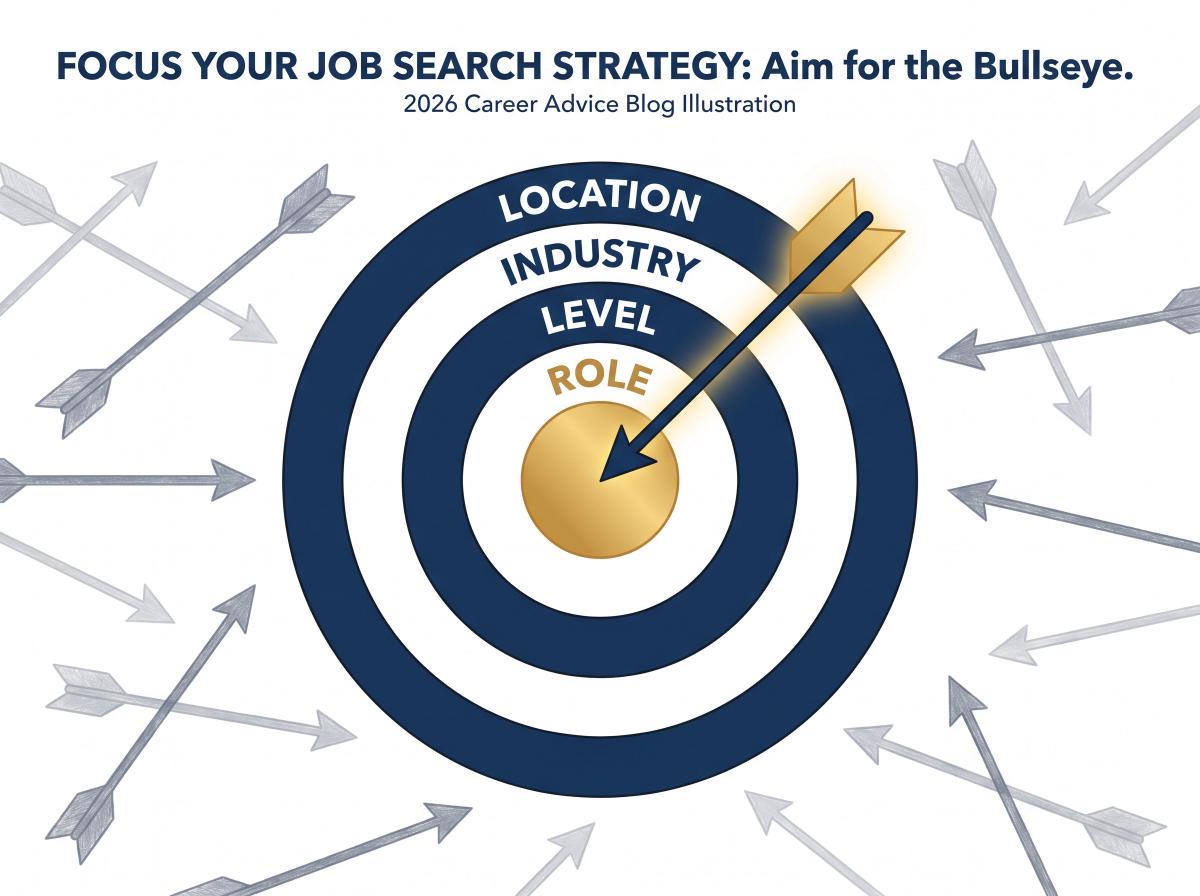
How to Choose the Right Job Target Before You Apply
Most job searches fail before the first application is submitted. Not because the resume is terrible. Because the target is fuzzy.
"I'm open to marketing, operations, product, customer success, maybe startups, maybe remote" sounds flexible. To a recruiter reviewing 200+ applications in a queue, it reads as unfocused. Pick one primary target:
→ Target role: "Customer Success Manager"
→ Target level: "2-4 years of experience"
→ Target industry: "B2B SaaS"
→ Target location: "Remote UK / Europe"
→ Target proof you'll highlight: Renewals, onboarding, account growth, CRM experience
Once you have this, every later step gets faster. You know which keywords matter, which achievements to highlight, which companies to research, and which people to contact.
Test your target with this one-sentence fit statement:
"I help B2B SaaS teams reduce churn by improving onboarding, customer communication, and renewal workflows."
If you can write a sentence like that, it can become your LinkedIn headline, your resume summary, your cover letter opener, and your networking pitch. If you can't write it yet, your target isn't specific enough. Once your target is clear, browse open roles matching your criteria to test how many real positions align with it.
How to Build a Strong Master Resume for Every Application
Don't start from scratch every time. That's a time trap.
Build a master resume first. This is a private document that can be longer than anything you'd actually submit. It captures everything:
- Every role you've held, with full detail
- Every measurable achievement
- Tools and software you've used
- Projects, certifications, awards
- Volunteer work and side projects
- Portfolio links and leadership examples
- Coursework (especially relevant for early-career candidates)
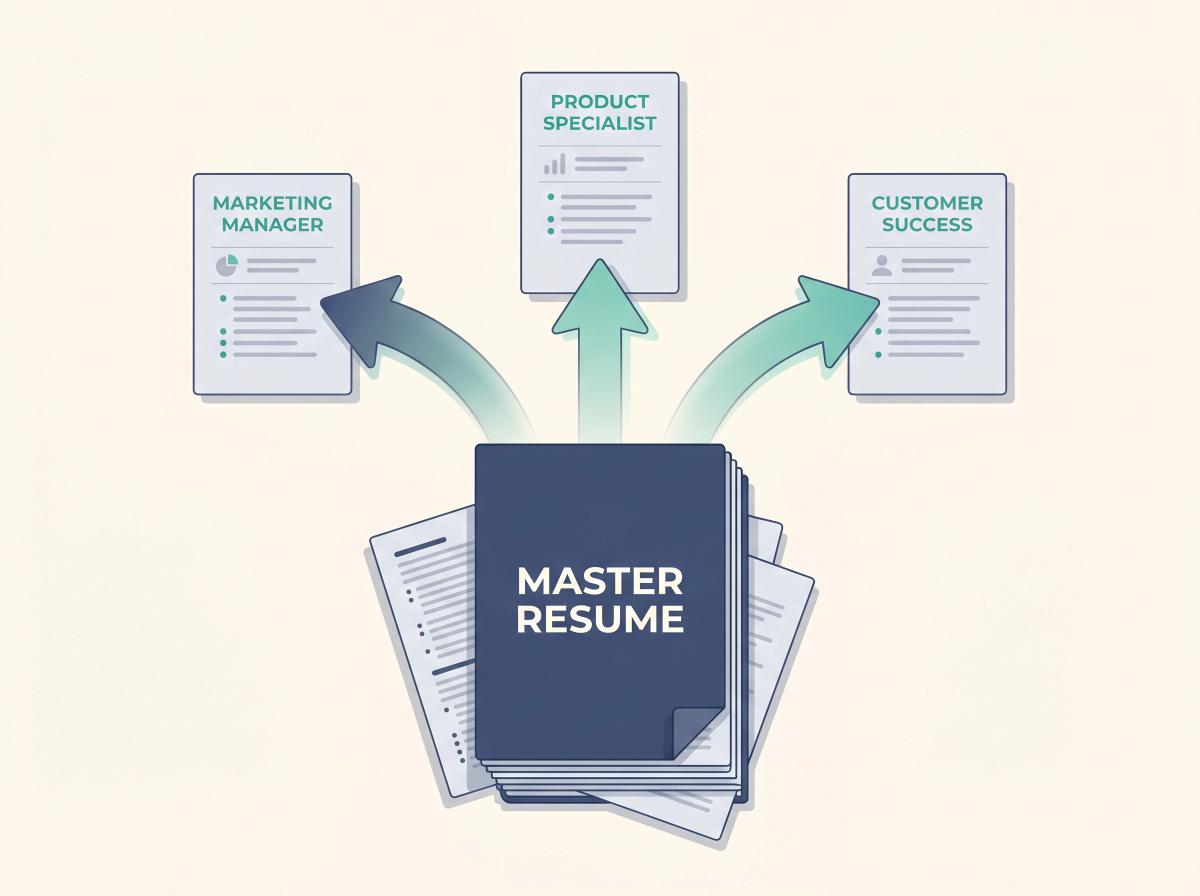
Then, for each application, you pull from this master version rather than rebuilding. It's dramatically faster and more consistent. Browse resume examples for your target role before you start, letting you see what strong final versions look like and informing what to emphasize in your master draft.
Our AI Resume Builder is useful here because you can import your existing experience, generate ATS-friendly tailored versions for each job, and export in PDF, DOCX, or plain text. You're never building from scratch when you have a solid base. Before you start tailoring, make sure you know the right format before submitting. The structure matters as much as the content.
How to Read a Job Description Like a Recruiter
Before you tailor anything, split the job description into three buckets.
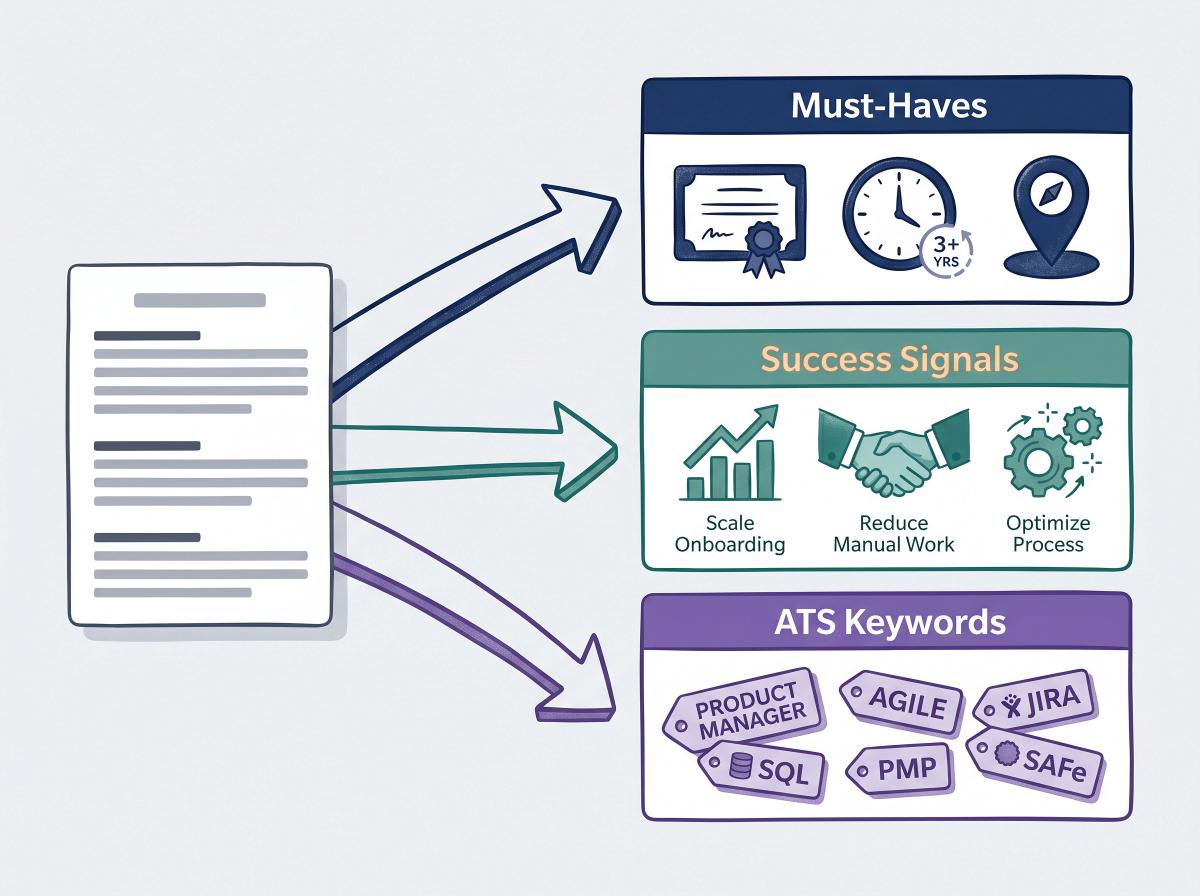
Must-have requirements
These are the non-negotiables: years of experience, technical skills, certifications, location, work authorization. If you're missing core requirements, be honest about it. You can still apply if you're close, but go in with eyes open.
Success signals hidden in the job posting
These are clues about what the hiring manager actually cares about: "scale onboarding," "own reporting," "build dashboards," "manage enterprise accounts," "reduce manual work." This is the real job description hidden inside the official one.
Keywords that ATS systems scan for
These are the exact skills employers look for: specific job titles, tools, methods, credentials, and industry terms.
Here's why this matters. Jobscan's 2025 State of the Job Search report, which analyzed over 2.5 million applications, found that candidates whose resume job titles matched the target job listing had a 10.6x higher interview rate. The same report found that including a cover letter correlated with a 3.4x higher interview rate, and an optimized LinkedIn profile with a 2.2x higher interview rate.
Those are large numbers. Matching the employer's language truthfully is one of the highest-impact moves in the whole search. Study tailoring your resume to each job description before you start editing. The approach matters as much as the keywords you pick.
The rule is simple: mirror the job description, but never invent experience.
| Weak Language | Stronger Language |
|---|---|
| "Growth Ninja" | "Growth Marketing Specialist" |
| "Handled customers" | "Managed onboarding and retention for 85 B2B accounts" |
Once you've identified the right keywords, scan for keyword gaps before submitting so nothing critical gets missed.
How to Tailor Your Resume for Each Job Application
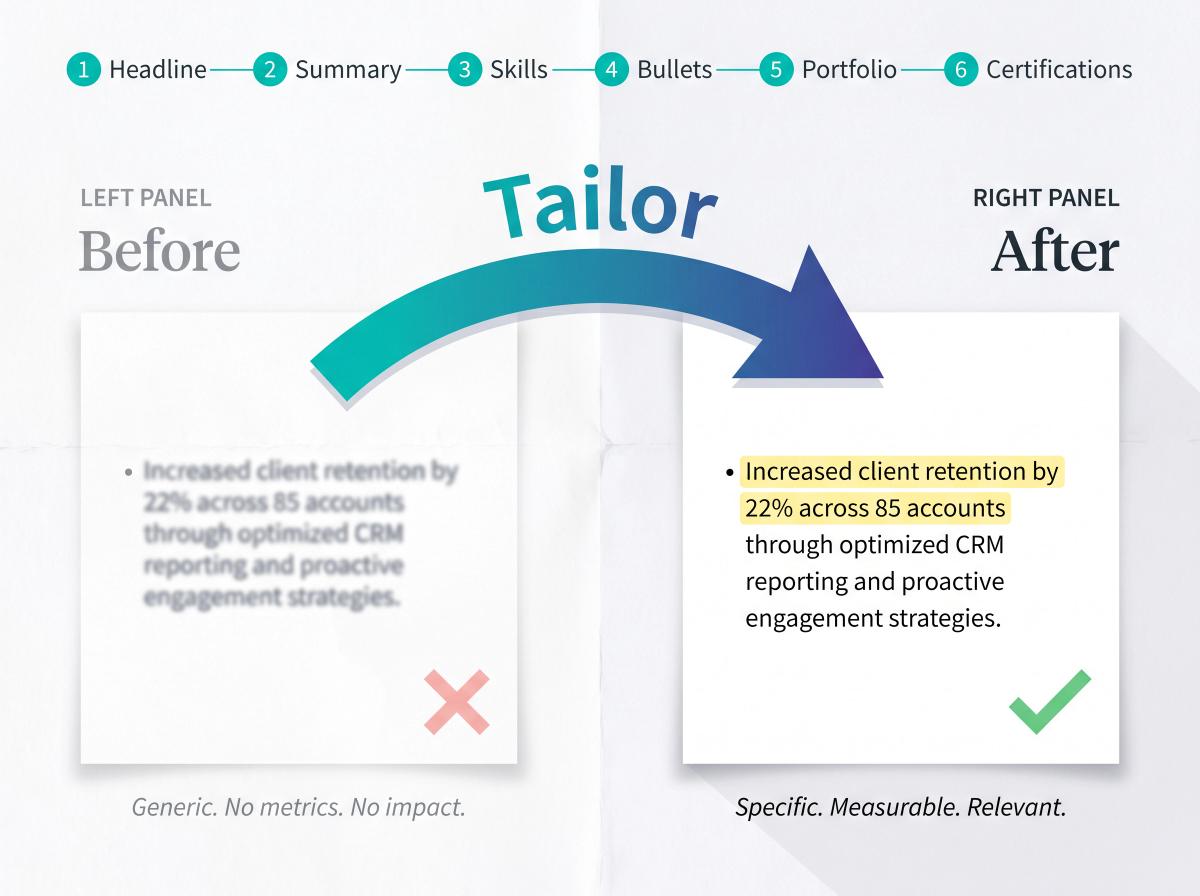
You don't need to rewrite your entire resume for every job. You need to tailor the parts recruiters actually scan first:
① Headline or target title
② Summary (2-4 lines)
③ Skills section
④ Top 3-5 bullets under your most relevant role
⑤ Project or portfolio section (if applicable)
⑥ Tools and certifications
Resume Genius's 2026 Hiring Insights Report, which surveyed 1,000 U.S. hiring managers, found that 71% use applicant tracking software, 79% use AI somewhere in hiring, and the most common ATS rejection reasons are: missing required skills, poor alignment with the job description, unclear work history, generic or AI-heavy content, and lack of relevant keywords.
The formula for strong bullets is:
Job title + required skill + proof + measurable result
Here's what that looks like in practice:
Instead of: "Responsible for managing customer accounts"
Write: "Managed 85 B2B customer accounts, improved onboarding completion by 22%, and reduced first-90-day churn through structured check-ins and CRM reporting"
Instead of: "Worked on marketing campaigns"
Write: "Launched 6 email campaigns in HubSpot, increasing trial-to-demo conversion from 11% to 17% over two quarters"
Your resume should not say "I am a great fit." It should make the recruiter think: "This person has already done something close to what we need." For more specific techniques for writing strong resume bullets, see our full optimization guide. To see how these principles apply to an actual resume, see a Customer Service Manager resume example built with these exact guidelines.
What Is the Best Resume Format for Online Applications?
Use a clean, text-heavy format. That's it.
Resume Genius's 2026 research confirmed what ATS behavior has shown for years: text-based PDFs are the most compatible format. Only 13% of hiring managers said resumes with images or heavy design elements were compatible with their ATS.
For most professional roles, use:
- Standard section headings (Experience, Education, Skills, Projects)
- Normal fonts
- Clear date formatting
- Bullet points
- No headshot (unless your market expects one)
- No charts or skill bars
- No two-column layouts (unless you're confident it won't break parsing)
- No icons replacing text
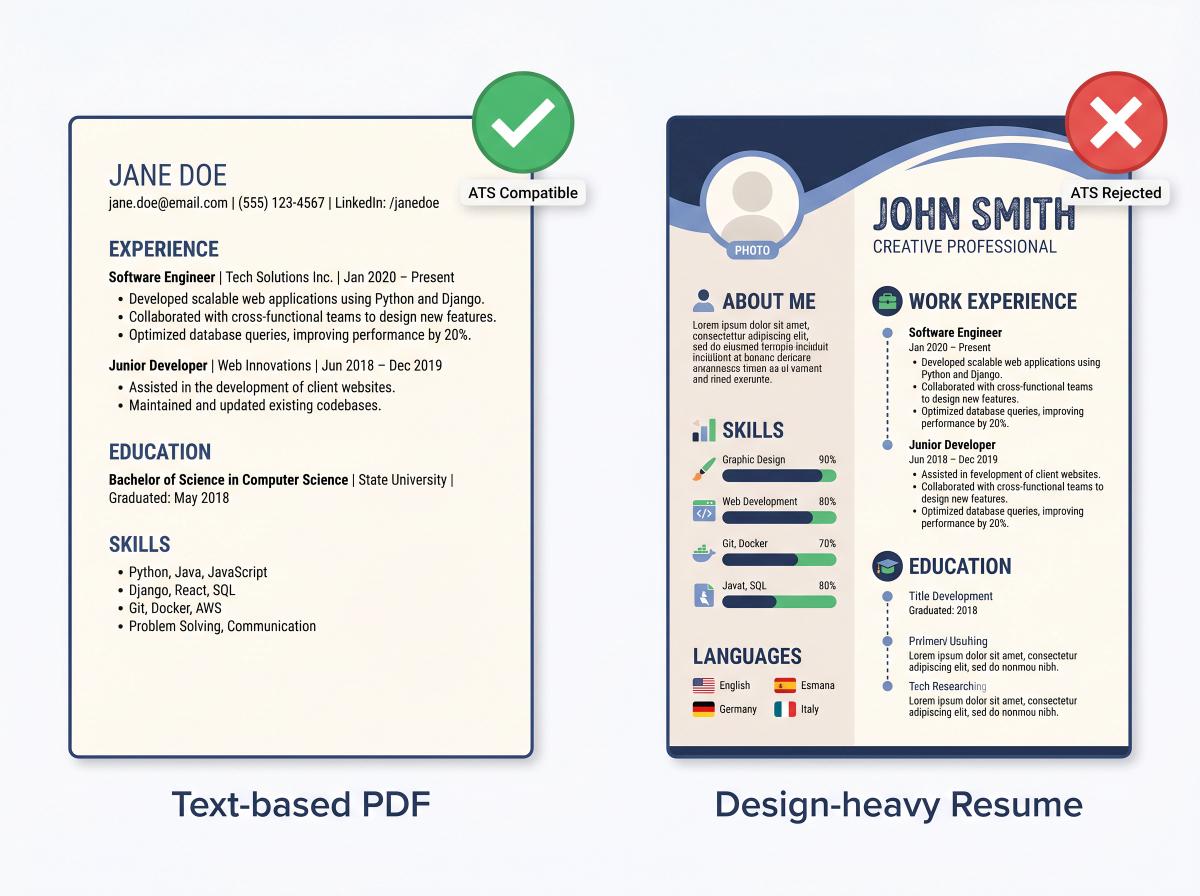
Submit a text-based PDF for most corporate, tech, and professional roles. Use DOCX only when specifically requested or for older government/agency systems. Our AI Resume Rewriter can clean up formatting issues and restructure content into a clean, ATS-compatible layout, which is useful when you're adapting an older or design-heavy resume to a standard format. For a deeper look at when AI-assisted formatting makes the most sense, see our 2026 comparison.
Should You Write a Cover Letter When Applying for Jobs?
Yes, when it genuinely explains fit. No, when it just restates the resume.
A cover letter adds value when:
→ You're changing careers and need to explain a non-linear path
→ The role is highly competitive
→ You have a specific reason for wanting that company
→ You need to explain a gap or non-linear path
→ The job asks for one
→ You can connect your experience to a specific company problem
A cover letter wastes everyone's time when:
- It's generic and could be sent to any employer
- It starts with "I am writing to express my interest"
- It repeats every bullet from the resume
- It sounds like AI wrote it with no personal detail
- The employer said not to include one
The best structure is four short paragraphs:
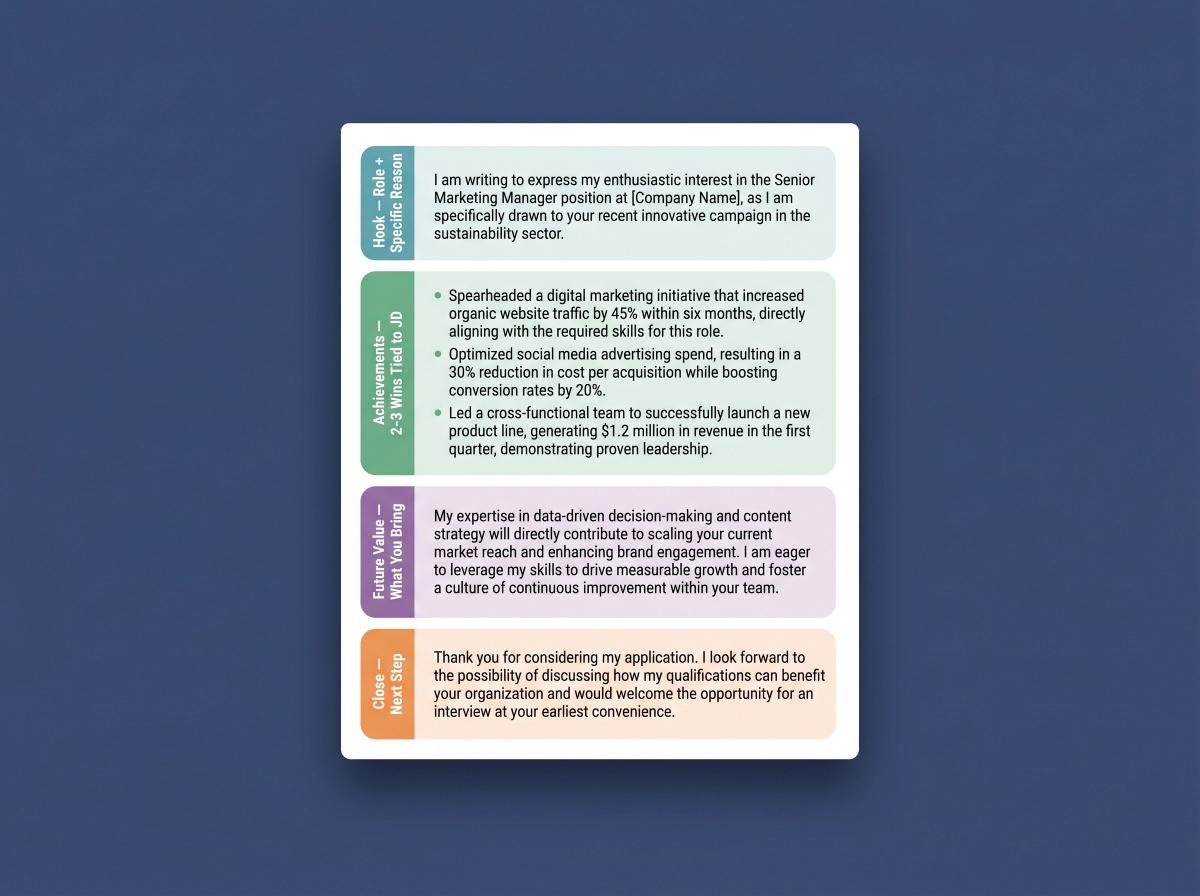
Paragraph 1: Name the role and show one specific reason you're interested. Paragraph 2: Connect 2-3 achievements to the job description. Paragraph 3: Make the future value obvious. Close: Thank them and point to your resume or portfolio.
Here's an example that actually works:
Dear Hiring Team,
I'm applying for the Customer Success Manager role because your team is scaling onboarding for mid-market customers, which is exactly the kind of work I've been doing for the past three years.
In my current role, I manage 85 B2B accounts and redesigned the onboarding check-in process, increasing completion by 22% and reducing first-90-day churn. I also built weekly renewal-risk reporting in Salesforce so account managers could identify expansion and retention risks earlier.
I'd bring a mix of customer communication, process improvement, and commercial awareness to your team. I've attached my resume and would be glad to share examples of onboarding workflows I've built.
Best, [Your name]
To see how a strong Customer Service Manager cover letter reads, check our role-specific example.
Our AI Cover Letter Generator can create a job-specific draft in minutes by analyzing the job description and your background. The key, though, is to edit the result until it sounds like you specifically, not like a professional template. You can also browse role-specific cover letter examples across dozens of fields to calibrate your tone and structure before you write.
When and Where to Submit Your Job Application
Early applications often get more attention because many recruiting teams review candidates as they come in.
Greenhouse co-founder Jon Stross noted that candidates are generally shown in the order they enter the system, and that being early, relevant, and internally referred all improve visibility. This workflow insight still holds even as tools evolve.
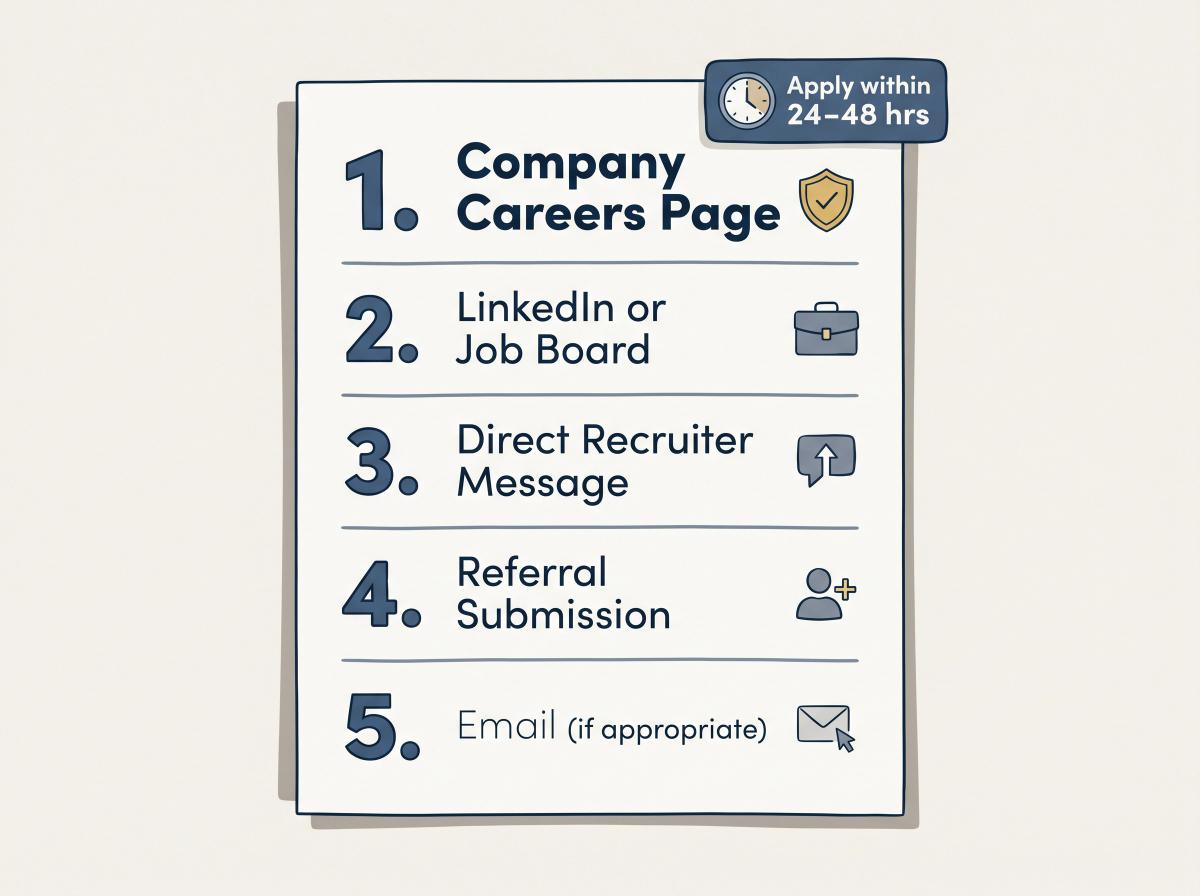
Your target: apply within 24-48 hours of a strong-fit job posting going live.
But do not submit a sloppy application just to be early. A strong application submitted on day two beats a careless one submitted in the first hour.
For most professional roles, the best channel priority is:
- Company careers page (confirms the role is real and active)
- LinkedIn or major job board listing
- Direct recruiter message
- Referral submission
- Email, only if specifically appropriate
Why company careers page first? Because it confirms the role exists in the employer's own system. It also matters for job scam protection. LinkedIn research found nearly three in four professionals stop to verify a role's legitimacy before applying, and about half specifically check whether it appears on the company's own site.
For a detailed walkthrough of the full process of applying online effectively, including how to navigate ATS forms without errors, see our guide. To keep your funnel full of verified, real-company roles, our job board links directly to company career pages so you're always applying in the right place.
Before you submit personal documents, verify:
- The job exists on the company's website
- The recruiter uses a company email or has a verified profile
- No one is asking you to pay money
- No one is requesting bank details before an offer
- The interview process makes logical sense
- The salary isn't suspiciously high for the role type
How to Follow Up After Submitting a Job Application
This is the step most applicants skip completely.
They click submit. Then they wait. Better move: click submit, then send a short, specific message to a real person at the company. This is what transforms you from a file in a queue to a person worth reviewing. Start with follow-up email templates that work. Having the right format ready means you can send within hours, not days.
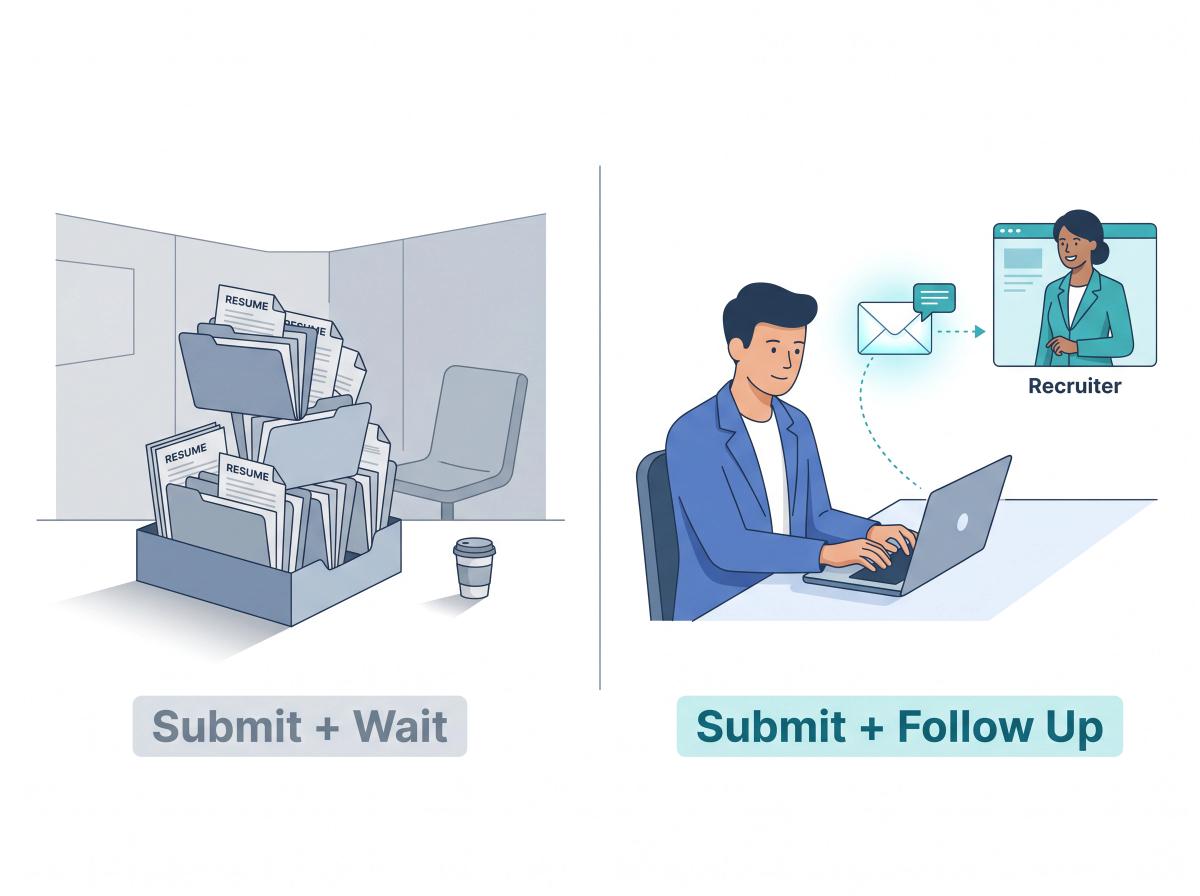
That message can go to:
- A recruiter who handles the role
- The hiring manager directly
- An employee who works on the relevant team
- A connection who can give you a warm referral
Your message should not beg. It should make relevance obvious in 3-4 sentences.
What to say to a recruiter after applying
Hi [Name], I just applied for the [Role] position. I noticed the team is looking for someone with [skill/responsibility]. In my last role, I [specific proof with result]. Happy to share more context if useful.
What to say to a hiring manager directly
Hi [Name], I applied for the [Role] today and wanted to briefly introduce myself. Your team seems focused on [business problem]. I've worked on something similar: [1-sentence proof]. I'd be glad to bring that experience to [Company].
For more templates and tips for reaching hiring managers directly, including how to find the right person and what subject lines work, see our full guide.
How to ask an employee for a referral
Hi [Name], I saw you work on [team/function] at [Company]. I'm applying for [Role] and noticed the job focuses on [specific responsibility]. I've done similar work in [context]. Would you be open to a quick question about the team or whether my background looks relevant?
A few rules: don't send a wall of text. Don't attach your resume unless asked. Don't open a stranger conversation with "can you refer me?" Ask for advice first. Earn the referral if the fit is real.
How to Beat ATS Without Gimmicks
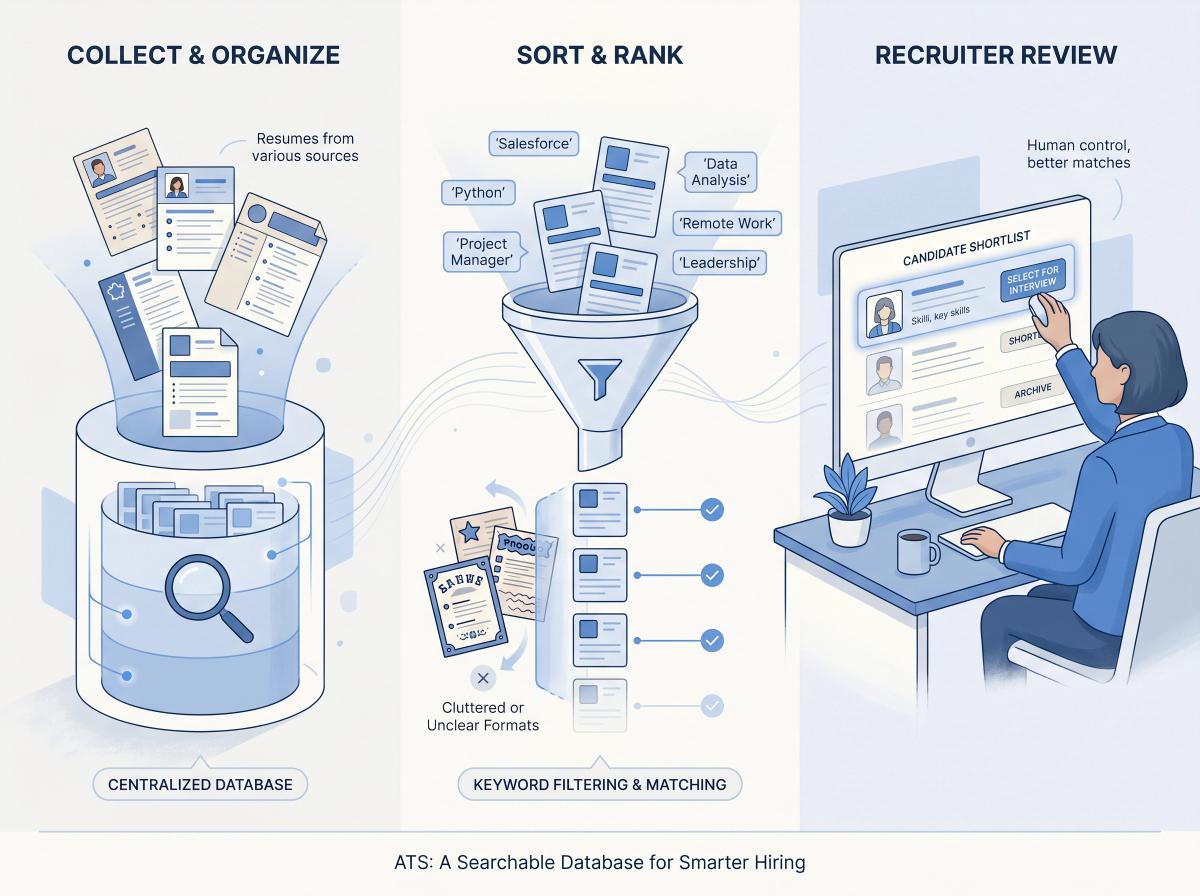
First, let's clarify what ATS actually is.
ATS (Applicant Tracking System) is software that employers use to collect, organize, search, and manage applications. It's not always a robot auto-rejecting candidates. Often it's a database that recruiters search.
Resume Genius's 2026 research found that 49% of hiring managers personally review resumes while using ATS to flag, rank, or organize them, while 37% let ATS screen out applications based on criteria they set. Jobscan's 2025 report found that over 99.7% of recruiters use filters, and 76.4% filter by skills from the job description.
So ATS optimization isn't some mysterious trick. It's clarity. Our AI Resume Scanner checks your resume against the job description and shows you exactly which keywords are missing before you submit.
| Do This | Skip This |
|---|---|
| Use the exact job title when truthful | Stuff keywords in white text |
| Include required hard skills by name | Paste the whole JD into the resume |
| List tools specifically (Salesforce, not "CRM tool") | Use fake job titles |
| Use standard section headings | Put content in tables that break parsing |
| Show clear dates | Use two-column layouts without testing them |
| Include certifications and credentials | Rely on a beautifully designed visual that hides substance |
| Save as text-based PDF or DOCX | Use graphics, skill bars, or icon-only sections |
Our AI Resume Checker analyzes your resume against 50+ ATS systems, flags keyword gaps, and suggests improvements before you submit. It's free to use and takes a few minutes.
How to Use AI Tools When Applying for Jobs in 2026
AI in job search is now normal. LinkedIn's January 2026 research found that 81% of people have used or plan to use AI in their job search. But there's a catch.
The same Resume Genius 2026 report found that 80% of hiring managers said they can often tell when a resume was written by AI, and 72% said heavy reliance on AI makes candidates seem less skilled. The Greenhouse 2025 report noted that some candidates feel AI makes it harder to stand out because everyone's materials start sounding the same.
That's the trap. AI should make you faster, not fake. Read our honest breakdown of whether and how to use AI in your job search before you commit to any AI workflow.
Use AI to:
→ Decode and categorize job descriptions
→ Identify missing keywords before submitting
→ Rewrite bullets clearly and specifically
→ Turn task descriptions into achievement statements
→ Generate cover letter drafts you then personalize
→ Practice interview answers with targeted feedback using our AI mock interview tool
→ Summarize company research quickly
Don't use AI to:
- Invent projects or exaggerate skills
- Create generic buzzword soup
- Submit the exact AI-generated output without editing
- Answer interview questions you can't actually defend
- Flood companies with untargeted applications
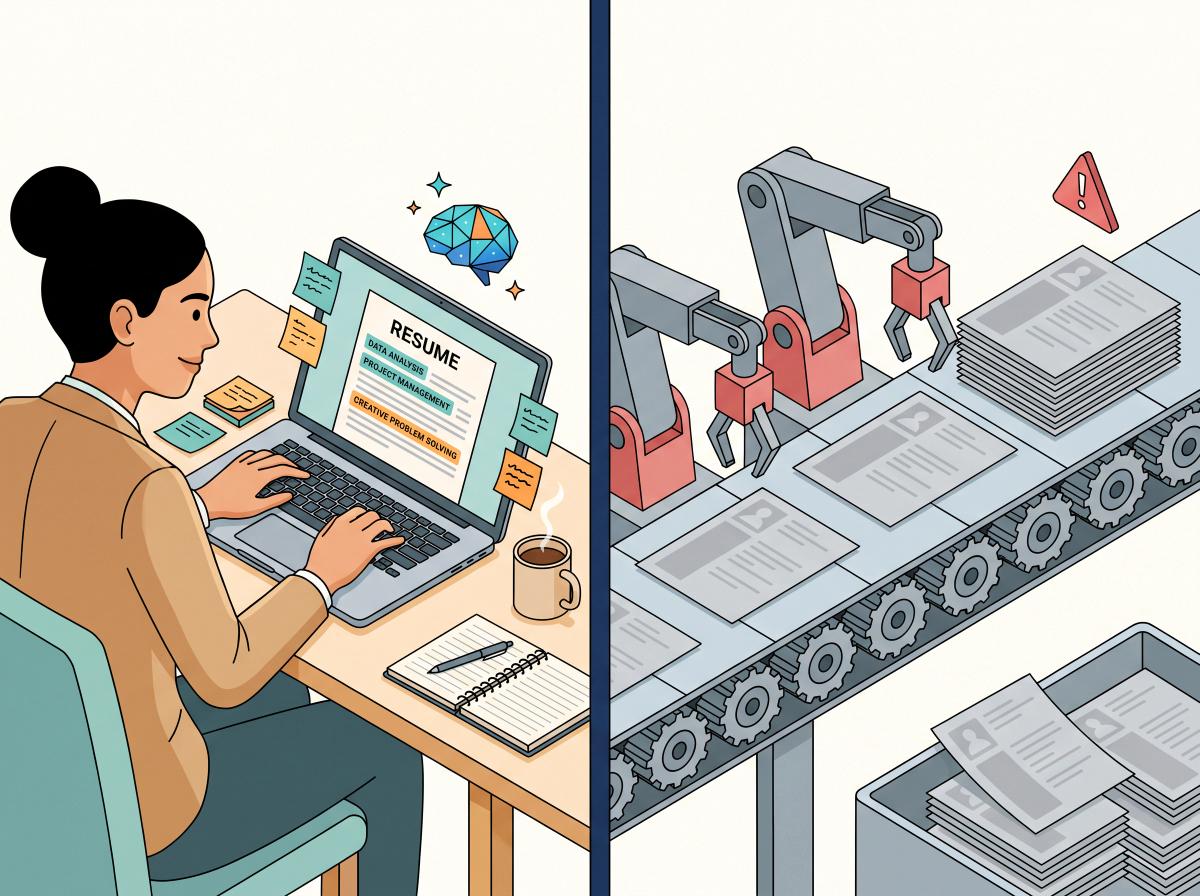
The best AI-assisted application still sounds like a real person with real experience. Use AI to sharpen what you already know, not to replace the knowing.
We built AIApply exactly around this principle: our platform handles the formatting, keyword matching, drafting, and repetitive submission work, while you control the strategy, the honesty, and the relationships.
How Many Jobs Should You Apply to Per Week?
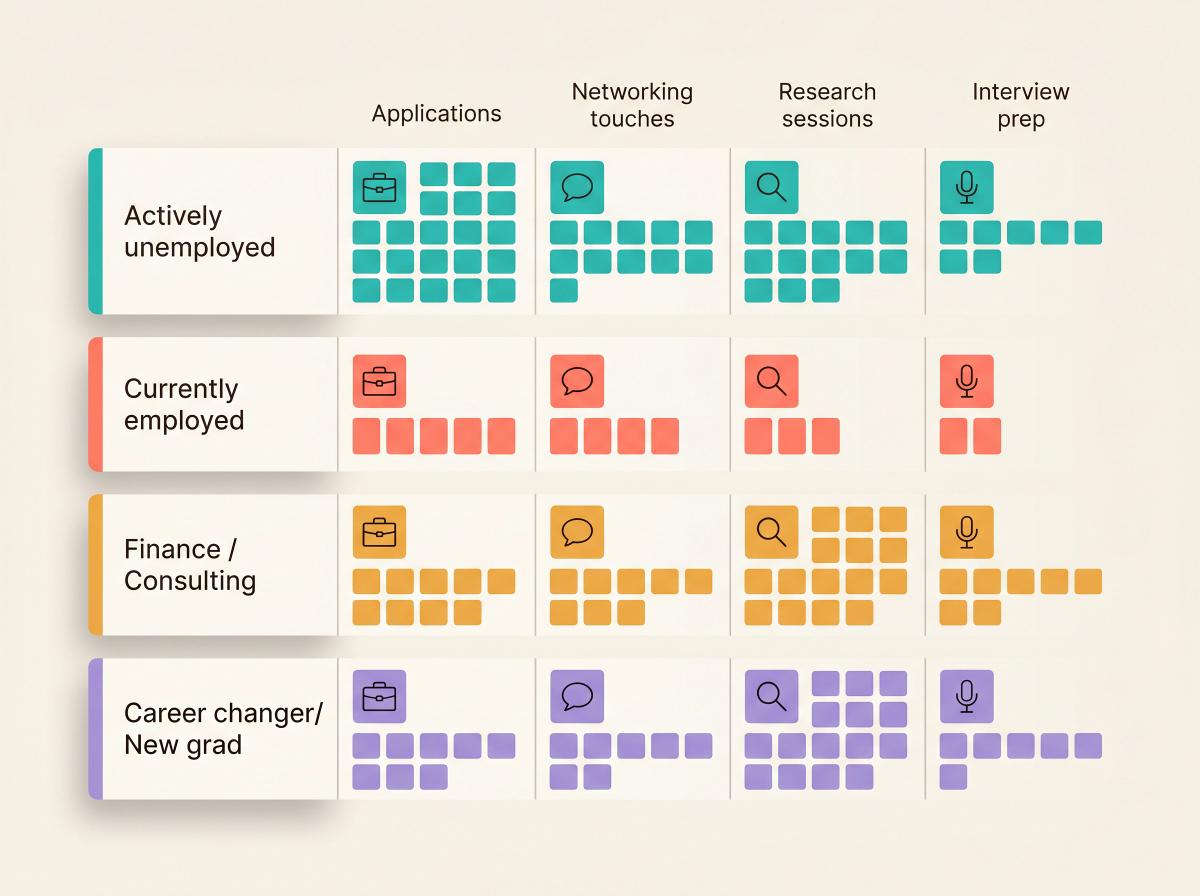
Most active job seekers should target 10-20 tailored applications per week, or 20-30 if you're unemployed and searching full time. The real constraint isn't a magic number, it's how many high-quality applications you can send each day while still tailoring, tracking, and following up on each one.
Here's a practical volume guide:
| Situation | Weekly Target | Notes |
|---|---|---|
| Active search, unemployed | 20-30 targeted applications | Focus on quality; more volume is possible with Auto Apply |
| Active search, currently employed | 5-10 high-fit applications | Selectivity is your advantage |
| High-competition fields (finance, consulting) | 30-50/week | More volume needed to compensate for lower response rates |
| Recent grad / career changer | 15-25 applications | Network-heavy strategy compensates for thin resume |
For each target, also plan:
- 10-20 networking or referral touches per week
- 3-5 deeper company research sessions
- 2-3 interview practice sessions
- 1 weekly review of what's working
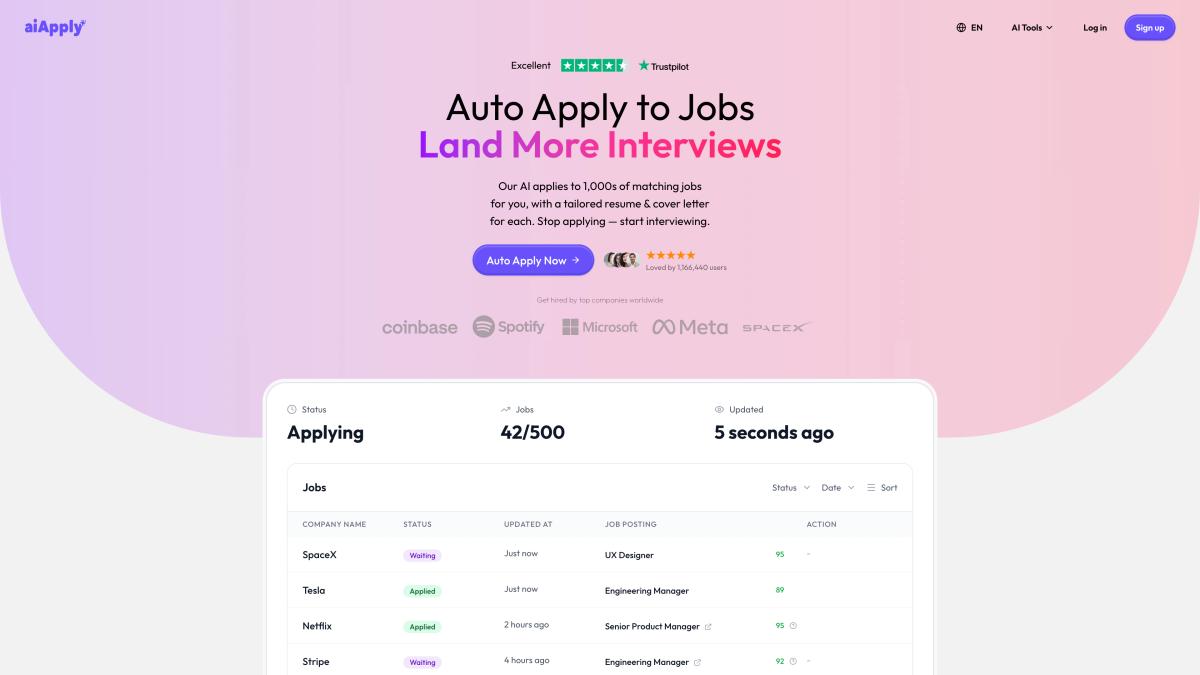
If you need to apply at scale without losing quality, our Auto Apply tool can submit up to 500 tailored applications per month, matching jobs to your criteria and customizing each one. It's designed to extend your reach on matched roles, not to fire randomly.
How to Score a Job Posting Before You Apply
Stop applying to everything. Your time is finite. Score each role before committing.
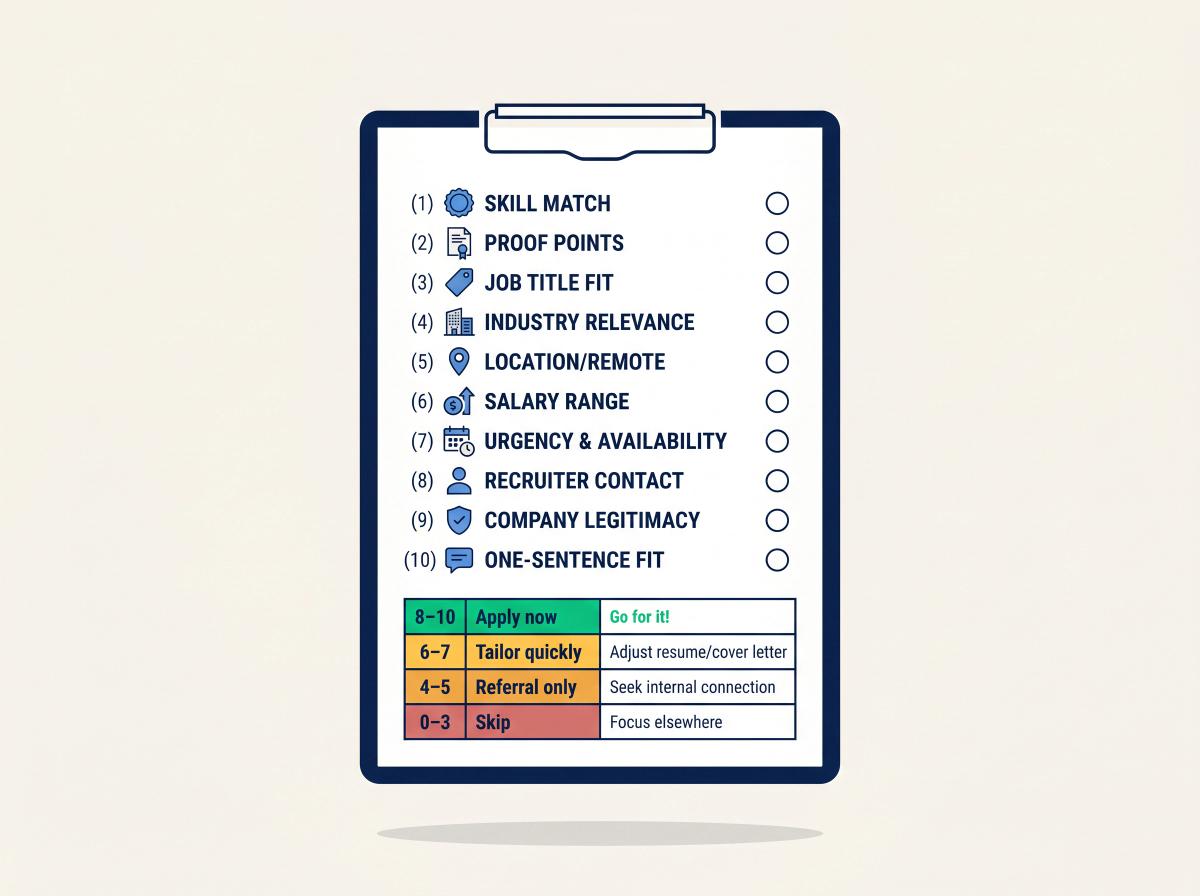
Give each job 1 point for each of the following:
① You meet the core requirements
② You have proof of the main skill they're asking for
③ The job title matches your target
④ The industry makes sense for your background
⑤ The location or remote setup works
⑥ The salary range is in your range (look up typical salary ranges for your target role if you're unsure what to expect)
⑦ The role was posted recently (within 2 weeks)
⑧ You can find a recruiter, hiring manager, or employee to message
⑨ The company looks legitimate
⑩ You can explain your fit in one sentence
Scoring:
| Score | Action |
|---|---|
| 8-10 | Apply now and follow up |
| 6-7 | Apply if you can tailor quickly |
| 4-5 | Only apply if you have a referral or strong reason |
| 0-3 | Skip it |
Skipping a 3-point job is not laziness. It protects time for the 8-10 jobs where you can actually compete.
How to Apply for Jobs Based on Your Situation
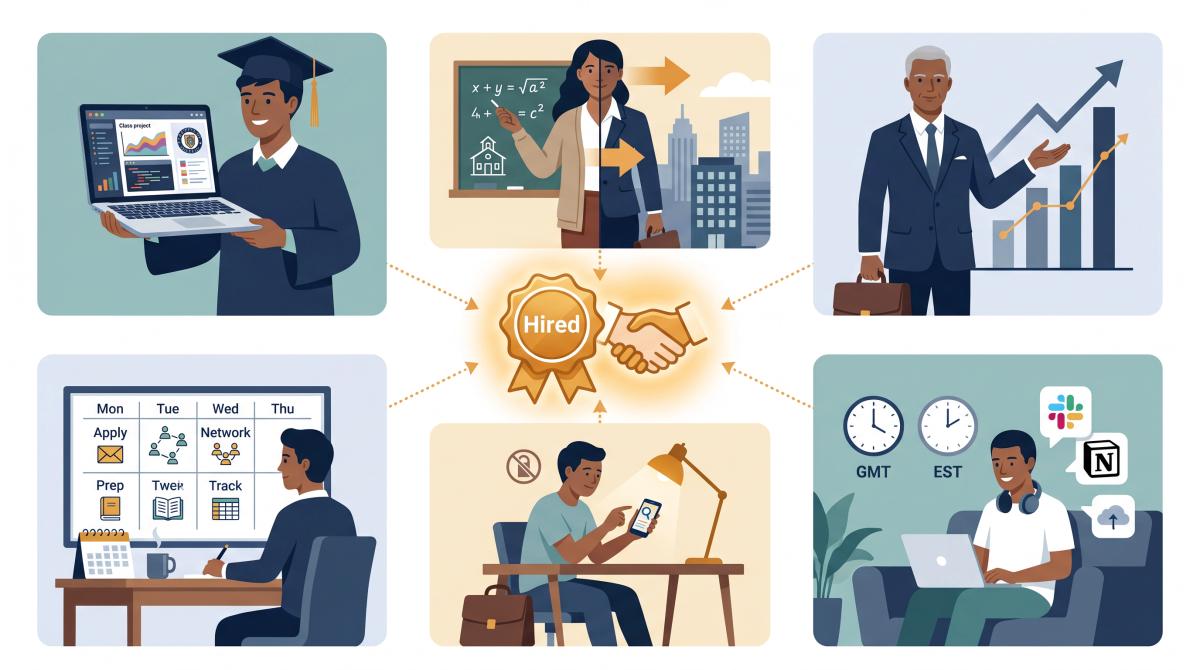
The best approach to applying for jobs depends on your situation. New grads, career changers, senior candidates, remote applicants, and people with no formal experience each need a different strategy, and the sections below break down exactly what changes for each one.
How to Apply for Jobs as a Student or New Grad
The key insight: proof doesn't have to come from a formal job.
NACE's April 2026 Job Outlook Spring Update found employers expect a 5.6% increase in new graduate hiring, but growth is uneven. Nearly all employers cited U.S.-based internships as valuable, and more than 40% specifically look for on-campus student work and apprenticeships.
The best resume bullet for a new grad often comes from outside a formal job:
"Built a Python dashboard for a class project analyzing 12 months of retail sales data, identifying seasonal demand patterns and presenting recommendations to a 4-person panel"
"Coordinated 18 volunteers for a campus fundraising event, raising £4,200 and increasing attendance by 35% from the previous year"
NACE's update also confirmed that employers reviewing Class of 2026 resumes are specifically looking for evidence of teamwork, problem-solving, and communication skills. If you have any examples of those, put them front and center. For practical help building your first resume without traditional experience, we've built a dedicated guide. If you're still figuring out how to get started, our post on landing your first job covers the full picture.
Students can access AIApply's student plan with a 40% discount on premium features using a verified student email.
How to Apply for Jobs When Changing Careers
The mistake most career changers make: expecting recruiters to connect the dots between their old industry and the new one. They won't. You have to do it for them.
Your resume should show:
→ Transferable skills (explicitly named)
→ Proof of learning (certifications, courses, projects in the new field)
→ Relevant tools you've started using
→ Why the change makes logical sense
→ Previous achievements that translate
Bad career-change summary: "Teacher looking to move into project management."
Better: "Former secondary teacher moving into project coordination, with 5 years of experience managing lesson planning, stakeholder communication, deadlines, student data, and cross-functional school initiatives. Recently completed Google Project Management certification and built sample project plans in Asana."
For a full set of sample resumes built for career changers, including before/after comparisons by industry, see our examples library.
How to Apply for Senior-Level Positions
Your edge isn't "I know the tool." Your edge is judgment, leadership, commercial impact, pattern recognition, and risk reduction.
Senior resumes should focus on business outcomes, not task lists:
Bad: "Managed team and led strategy"
Better: "Led 14-person operations team through ERP migration, reducing month-end reporting cycle from 9 days to 4 and cutting external contractor spend by £180k annually"
For senior roles, network before applying. Many searches at director level and above are influenced by referrals and executive recruiters before the job is ever publicly posted. For strategies for standing out as a senior candidate, see our 2026 guide on accelerating the search.
How to Apply for Jobs When You're Unemployed
Your main challenge isn't just getting hired. It's protecting your energy so you don't burn out and start submitting worse applications. A structured daily rhythm helps:
| Block | Activity |
|---|---|
| 2 hours | Finding and applying to roles |
| 1 hour | Tailoring documents |
| 1 hour | Networking and outreach |
| 1 hour | Interview prep |
| 30 min | Tracking and admin |
Don't spend 8 hours a day clicking apply. More volume without quality doesn't move the needle.
How to Apply for Jobs While Still Employed
Use a quieter strategy. Fewer, better applications.
- Don't use your work email
- Don't search on company devices
- Don't list your current manager as a reference
- Don't tell colleagues unless you fully trust them
Your advantage is selectivity. You don't need any job. You need the right next job. Use that advantage.
How to Apply for Remote Jobs
Remote applications face more competition because geography isn't filtering the pool. So remote applications need stronger proof of remote readiness specifically.
Include on your resume:
- Explicit remote work experience (mention time periods)
- Async communication examples (Slack, Notion, documentation)
- Cross-timezone collaboration
- Specific remote tools: Zoom, Jira, Asana, Google Workspace
Bad: "Comfortable working remotely"
Better: "Worked remotely across GMT and EST teams for 18 months, using Slack, Notion, and weekly async updates to coordinate product launches with design and engineering"
Remote employers worry about trust and communication. Show them you can deliver without being chased. For a broader look at modern job search techniques that help in high-competition situations, including remote-first strategies, see our strategy guide.
How to Apply for Jobs With No Work Experience
Stop saying "no experience." You may have no formal employment, but you can build proof from:
- Class projects
- Certifications
- Volunteer work
- Freelance work or side projects
- Open-source contributions
- Competitions and hackathons
Example for a marketing role: "Created a 4-week content calendar and sample email campaign for a local fitness studio, including audience research, copy, creative brief, and performance assumptions"
Experience is not just employment. Experience is proof you can do the work. Browse cover letter examples from entry-level applicants to see how others frame non-traditional backgrounds compellingly.
Job Application Checklist Before You Click Submit
Use this every time. It takes less than two minutes.
- [ ] The job is verified and exists on the company website
- [ ] The role matches your target
- [ ] You meet most core requirements
- [ ] Resume title matches the target role truthfully
- [ ] Summary is tailored to this specific role
- [ ] Top bullets match the employer's priorities
- [ ] Skills section includes required tools and hard skills
- [ ] Resume format is clean and ATS-friendly
- [ ] Cover letter (if included) adds new information
- [ ] Update your LinkedIn headline so your profile matches your resume
- [ ] How to build a professional portfolio (if applicable, make sure your portfolio link is current and works)
- [ ] File name is professional: firstname-lastname-resume-role.pdf
- [ ] You saved a copy of the job description
- [ ] You know who to message after applying
- [ ] You've logged the application
On file names: "firstname-lastname-resume-product-manager.pdf" is professional. "resume-final-final-new-v7.pdf" is not.
How to Diagnose a Job Search That Isn't Working
Your job search is a funnel. You improve it by finding where it breaks.
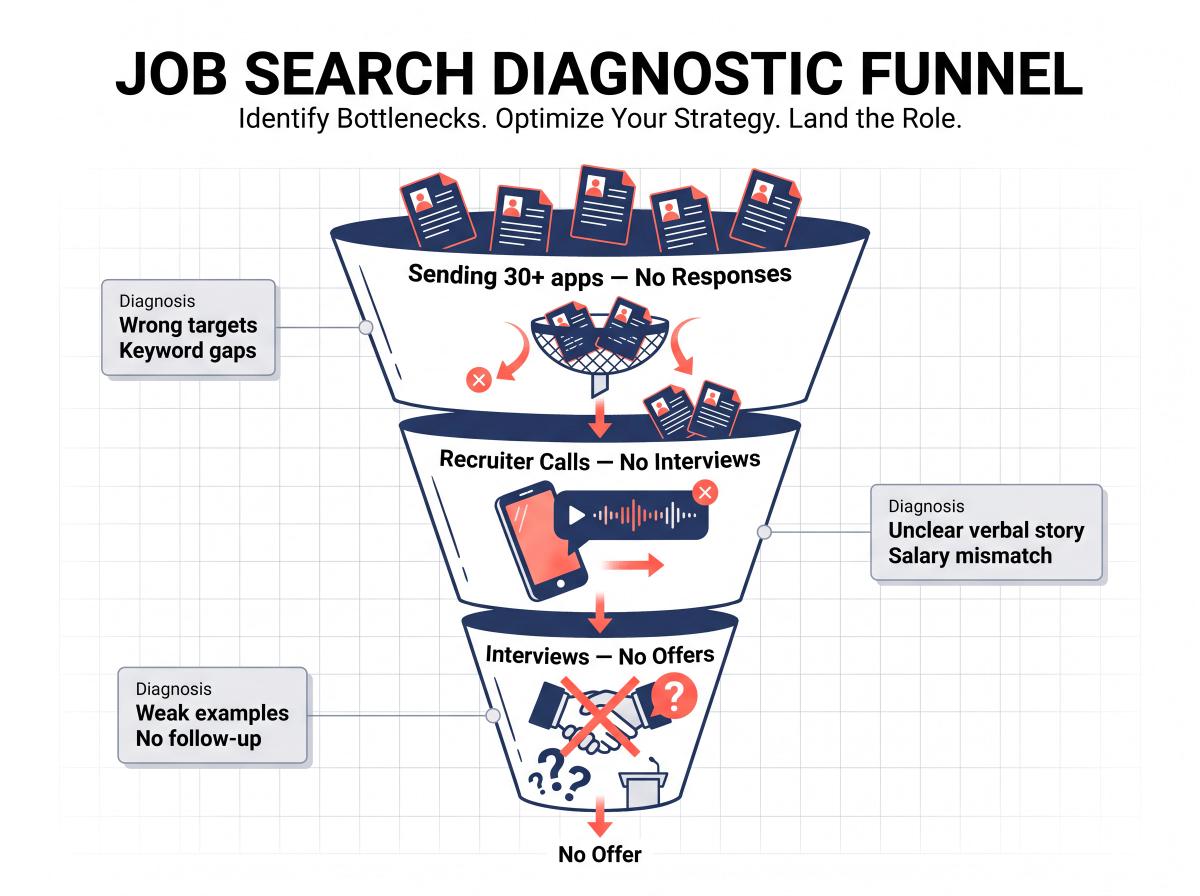
Why you're getting no responses after 30+ applications
Likely problems:
- Applying to poor-fit roles
- Resume not aligned with job descriptions
- Missing core keywords
- Applying too late (roles already filled)
- Too much Easy Apply, not enough company-site applications
- No referrals or follow-up outreach
Fix:
- Narrow your target to one primary role type
- Scan each resume against the specific JD before submitting
- Rewrite top bullets with the action + scope + tool + result formula
- Start applying within 24-48 hours of postings going live
Our AI Resume Checker will identify keyword gaps and ATS compatibility issues before you submit, which removes a lot of the guesswork.
Why you're getting recruiter calls but not hiring manager interviews
What's going wrong:
- Your resume works, but your verbal story is unclear
- Salary expectations are misaligned
- Experience is close but not convincing once you open your mouth
- Sounding too broad when asked "tell me about yourself"
How to fix it:
- Prepare a sharp 30-second intro that connects directly to the role
- Have 3 specific proof stories ready before any call
- Clarify salary range early in recruiter conversations
- Prepare better questions for the recruiter call. Showing genuine curiosity about the team and role builds immediate credibility
Why you're getting interviews but no job offers
The pattern here is almost always the same: strong on paper, weak in the room.
Likely problems:
- Weak examples during behavioral questions
- Poor technical prep
- Unclear motivation for wanting this specific company
- Weak closing (not asking next steps, not sending thank-you notes)
How to close the gap:
- Practice STAR-format answers for every major responsibility in the job description
- Prepare a 30/60/90-day plan and mention it
- Send a strong follow-up within 24 hours of each interview
Our Interview Buddy provides real-time coaching during live interviews on Zoom, Google Meet, and Teams, and our mock interview tool lets you rehearse before the stakes are real.
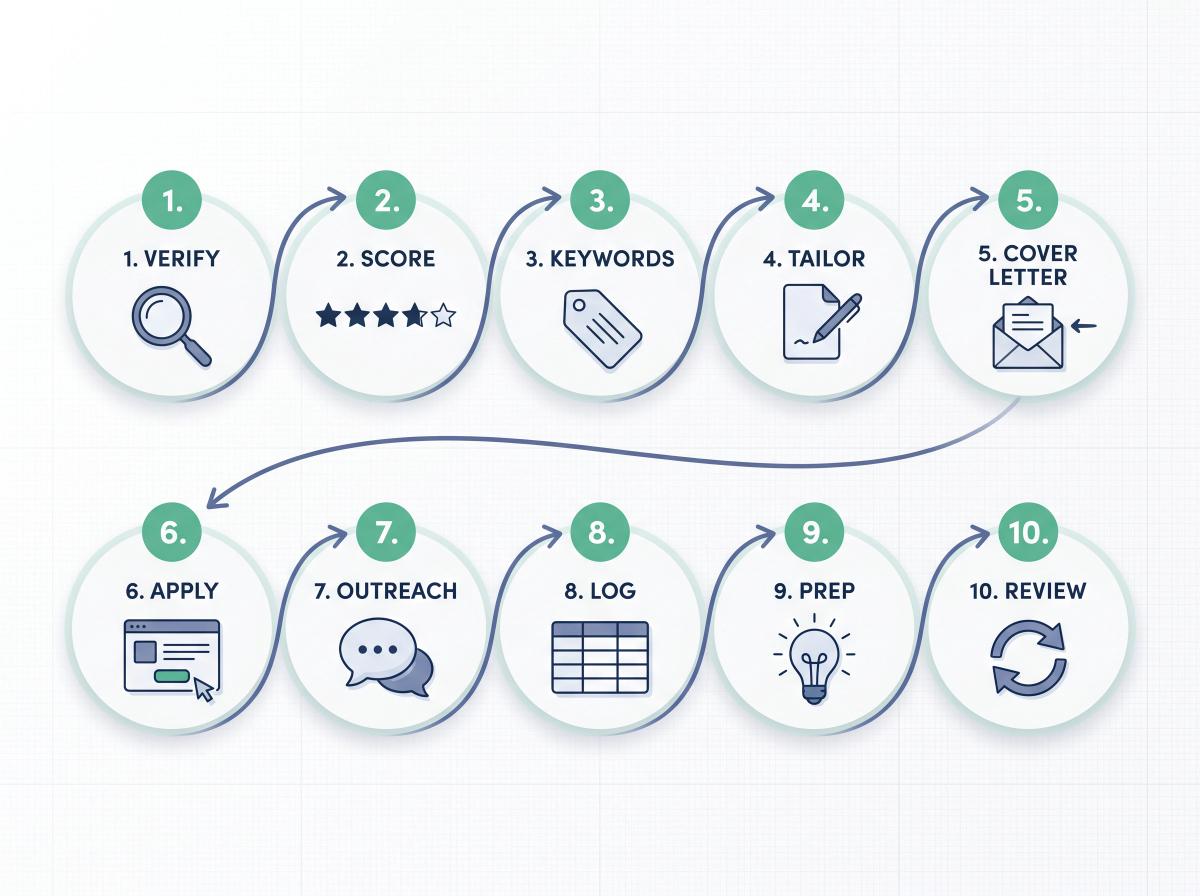
The Complete Job Application Workflow (All 10 Steps)
Here's the exact workflow for each serious application:
① Verify the job: confirm it's real, check the company careers page, check recency and salary
② Score the role: use the 10-point system above; only go deep on 8-10 scores
③ Extract keywords: copy the JD and identify job title, required skills, tools, responsibilities, company values
④ Tailor your resume: update headline, summary, skills, top bullets, and project section
⑤ Write a cover letter: only if it adds information the resume doesn't already provide
⑥ Apply through the best channel: company careers page first
⑦ Message a human: recruiter, hiring manager, or relevant employee within 24 hours
⑧ Log it: record the resume version, date, contact, source in a job search tracking system
⑨ Prepare for the interview: save the JD and draft answers to behavioral questions before the invite arrives
⑩ Review weekly: double down on what's generating responses, adjust what isn't
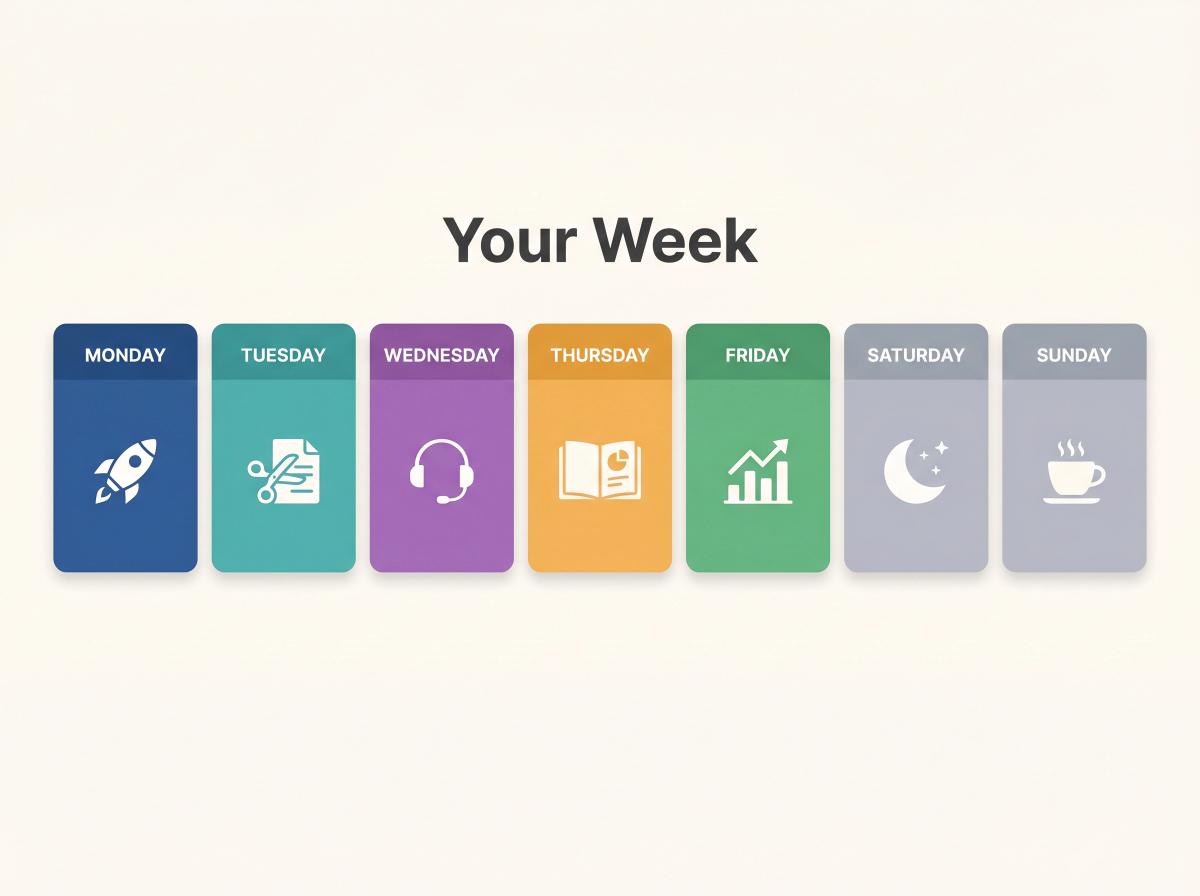
The Best Weekly Job Search Schedule for Active Applicants
Structure prevents burn-out and improves quality. Here's a schedule that works for active searchers:
| Day | Focus | Key Activities |
|---|---|---|
| Monday | Fresh roles + priority applications | Check alerts, apply to new high-fit roles, send 3-5 outreach messages |
| Tuesday | Tailoring and referrals | Improve resume versions, ask for referrals, research target companies |
| Wednesday | Recruiter day | Message recruiters, follow up on older applications, update LinkedIn |
| Thursday | Proof-building | Improve portfolio, work on a sample project, take a short course |
| Friday | Review and optimize | Count applications, count responses, identify best-performing resume version |
| Weekend | Light prep | Save roles, read company pages, practice interview answers, rest |
Rest matters. Burned-out applicants write worse applications and interview worse. The modern job search techniques that actually reduce burnout are the ones built on systems, not hustle.
How to Use AIApply to Speed Up Your Job Search
We built the platform to handle the repetitive parts without losing the strategy. Here's how the pieces connect:
① Build or import your base resume in our AI Resume Builder
② Paste the job description and generate a tailored version in under two minutes
③ Scan for ATS gaps with our AI Resume Checker
④ Generate a cover letter draft with the AI Cover Letter Generator and edit it until it sounds like you
⑤ Apply manually for the highest-priority roles, or use Auto Apply to extend your reach on matched roles at scale
⑥ Track your applications so you can review weekly and adjust
⑦ Prepare for interviews using our mock interview tool and Interview Buddy, which gives you real-time coaching during live video interviews
The right mindset: let AI handle the formatting, keyword matching, and repetition. You handle the judgment, the truth, and the relationships. That combination is hard to beat.
What a Successful Job Search Actually Looks Like
A successful job application process eventually produces:
- Clearer target roles
- Fewer random applications
- Better resume alignment
- More recruiter screens
- More referrals
- Stronger interview answers
- Faster follow-up
- Better offers
You can't control the whole market. You can control the quality of your pipeline.
The applicants who land jobs in 2026 aren't always the most qualified. They're the ones who made their fit impossible to miss.
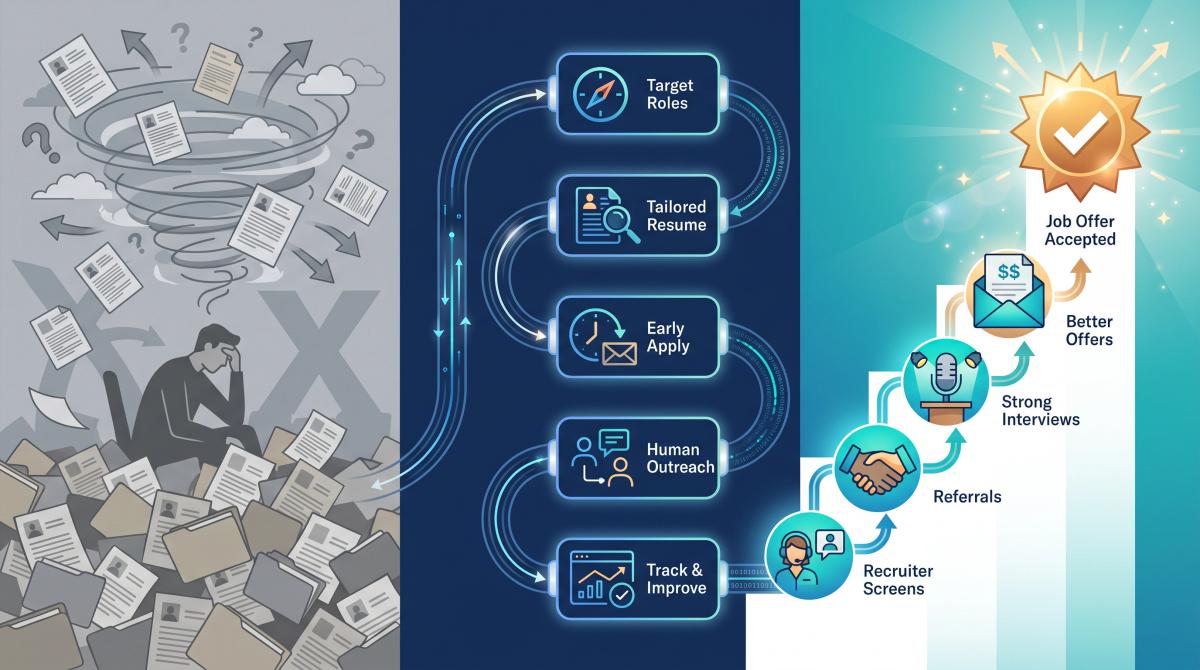
Build the system. Run the system. Improve the system every week. That's the best way to apply for jobs.
Frequently Asked Questions
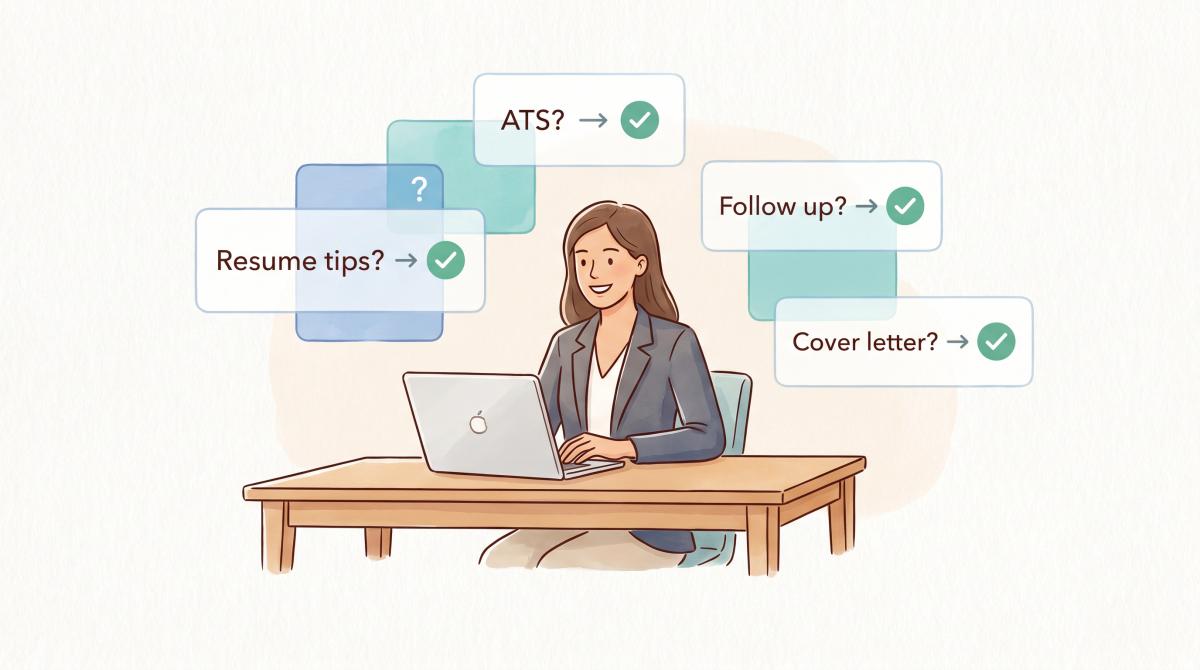
What is the best way to apply for a job in 2026?
Apply through the company's official careers page with a tailored resume, then follow up within 24 hours with a short, specific message to a recruiter, hiring manager, or team employee. This gives you both system visibility and human visibility. Volume helps only when every application is relevant and tracked.
Is it better to apply online or in person?
For corporate, remote, tech, finance, healthcare admin, and professional roles: apply online, always. For retail, hospitality, restaurants, service businesses, and small local employers: going in person can still work well, especially if you also applied online first and dress appropriately with a simple one-page resume.
Should I use the same resume for every job?
No. Use a master resume as your source document, but tailor each submitted version. At minimum, update the headline, summary, skills section, and the most relevant bullets. The tailoring is what closes the keyword gap between your experience and the employer's requirements.
How much should I tailor my resume?
Focus heavily on the top third: headline, summary, skills, and the first few bullets under your most relevant role. That's where recruiters make fast decisions. You don't need to rewrite every bullet, just the ones where the language gap is largest between your draft and the job description.
Should I include a cover letter?
Include one if it genuinely explains your fit better than the resume alone. Cover letters are most useful for career changers, highly competitive roles, mission-driven companies, and applications where your motivation for this specific company matters. Skip them if the result would be generic or if the employer specifically says not to include one. Jobscan's 2025 data found including a cover letter correlated with a 3.4x higher interview rate.
Is ATS automatically rejecting my resume?
Sometimes, but not always. Resume Genius's 2026 survey found that 49% of hiring managers still personally review resumes while using ATS tools, and 37% let ATS screen out applications automatically. The risk is real, which is why clear formatting, relevant keywords, and standard section headings matter. It's not magic, it's just clarity.
What is the best resume format for job applications?
Use a clean, text-based PDF for most professional roles. Avoid heavy graphics, two-column layouts, skill bars, images, and unusual section headings. Resume Genius's 2026 research confirmed that only 13% of hiring managers said design-heavy resumes were compatible with their ATS systems.
Should I message the hiring manager after applying?
Yes, if your message is short, specific, and shows relevance (not a request for special treatment). Mention the role, give one proof point that connects to a key responsibility, and keep it under 4 sentences. The goal is to be a person, not just a file.
How soon should I apply after a job is posted?
Aim for within 24-48 hours for strong-fit roles. Early applications can matter because many recruiting teams review applications as they arrive, and the strongest candidates are often reached before the official close date. But quality still matters more than speed.
How many jobs should I apply to per week?
For most active job seekers: 10-20 targeted applications per week, with each one tailored and tracked. If you're unemployed and searching full-time, you can go higher, especially with Auto Apply handling volume. If you're employed, aim for 5-10 higher-quality applications. For the daily breakdown, see our guide on how many to apply to each day. The research consistently shows that quality outperforms raw volume.
Can AI help me apply for jobs?
Yes, significantly, when used well. AI tools can tailor resumes, draft cover letters, scan for ATS keyword gaps, practice interview answers, and organize your search. The key is not letting AI replace your authenticity. Resume Genius's 2026 data found 80% of hiring managers can often tell when a resume was AI-generated, and 72% view heavy AI reliance negatively. Read our analysis of AI-assisted job applications to understand exactly when AI helps vs. when it hurts.
What is the biggest mistake job seekers make?
Treating the job search like a pure numbers game. Sending 100 generic applications produces less than 10 tailored ones to the right roles. Random volume creates noise. Targeted volume creates interviews. The second most common mistake is not adding a human signal after applying, which is often the difference between being a forgotten file and getting a call.
How do I follow up after applying?
Wait 3-5 business days after submitting, then send a brief note referencing the role, your relevant background, and your continued interest. Keep it to 3-4 sentences. After an interview, send a thank-you message the same day or next morning that references something specific from the conversation. Don't follow up daily. Professionalism, not panic. See our guide on the right timing and tone for follow-up messages for templates you can adapt.
What should I do if I have no work experience?
Build proof from projects, coursework, certifications, volunteering, freelance work, and hackathons. Employers hire people who can demonstrate they can do the work, not just people who have formal titles. See our full guide on how to build a resume without formal experience. It covers exactly how to turn non-traditional proof into compelling resume bullets.
How long should a job search take?
The average search takes 20+ weeks, but strategic searches using AI tools, targeting, and networking often see results in 4-8 weeks. The variable isn't time, it's system quality. The patterns we see consistently: narrowing the target, tailoring materials, and adding a human signal after each application cut the timeline significantly compared to high-volume, low-quality approaches.