Can Employers Tell If You Use AI for a Cover Letter? (2026)
Can employers tell if you use AI for a cover letter? Usually not. But a generic AI letter still hurts you. This covers what actually matters.


Audio and video are AI narrations of this article.
Can Employers Tell If You Use AI for a Cover Letter? (2026)
Narrated version · 7 min
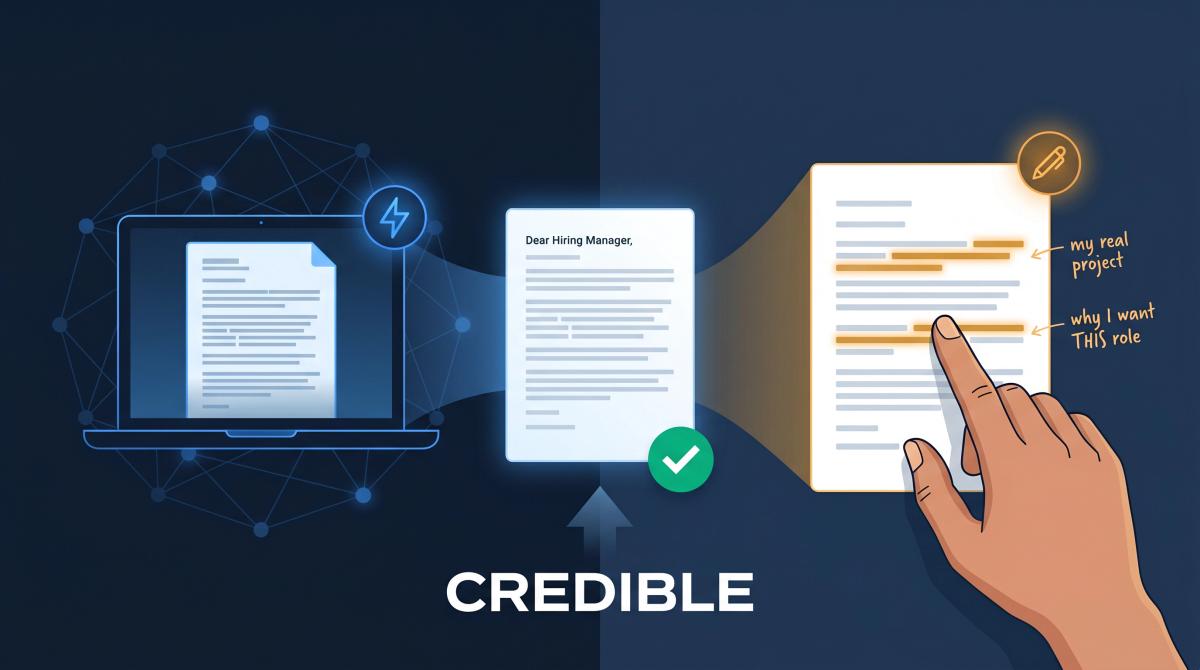
In most cases, no, employers can't tell for certain that you used AI for a cover letter, and usually they won't try to prove it. What they can spot is a letter that sounds generic, exaggerated, or disconnected from the person behind it. So the thing that gets candidates rejected isn't using AI. It's submitting a letter that reads like everyone else's AI letter.
That reframe matters, because most job seekers are asking the wrong question. The concern isn't "will I get caught," it's "does my application give a recruiter a reason to doubt me." This guide covers what recruiters actually notice, whether ATS software can detect AI writing, how reliable AI detectors really are, and how to use AI without making your cover letter sound like everyone else's.
First, some context on why this question is everywhere in 2026. A March 2026 survey from Robert Half found that 67% of U.S. HR leaders say reviewing AI-generated applications has slowed their hiring process, and 65% of hiring managers say AI-enhanced applications make it harder to verify candidates' skills. At the same time, AI use by job seekers is now the norm rather than the exception, which is exactly why recruiters have started paying closer attention to which applications feel real.
What Recruiters Actually See When You Use AI
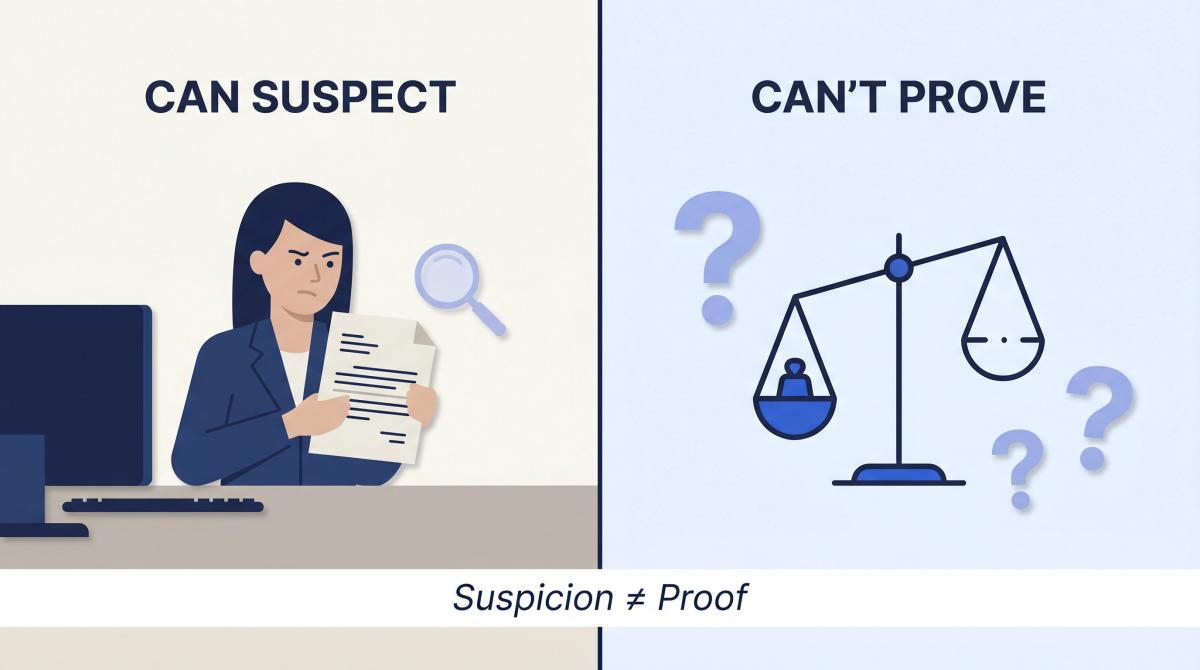
Employers can't know for certain that you used AI, because there's no label attached to an AI-generated cover letter and Applicant Tracking Systems aren't built to detect AI writing. What recruiters do notice is when a letter sounds generic, exaggerated, or doesn't match the candidate behind it. They won't try to prove you used ChatGPT. They'll just judge whether the letter feels authentic and reflects your real experience.
Here's the simplest way to look at it:
| Question | Answer |
|---|---|
| Can employers know for sure that you used AI? | Usually no. They can suspect it, but proving it is much harder. |
| Can recruiters recognize obvious AI writing? | Yes. Many say they can, especially when the letter is generic or robotic. |
| Do AI detectors reliably prove a cover letter was AI-written? | No. Current AI detectors can be wrong, especially on short, edited, or hybrid text. |
| Will an ATS automatically reject you for using AI? | Not usually. ATS tools are mainly built to parse, filter, and match applications, not prove authorship. |
| Is it okay to use AI for a cover letter? | Yes, if the content is truthful, personalized, policy-compliant, and edited by you. |
| What gets candidates into trouble? | Fake achievements, generic mass-apply letters, obvious AI phrasing, and using AI when the employer explicitly says not to. |
Using AI during the job search has become completely normal. Job seekers use it to tailor resumes, write cover letters, prepare for interviews, and research companies. Recruiters use it too, to write job descriptions, search candidate profiles, and summarize applications. AI itself is rarely the issue.
What matters is whether your cover letter is relevant to the role, reflects your actual experience, and sounds like something you would genuinely write. A letter that starts with AI but ends up personalized, accurate, and tailored to the company will beat a fully human-written letter that's stuffed with generic claims and no real evidence. At AIApply, we see this pattern constantly across cover letters generated through our tool: the drafts that perform are the ones people ground in their own achievements and edit in their own voice, not the ones sent straight from the generator.
Why Employers Are Watching for AI Cover Letters in 2026
AI is everywhere in hiring now, on both sides of the table.
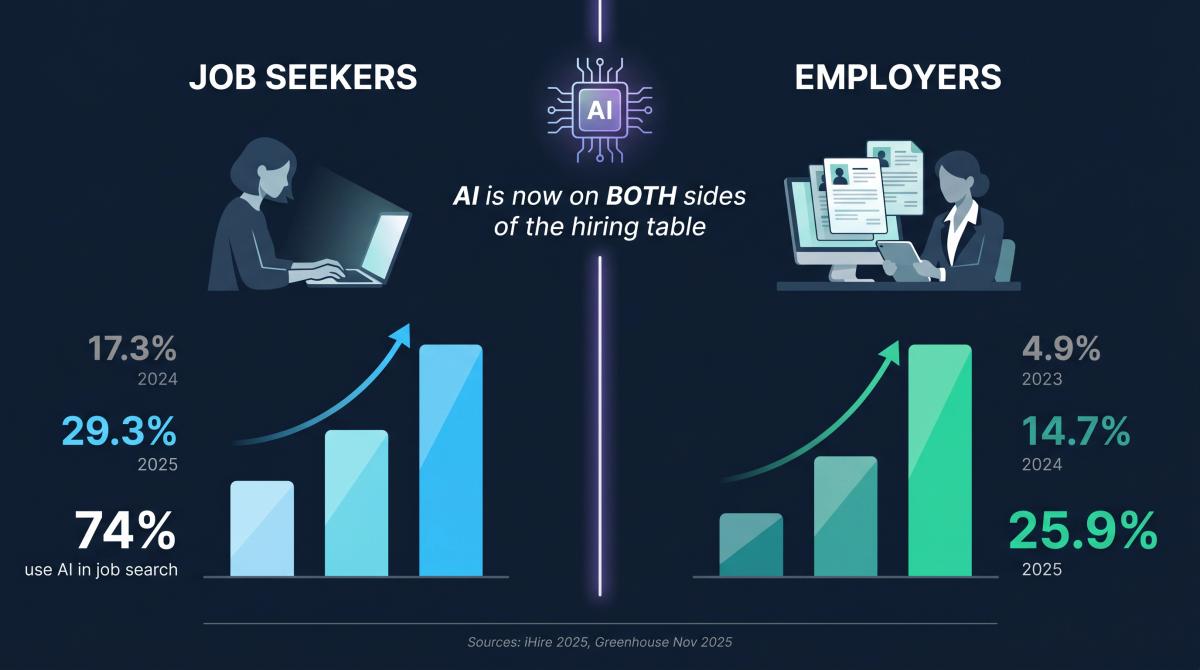
iHire's 2025 State of Online Recruiting report found that 29.3% of candidates had used AI to write or customize a resume or cover letter in the past year, up from 17.3% in 2024. The same report found that 25.9% of employers used AI in recruitment, up from 14.7% in 2024 and just 4.9% in 2023. (The survey reached 1,421 job seekers and 529 employers in July 2025.)
On the candidate side, Greenhouse's November 2025 AI hiring research found that 74% of U.S. job seekers personally use AI in their job search. That's not a fringe behavior anymore. It's the majority.
The tension you're feeling is real. Candidates want speed and fairness. Employers are worried about deception, mass-applying spam, and whether an application actually reflects the person behind it.
So the real question isn't whether AI is used in hiring. It clearly is. The question is: does your specific application give employers a reason to worry?
What Employers Can Actually See in Your Application
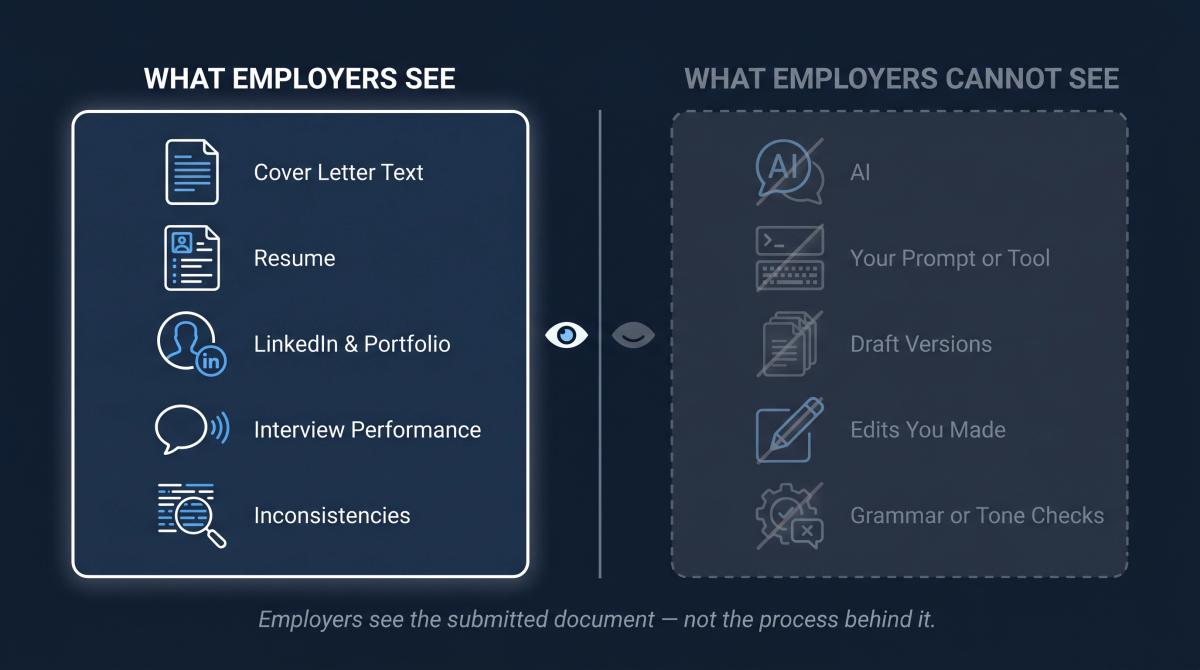
Employers don't see your writing process. They see the submitted document.
What they typically can see:
- The text of your cover letter
- Your resume
- Your application answers
- Your LinkedIn profile or portfolio (if you linked it)
- Your interview performance
- Your writing sample, if one was requested
- Inconsistencies between any of the above
- In some cases, AI-detection or fraud-screening signals
What they usually cannot see:
- Whether you used ChatGPT, Claude, AIApply, Grammarly, or another tool
- Which prompt you used
- How many drafts you generated
- Whether a sentence started as AI text and was later rewritten by you
- Whether you used AI only for grammar, structure, or tone
This matters. The question "can employers tell?" is really the wrong frame. A better question is:
Does the final letter give them a reason to distrust you?
That's what actually determines outcomes.
8 Signs Your Cover Letter Looks AI-Generated
Recruiters may not know exactly how you wrote your cover letter, but they can usually tell when very little effort went into it. A cover letter starts looking AI-generated when too many of these signals show up together.
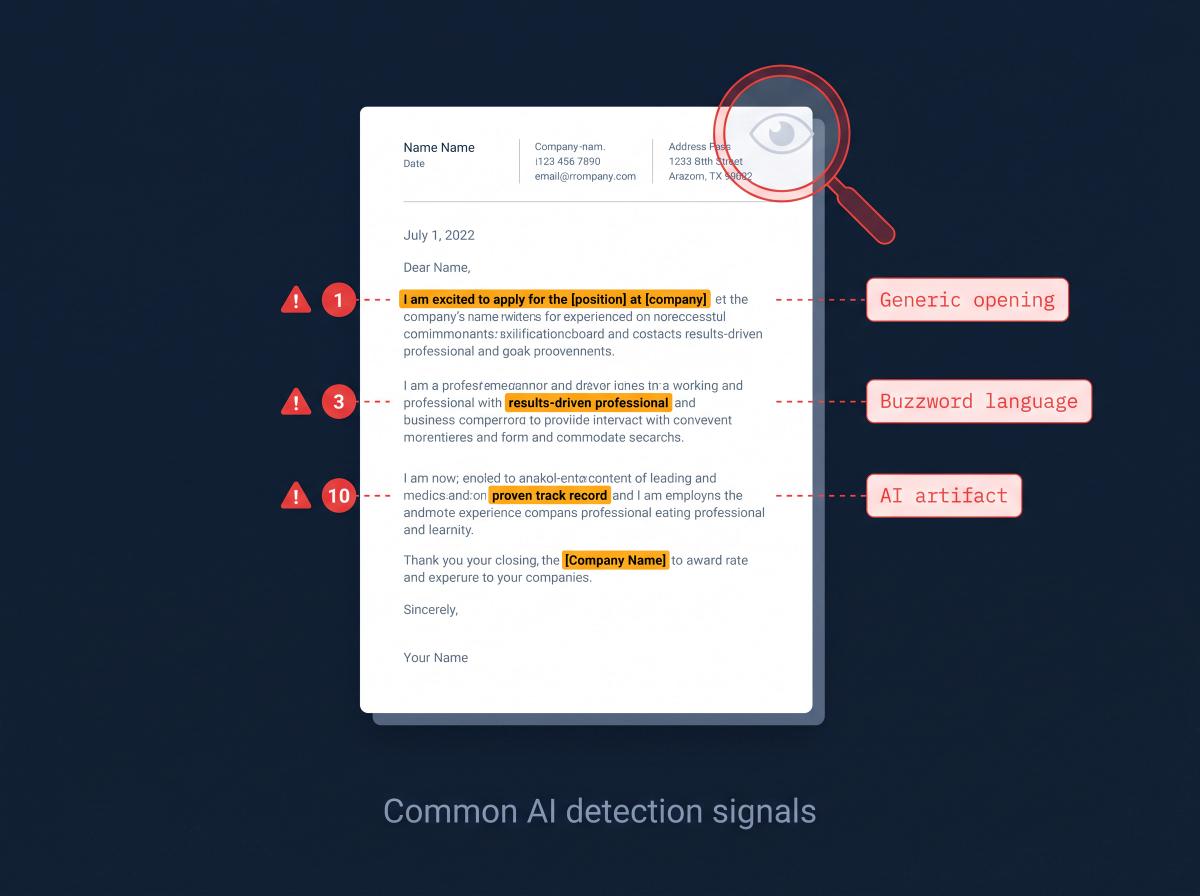
- Buzzwords with no proof: Describing yourself as a "results-driven, passionate, detail-oriented team player" tells a recruiter nothing. Instead of "a proven track record of delivering results," show it: you increased organic traffic by 40%, managed a team of eight, or cut customer response times. Those are the details recruiters remember.
- It repeats the job description: Your letter shouldn't echo what's already in the posting. Recruiters know what the role involves. Your job is to explain why you fit it.
- It doesn't mention the company or role specifically: If you could swap the company name and send it elsewhere unchanged, it's generic. One specific detail about the company shows you actually thought about the application.
- Every paragraph sounds the same: AI drafts often keep the same rhythm start to finish, which reads clean but lifeless. A few edits and a more natural style fix this fast.
- Enthusiasm without substance: There's nothing wrong with saying you're excited, but recruiters want to know why. Skip "innovative company" and "dynamic team," and name what actually drew you to the role.
- Broad claims with no backing: "Results-driven professional" means little on its own. What did you achieve, and by how much?
- It doesn't match your resume: Your resume and cover letter should tell the same story. Skills or achievements that appear in one but not the other get noticed.
- It could go to ten different employers unchanged: This is the biggest giveaway. A strong letter explains why this company, this role, and why your experience fits.
None of these are exclusive to AI. Generic cover letters existed long before ChatGPT. Recruiters aren't trying to work out whether you used AI. They're looking for candidates who understand the role, have the right experience, and took the time to tailor the letter.
Can ATS Detect AI-Written Cover Letters?
No, an ATS can't detect AI-written cover letters, because that isn't what it's built to do. An Applicant Tracking System helps employers organize and filter applications by how well they match the role. Depending on the system, it may scan for relevant keywords, skills, qualifications, and job titles, but it isn't checking whether ChatGPT helped you write anything. Using AI won't automatically get your application rejected.
What matters far more is whether your cover letter is relevant to the role and easy for both recruiters and ATS software to read. A few things that actually help:
- Use keywords from the job description naturally
- Highlight the skills and qualifications most relevant to the role
- Use clear headings and standard fonts
- Keep formatting simple and easy to read
- Make sure your cover letter matches the experience on your resume
One trick to avoid: adding hidden keywords in white text to "game" the ATS. Modern recruiting systems are smarter than they used to be, and invisible keyword stuffing won't make you a stronger candidate. If it's discovered, it makes your application look dishonest.
The simplest approach still wins. Write for the recruiter first, use the job description's language where it fits, and let the ATS do its job of matching experience to the role.
<!-- IMAGE: Diagram of what an ATS actually does (parse, keyword-match, rank) vs the myth that it detects AI. ALT: Diagram showing an ATS parsing and keyword-matching applications rather than detecting AI -->
Do AI Detectors Actually Work?
AI detectors can't reliably prove you used AI to write a cover letter. Tools like GPTZero, Originality.ai, and ZeroGPT estimate whether writing looks AI-generated, but they can't tell an employer with certainty that you used ChatGPT or any other tool.
That's because AI detectors don't know how your letter was created. They don't have your prompts, your ChatGPT history, or your editing process. They analyze patterns such as sentence structure, word choice, and predictability, then calculate a probability. Like any prediction, that comes with limits. AI detectors can:
- Incorrectly flag human-written text as AI
- Miss AI-generated content that's been edited
- Produce different results for the same document
- Struggle with documents written jointly by a person and AI
That last point matters most, because joint human-AI writing is exactly how most people use these tools. They generate a first draft, rewrite sections, add examples, and cut generic language until the final version is their own. Research has repeatedly found that detectors become less reliable once AI text has been edited by a person, which means a detector score alone can't prove anyone used AI.
Recruiters know this. So instead of leaning on a detector, they judge whether your letter is accurate, believable, tailored to the role, and consistent with the rest of your application. That's also why personalizing an AI draft is so important. The goal isn't to fool a detector, it's to write a stronger letter that reflects your real experience and gives recruiters a clear reason to interview you.
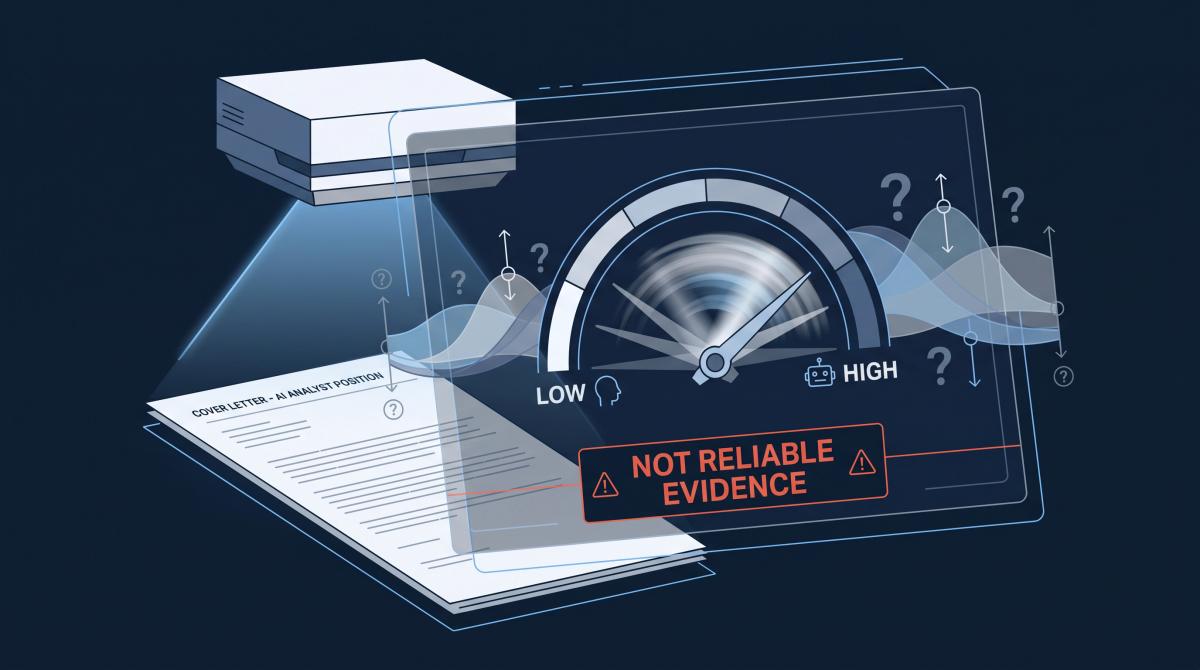
So can an employer run your cover letter through an AI detector? Yes.
Should that detector result be treated as proof? No.
The practical takeaway: don't try to "beat AI detectors." Write a letter that is specific, truthful, and clearly connected to your real experience. That approach is both safer and more effective than obsessing over a detection score.
Will ATS Systems Flag AI-Written Cover Letters?
Usually, no.
An Applicant Tracking System is mainly designed to collect applications, parse resumes, organize candidate data, search for keywords, and help recruiters manage high-volume pipelines. Some employers layer additional AI screening tools on top of ATS, but the standard ATS concern isn't "this sounds like AI." It's "does this application match the job?"
Harvard's career guidance notes that many employers use ATS tools to scan resumes and cover letters for keywords and phrases, recommending basic formatting, relevant skills, and keywords from the job description.
That means your cover letter shouldn't be optimized for "human vs AI." It should be optimized for:
- Relevance to the role
- Natural use of job-description keywords
- Clear evidence of your skills
- Consistency with your resume
- Readable formatting with no unusual encoding or symbols
- No fake or inflated claims
Our resume scanner is built around this same practical issue: ATS compatibility, keyword optimization, formatting problems, and job-description alignment. Before you submit, it's worth checking your resume against the role to make sure the whole package works together.
That said, hiring tech is evolving. Some employers now use AI tools for screening, ranking, fraud detection, and interview analysis. The EEOC has confirmed that federal anti-discrimination laws still apply when employers use AI tools for job ads, resume screening, video interviews, and chatbots. New York City's Local Law 144 regulates automated employment decision tools through bias audits and notice requirements. In the EU, the AI Act treats AI systems used to analyze or evaluate job candidates as high-risk.
But for a cover letter today, the practical advice is still straightforward: make it true, specific, and easy to evaluate.
Is Using AI for a Cover Letter Cheating?
Not automatically.
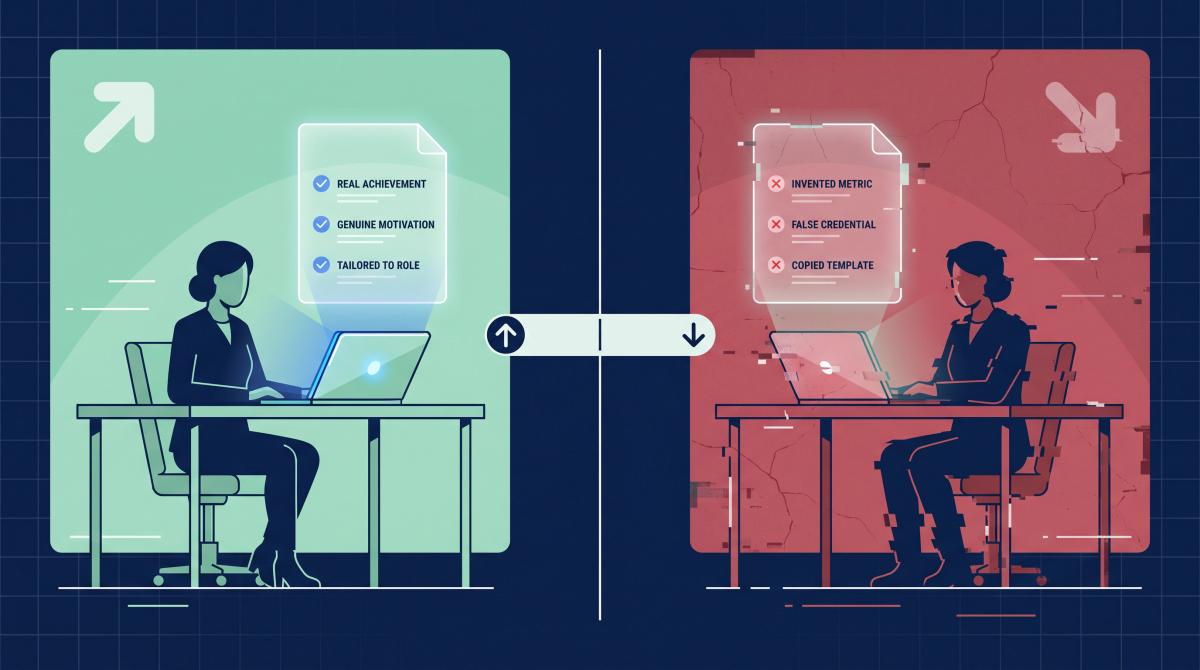
Using AI to improve a cover letter is closer to using a writing assistant, a grammar checker, or a career coach than it is to academic fraud. The ethical issue isn't the tool. It's whether the final application misrepresents you.
Anthropic's official candidate guidance, updated July 2025, is a useful example of how thoughtful employers in AI-native industries approach this. Anthropic encourages candidates to use AI to refine communication and articulate real experience, but says candidates should not use AI to create experiences they didn't have, or use AI in assessments unless explicitly permitted.
That's the clearest line we've seen:
Acceptable: AI helps you express your real qualifications more clearly.
Not acceptable: AI invents qualifications you don't have.
What's Actually Safe to Use AI for in a Cover Letter
- Creating a first structure from your resume bullets
- Tailoring the letter to a specific job description
- Making a rough paragraph clearer and more concise
- Reducing wordiness and filler phrases
- Checking tone against the role's requirements
- Finding keywords you might have missed from the job posting
- Turning resume bullet points into a flowing narrative
- Rewriting a stiff or overly formal sentence
- Comparing your draft against the role requirements to find gaps
AI Cover Letter Mistakes That Can Get You Rejected
- Inventing achievements or exaggerating metrics
- Claiming tools, degrees, certifications, or experience you don't have
- Mass-submitting the same vague letter to hundreds of roles with minor edits
- Writing in a voice you couldn't defend in a real interview
- Answering writing assessments where AI assistance is explicitly banned
- Hiding prompt instructions or keyword stuffing inside hidden text
- Ignoring an employer's explicit no-AI policy for application materials
If the employer says "do not use AI," don't use AI. If the instruction says "submit an unaided writing sample," treat that as no AI. And if an employer asks directly whether you used AI, be honest.
How to Use AI for a Cover Letter the Right Wayt
The right way to use AI for a cover letter is to let it handle the first draft, then personalize it with details only you can add. Tailoring is what makes the difference: research suggests applications with customized cover letters see meaningfully higher callback rates than generic ones, and most hiring managers say a tailored letter matters.
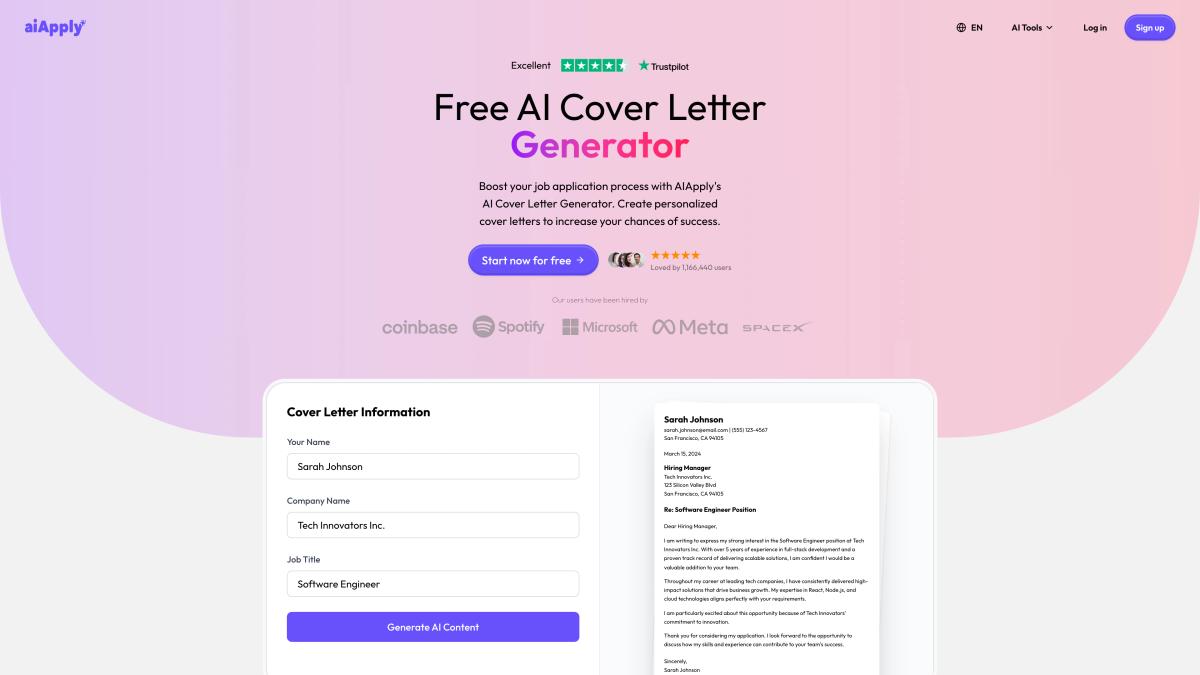
This is where AIApply's Cover Letter Generator helps. It builds a first draft from your resume and the job description, giving you something real to work with instead of a blank page. From there, you personalize it with your own achievements, reasons for applying, and voice.
Step 1: Gather Your Real Details Before Using AI
Don't start with "write me a cover letter." Start with facts.
Collect:
- The job title and company name
- The job description text
- 3 to 5 required skills from the posting
- 2 real achievements from your resume (specific, with numbers if possible)
- 1 genuine reason you want this specific company or role
- 1 detail that shows personality or motivation
- Any word count or tone constraints in the posting
AI is only as good as the raw material. Generic input produces generic output.
Step 2: Tell AI to Use Only Your Real Facts
When prompting a raw AI tool, a constraint like this makes a significant difference:
| Write a 250–350 word cover letter for this role. Use only the facts I provide. Do not invent achievements, metrics, tools, company details, or experience. Keep the tone direct and human, not overly formal. Include one specific reason I'm interested in this company and two proof points from my background. Job description: [paste job description] My background: [paste resume bullets or notes] Why I want this role: [your real reason] |
That one instruction ("use only the facts I provide") reduces hallucination and keeps the letter grounded in what you can actually defend.
Step 3: Rewrite the Opening in Your Own Words
The opening is where most AI letters fail. Here's the difference in practice:
Weak AI opening:
I am excited to apply for the Marketing Associate position at Acme. With my strong communication skills and passion for digital marketing, I believe I would be a valuable addition to your team.
Why it fails: it says almost nothing specific. It could be sent to 500 companies.
Better opening:
I'm applying for the marketing associate role because Acme's recent push into student-focused financial education matches exactly the kind of campaign work I've been building toward. In my last internship, I helped test 14 paid social ad variants for a university audience, and the best-performing version increased demo signups by 18%.
Why it works: it names a real company direction, connects to the role, and gives proof immediately.
Step 4: Replace Vague Claims With Specific Evidence
AI loves adjectives. Recruiters want evidence.
| Weak phrase | Specific alternative |
|---|---|
| "I am highly motivated" | "I completed the project two weeks early while balancing final exams" |
| "I am a strong communicator" | "I wrote weekly client updates that reduced revision requests by 30%" |
| "I am passionate about data" | "I built a dashboard to track churn risk across 1,200 accounts" |
| "I thrive in fast-paced environments" | "I handled 40+ support tickets per day during launch week" |
A cover letter isn't where you declare your personality. It's where you prove it.
Step 5: Add at Least One Line That Sounds Like You
A human sentence is a line that sounds like you, not a template. Examples:
- "I'm drawn to this role because I like work where the answer isn't obvious on day one."
- "The part of the job description that stood out most was the mix of customer research and execution."
- "I'm early in my career, but I've consistently been the person who turns vague problems into organized next steps."
These lines reveal judgment. AI can imitate them, but you should make the one in your letter true.
Step 6: Make Sure the Letter Matches Your Resume
Every claim in the cover letter should match your resume, LinkedIn profile, or interview story.
If the cover letter says "I led a cross-functional product launch," your resume shouldn't say "assisted with launch documentation." Those are different levels of ownership. Don't let AI upgrade your role without your permission.
Step 7: Read Your Cover Letter Out Loud
This catches most AI tone problems. If you'd feel weird saying the sentence in an interview, it probably doesn't belong in the cover letter.
Step 8: Cut Generic Phrases Before You Send
Delete sentences that add no information. Common offenders:
- "I am confident I would be a great fit"
- "I am excited about the opportunity to contribute"
- "My skills and experience align well with the role"
- "I look forward to the possibility of discussing my application"
If half the letter is made of lines like these, the letter is weak regardless of how it was written.
AI Cover Letter Examples: Weak vs Strong
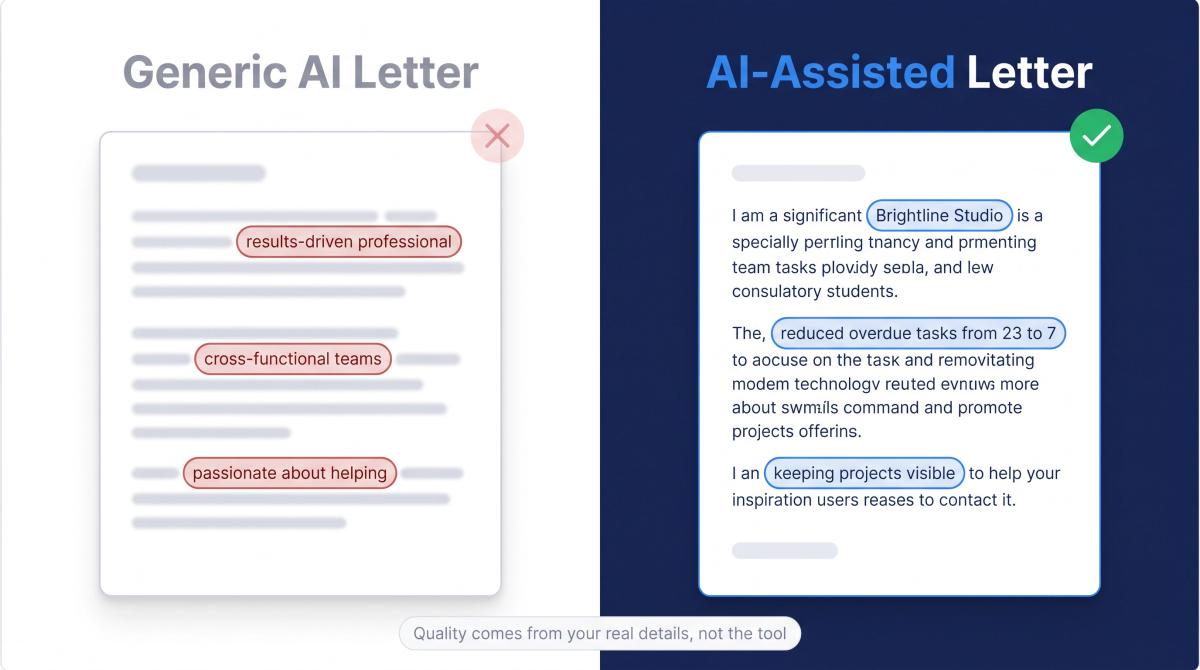
What a Generic AI Cover Letter Looks Like
Dear Hiring Manager,
I am thrilled to apply for the Project Coordinator position at your company. I am a highly organized and results-driven professional with excellent communication, leadership, and problem-solving skills. Throughout my career, I have demonstrated the ability to manage multiple priorities, collaborate with cross-functional teams, and deliver successful outcomes in fast-paced environments. I am passionate about helping organizations achieve their goals and believe my experience makes me an ideal candidate for this role.
This isn't terrible grammar. That's the problem. It's clean but completely empty.
What's wrong with it: no company detail, no specific project, no measurable result, no proof of leadership, no reason for this role, no distinct voice. It could be sent to almost any job.
What a Strong AI-Assisted Cover Letter Looks Like
Dear Hiring Team,
I'm applying for the Project Coordinator role because the job description focuses on exactly the kind of work I've enjoyed most: turning messy timelines into clear next steps. In my operations internship at Brightline Studio, I maintained the launch tracker for a six-week website migration, coordinated updates across design, content, and engineering, and helped reduce overdue tasks from 23 to 7 by the final week.
What stood out to me about this role is the mix of scheduling, stakeholder communication, and process improvement. I'm comfortable being the person who keeps details moving without making the team feel chased. I'd bring strong follow-through, clear written updates, and a practical approach to keeping projects visible and on track.
This version can still be AI-assisted. But it feels credible because it uses real details.
A Three-Paragraph Cover Letter Structure That Works
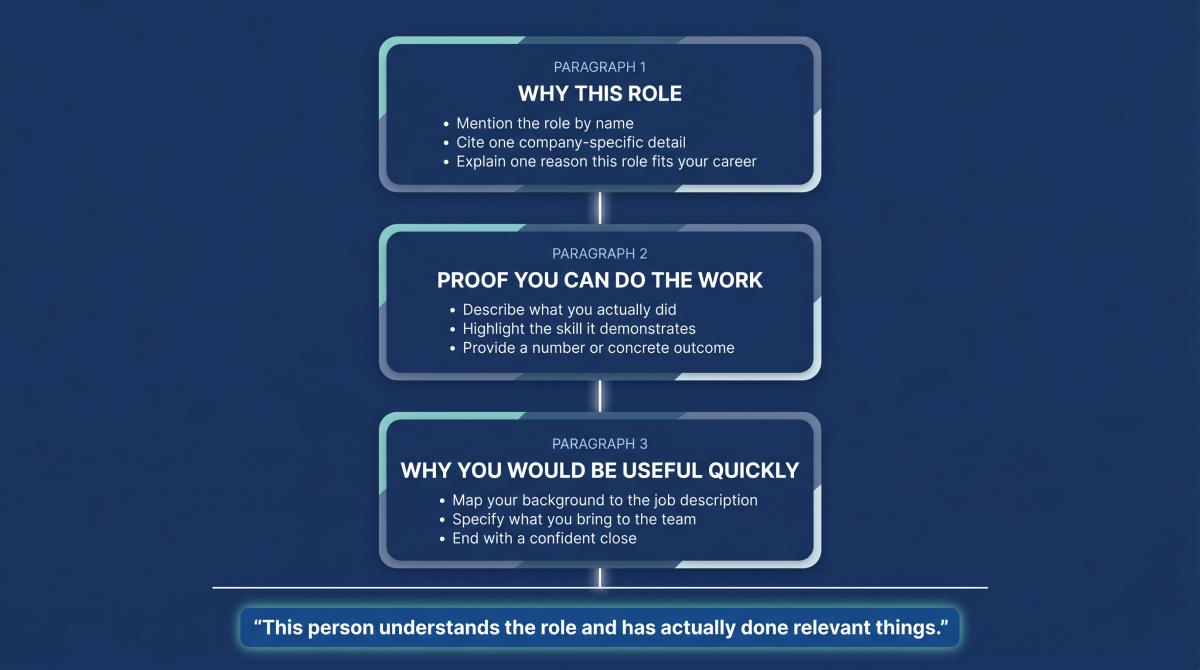
Use this three-paragraph structure as a starting frame:
Paragraph 1: Why This Role
Show that you understand the job and company.
Include: the role by name, one company-specific detail (not generic "I admire your mission"), and one reason the role fits where your career is heading.
Paragraph 2: Proof You Can Do the Work
Give one or two specific achievements.
Include: what you actually did, the skill it demonstrates, and a number or concrete outcome if you have one.
Paragraph 3: Why You'd Be Useful Quickly
Connect your experience to the employer's actual needs.
Include: how your background maps to the job description, what you'd bring to the team, and a confident (not desperate) close.
The goal isn't to sound impressive. The goal is to make the recruiter think:
"This person understands the role and has actually done relevant things."
ChatGPT vs an AI Cover Letter Generator
ChatGPT and a dedicated AI cover letter generator both write cover letters, but they work differently. ChatGPT depends on the prompts you give it and knows nothing about your resume or the job unless you paste it in. A cover letter generator is built for the task, using your resume and the job description to produce a draft that's already tailored, so you spend less time rewriting and more time adding your own experience.
ChatGPT
AI cover letter generator
Requires detailed prompts
Guided step-by-step workflow
Often creates a generic first draft
Tailors the draft to the specific job
Doesn't automatically use your resume
Uses your resume and the job description
Usually needs more formatting and editing
Creates a structured draft ready to personalize
Can invent details if you underprompt
Builds the draft around your own experience
If you're writing one cover letter, either option works. If you're applying for several roles and tailoring each one, a dedicated generator saves real time by handing you a draft already built around your experience, so you can focus on the details that make you stand out.
Common Mistakes People Make When Using AI for a Cover Letter
An AI cover letter generator is a powerful tool, but it works best when you use it well. Here are the mistakes to avoid.
- Copying the first draft without reviewing it: The draft is a draft. Read it before you send, check accuracy, cut anything that doesn't sound like you, and make sure it reflects your real experience.
- Giving AI very little information: Output quality depends on input. Paste only a job title and you'll get something generic. The best results come from providing both your resume and the full job description.
- Expecting AI to know your career story: AI doesn't know which project you're proudest of or why you're changing careers unless you tell it. Those personal details are what make a letter memorable.
- Skipping the final proofread: AI can misread information, repeat itself, or include awkward wording. A final read catches small mistakes and confirms everything is accurate before you submit.
<!-- IMAGE: Editorial illustration of a job seeker editing an AI draft, crossing out generic lines and adding real details. ALT: Job seeker personalizing an AI-generated cover letter draft by adding specific details -->
Ready to Write a Better Cover Letter?
Used the right way, an AI cover letter generator saves you time while helping you create a stronger application. With job postings now drawing high volumes of applicants, taking a few extra minutes to personalize your letter matters more than ever.
<!-- EDITOR: Please verify before publish — the Greenhouse "244 applications per job" figure against Greenhouse's 2026 Hiring Benchmarks. Source with a link or remove. I've kept the point general above rather than citing the unverified number. -->
Let AI handle the first draft, then add your own experience, achievements, and reasons for applying. Those edits are what separate a generic cover letter from one that actually reflects you.
If you're applying for multiple jobs, AIApply's Cover Letter Generator can create a personalized first draft for each role using your resume and the job description. From there, review it, make it your own, and send an application you're confident in.
Frequently Asked Questions
Can Employers Tell I Used ChatGPT for My Cover Letter?
Usually not. Recruiters can sometimes recognize generic writing, but they generally can't tell for certain whether you used ChatGPT or another AI tool to help write your cover letter.
Can ATS Detect AI-Written Cover Letters?
No. ATS software looks for keywords, skills, qualifications, and formatting. It isn't designed to detect whether AI helped you write your letter.
Should I Tell Recruiters That I Used AI?
Usually no. Recruiters care far more about the quality of your application than the tool you used to write it. The exception is when an employer directly asks or a posting bans AI, in which case be honest.
Can AI Detection Tools Tell If I Used AI for My Cover Letter?
AI detection tools can estimate whether a letter looks AI-generated, but they can't prove you used ChatGPT or another tool. They're also frequently inaccurate, especially once a draft has been reviewed and edited by a person.
Is It Cheating to Use AI for a Cover Letter?
No. Using AI to create a first draft or improve your writing isn't cheating. The problem starts when AI is used to exaggerate your experience or invent qualifications you don't have.
What Is the Best AI Cover Letter Generator?
The best AI cover letter generator builds a draft from your resume and the job description instead of producing generic content, and makes it easy to personalize the final version so it sounds like you.
Can Employers Reject AI-Written Applications?
Yes, but in most cases they aren't rejecting it because AI was used. They're rejecting it because the letter feels generic, doesn't match the role, or wasn't personalized before it was submitted.