How to Find a Job Fast: A 14-Day Plan That Actually Works (2026)
Job search going nowhere? Run a focused 14-day sprint instead. Targeting, timing, and daily tracking are what actually get you hired fast.


To find a job fast, focus your search on one clear target role, apply within 24 hours of a posting, message a human connected to every serious application, and start interview prep before any invites arrive. Most job seekers do the opposite, which is exactly why their searches drag: broad targeting, late applications, no outreach, and no practice until an interview is already on the calendar. This guide turns that around into a 14-day sprint you can start today.
You've sent 40 applications. Maybe 50. You've heard back from two, and one of those was a rejection. The math feels broken.
It kind of is. Not because the job market is hopeless, but because volume without a system doesn't scale. Sending more applications doesn't fix a search that's poorly targeted. It just means more of the same result, faster.
A United Way NCA survey of 1,000 recent and current US job seekers, conducted in early 2026, found that the average job search now takes about 6.6 months and 62.6 applications. The 14-day sprint below is built to compress that, because the people who get hired quickly aren't sending more applications than you. They're running a focused campaign with a specific structure: one clear target, early timing, human outreach on every serious job, fast tailoring, daily tracking, and interview prep that starts before any invitations arrive. That system is what the rest of this guide covers, step by step.
A quick note for one group of readers: if you need income right now, don't wait two weeks. Skip ahead to When You Need Money Now for the dual-track plan, then come back for the full sprint.
For context: as of April 2026, the U.S. Bureau of Labor Statistics reported 4.3% unemployment with 7.4 million unemployed workers and 1.8 million who have been out of work for six months or more. In the UK, the Office for National Statistics found that vacancies dropped 8.3% year over year in early 2026, with declines across 14 of 18 industry sectors. Competition is real (one reason a chunk of postings you see aren't even live roles, which is why spotting ghost jobs is a step in this sprint, not an afterthought). The system matters more than it ever has.
At AIApply, we've worked with over 1,166,000 job seekers, and the pattern in the fastest searches is consistent every time. It isn't about luck or connections. It's about running each step of this process with intention.
Here's the 14-day sprint at a glance before we get into each step:
| Step | What You Do | Why It Speeds Things Up |
|---|---|---|
| 1. Pick one target | One primary role, two backups, 30-50 companies | Tailored beats generic; one focus makes every application reusable |
| 2. Build a master resume | One document with everything you've done | Tailoring becomes selecting, not rewriting from scratch |
| 3. Apply within 24 hours | Prioritize roles posted in the last 24-72 hours | First-wave applicants get reviewed before interviews start |
| 4. Message a human | Contact a recruiter or insider on every serious role | Turns one application into a name that appeared twice |
| 5. Tailor in 20 minutes | Headline, summary, top skills, top bullets | Speed without going generic |
| 6. Network in parallel | Five real outreach messages a day | Most jobs fill through referrals, often before they post |
| 7. Filter out ghost jobs | Skip stale, vague, repost-only listings | Stops you from burning effort on dead roles |
| 8. Prep interviews from day one | 20-30 minutes of practice daily | The fastest applicants lose offers by interviewing rusty |
Here's the sprint.
How to Structure a 14-Day Job Search Sprint
The goal for the next 14 days isn't "apply everywhere." It's to create as many high-quality hiring conversations as possible.
That's a different objective. High-quality conversations come from being relevant, timely, and human. Random applications don't create them. We've covered what AI tools for job searching do well, and the pattern is the same: automation handles volume so you spend your time on the moves that actually matter.
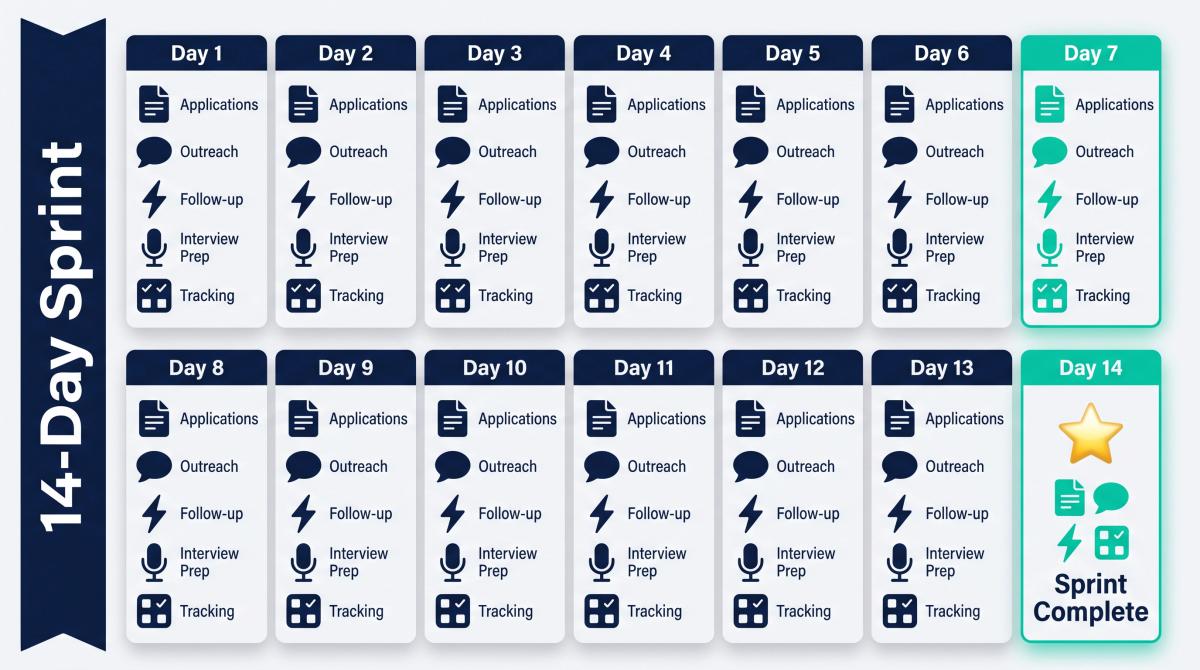
Here's what the sprint looks like on a daily basis:
| Daily Target | Goal |
|---|---|
| 10-15 targeted applications | Strong fits only, applied within 24-72 hours of posting |
| 5 outreach messages | Recruiter, hiring manager, referral, or employee contact |
| Same-day follow-up on warm leads | Prioritize replies that came in today |
| Interview practice (20-30 min) | Every day, even before invites arrive |
| Tracking sheet update | Log every application, contact, and next step |
That's the daily rhythm. It's intensive, but it's finite. You're not spinning plates indefinitely. You're running a 14-day focused effort with specific metrics to hit.
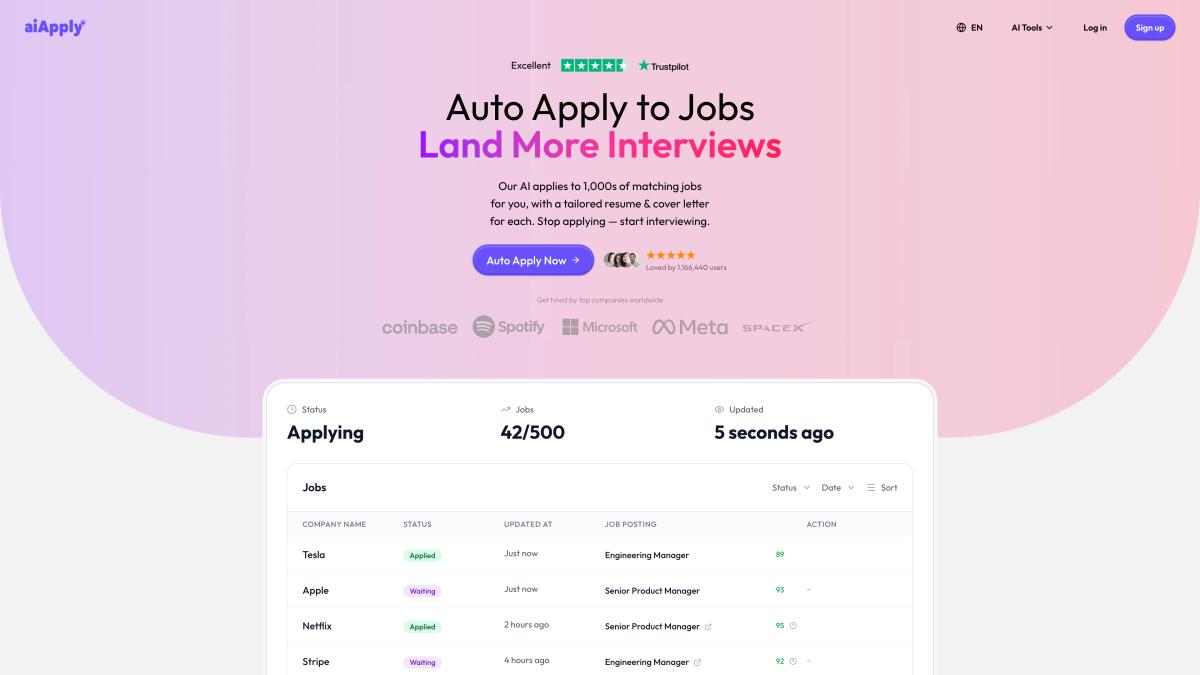
A few of these steps are repetitive by design: tailoring resumes, generating cover letters, scanning for ATS alignment, applying through job boards. Those are exactly the tasks that Auto Apply handles automatically. It scans over a million job postings, matches roles to your profile, and submits a tailored resume and cover letter for each application. The result is that the repetitive application volume gets handled while you spend your time on the activities that actually move the needle: networking, follow-up, and interview prep.
Here's what the Auto Apply dashboard looks like in practice. The status tracker, job matches, and per-application match scores update in real time as it works through your queue:
Before you touch a job board, though, do this first.
Why a Focused Job Search Works Faster Than a Broad One
According to Greenhouse's 2026 hiring benchmarks report, the number of applications per open role jumped from 116 in 2022 to 244 in 2025, a 111% increase. When every posting draws that much volume, being one more generic resume in the pile is a losing position. A focused search is what gets you read.
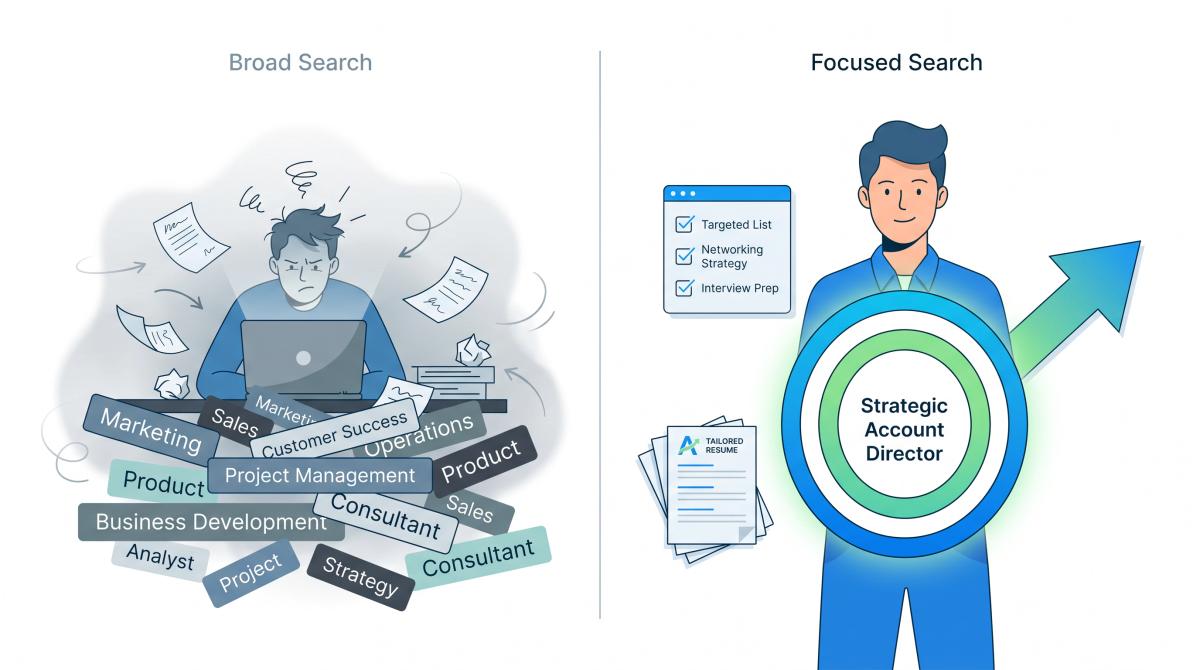
Most slow job searches start with vague targeting.
"I'm open to marketing, operations, customer success, project management, sales, maybe product."
That sounds flexible. It's actually paralyzing. Every job title has its own keywords, its own proof points, its own interview logic, and its own resume framing. When you apply broadly, every resume becomes generic. Generic resumes don't match ATS filters. They don't stand out to recruiters. And they're exhausting to write, because nothing from one application carries over to the next.
The fix is one clear primary target before you search a single job board.
Pick:
- 1 primary job title
- 2 backup job titles (similar role, different title)
- 1-2 industries where your experience is relevant
- 30-50 target companies (mix of sizes)
- Your minimum salary, location, and remote requirements
- The 4-5 proof points that matter most for this role type
Here's what that looks like in practice:
| Target | Example |
|---|---|
| Primary role | Customer Success Associate |
| Backup roles | Account Coordinator, Support Specialist |
| Industry | B2B SaaS, fintech |
| Location | Remote US or London hybrid |
| Proof points | Customer support, onboarding, CRM, retention |
| Daily goal | 12 applications + 5 outreach messages |
Do this before you search a single job board. With that target locked in, you need one document before you can apply effectively.
How to Build a Master Resume (And Why It's Not What You Send)
The master resume isn't what you submit to employers. It's raw material.
Create one comprehensive document with everything:
- Every role you've held, with full context
- Every measurable result (numbers, percentages, scale)
- Every tool and platform you know
- Every project, certification, and strong example
- Skills you'd describe only in conversation but should be written down
This document becomes the source you draw from when you tailor applications. You're not rewriting from memory with each job. You're selecting from an organized bank.
Once you've built your master resume, see resume examples for your target role to calibrate what strong looks like at the level you're targeting.
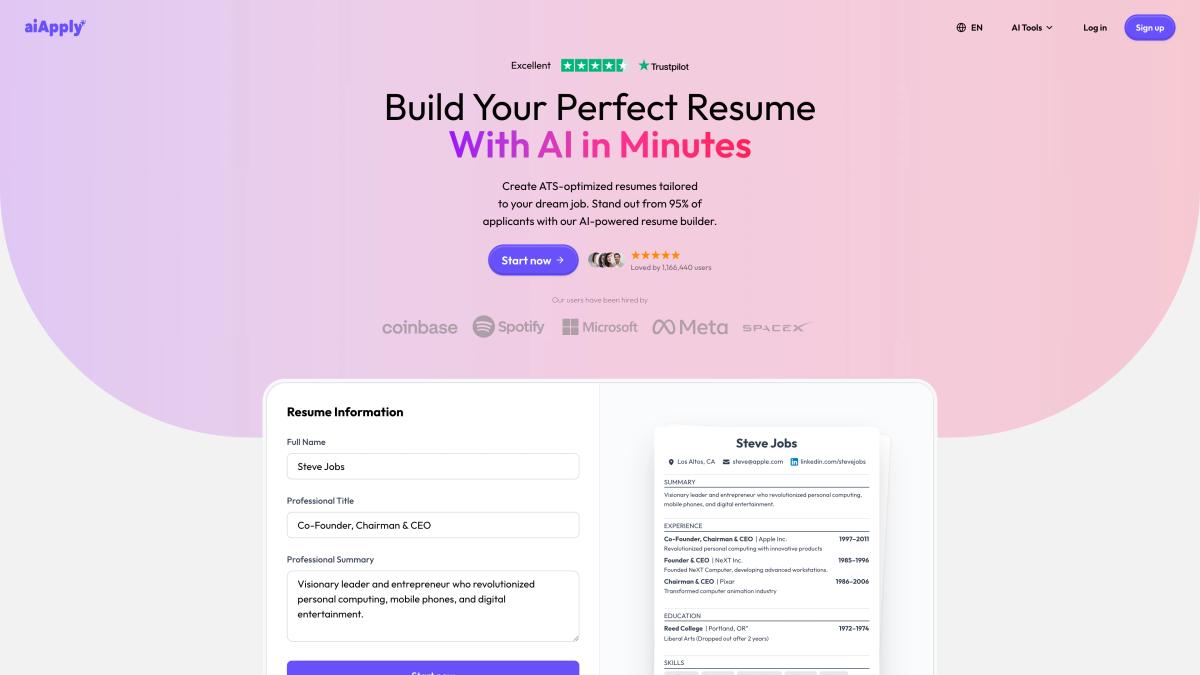
The AIApply Resume Builder is built for exactly this workflow: import or build your master resume, tailor it to a specific job description, run it through the ATS scanner to check keyword alignment, and export it or route it directly into Auto Apply.
The fastest resume formula: job title match + relevant keywords + proof. Here's what that means for a specific bullet point:
Too vague:
Responsible for social media
ATS-friendly and recruiter-ready:
Managed Instagram and LinkedIn content calendars for 3 brand accounts, increasing weekly posting consistency from 2x to 5x and lifting engagement on top-performing posts
The second version works because it gives the recruiter evidence. It also mirrors the language from job descriptions in this space. With your master resume built, here's how to apply it strategically.
Why You Should Apply Within 24 Hours of a Job Posting
Speed matters on job applications in a specific, documented way.
LinkedIn's career guidance explicitly recommends focusing on recently posted jobs because it increases your chance of being seen before recruiters stop actively reviewing new applicants. Recruiters often review on a rolling basis: they start interviewing when they have enough qualified candidates, not when the deadline passes. If you apply on day 12 of a 30-day posting, there's a real chance the first interviews have already happened.
Your daily search priority order should be:
- Jobs posted in the last 24 hours
- Jobs posted in the last 3 days
- Company career pages (often list roles before third-party boards)
- Recruiter posts on LinkedIn
- Niche job boards for your specific field
- Older listings only if the company is still actively promoting the role
Timing is a filter, not just a preference. The first wave of applicants gets reviewed most carefully. By day 15 of a 30-day posting, many hiring teams are already scheduling first-round calls.
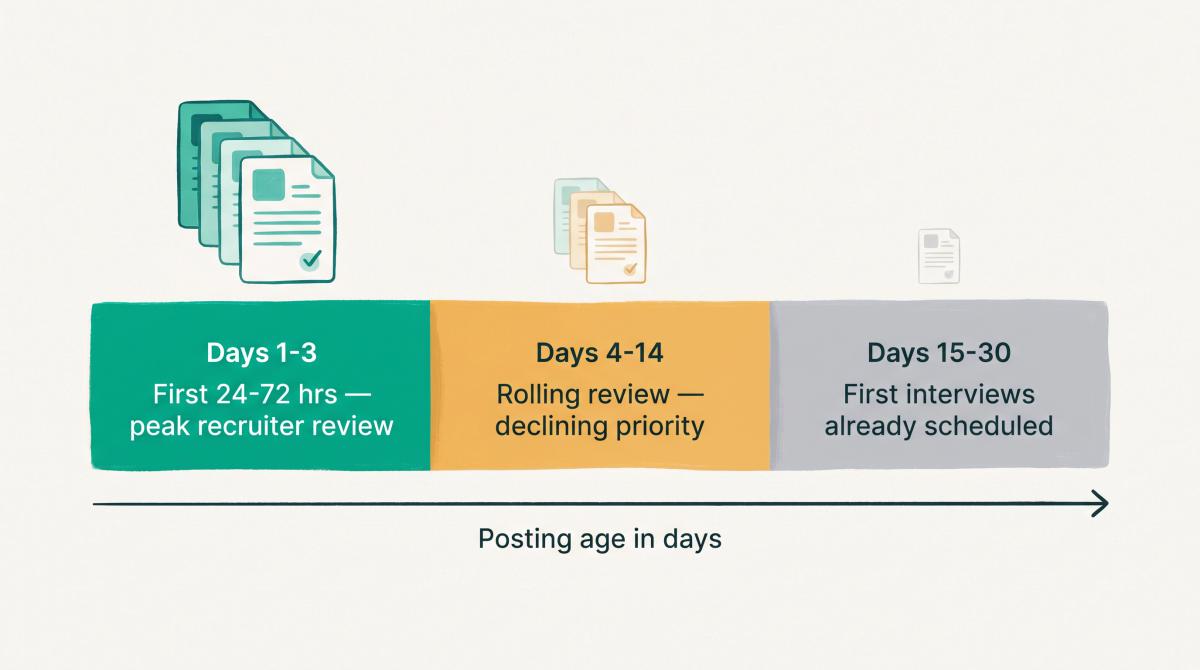
Avoid spending your best energy on 30-day-old postings unless something clearly signals active recruitment. Early applications plus one extra move doubles your visibility, and that move is coming up next.
How to Message a Recruiter Right After You Apply
In Greenhouse's 2025 AI in Hiring Report, 34% of recruiters said they spend up to half their week filtering out spam and junk applications. A quiet, human note connected to the role is how you land on the other side of that filter. So never rely only on the application form.
For every serious job you apply to, do two things simultaneously:
- Submit the application through the usual channel
- Contact one human connected to the role
That human could be the recruiter, the hiring manager, someone in the department, an employee who might refer you, or the founder if it's a small company. The point is that you're not just a name in a database. You're a person who was specific enough about the opportunity to reach out directly.
Use this message as a starting point:
Hi [Name], I just applied for the [Role] position at [Company]. I'm especially interested because [specific reason].
My background is in [relevant experience], and I've [specific proof or result]. Totally understand if you're not the right person, but wanted to reach out directly in case the team is actively reviewing candidates.
Keep it short. Don't beg. Don't send your life story. Make it easy for them to understand why you're relevant in the time it takes to read three sentences.
The difference this makes: instead of being one of 400 applications sitting in an ATS queue, you're a name that appeared twice. That's the gap between invisible and memorable. Once you're in the system with a human aware of you, here's how to tailor efficiently without spending two hours per application.

How to Tailor Your Resume in 20 Minutes, Not 2 Hours
You don't need to rewrite your entire resume for every application. You need to tailor four things:
- Headline / target title (match the job description's language)
- Summary (one paragraph, emphasizing your most relevant angle for this specific role)
- Top 6-10 skills (pulled from the job description's required and preferred skills)
- First 3-5 bullets under your most relevant experience (these carry the most weight)
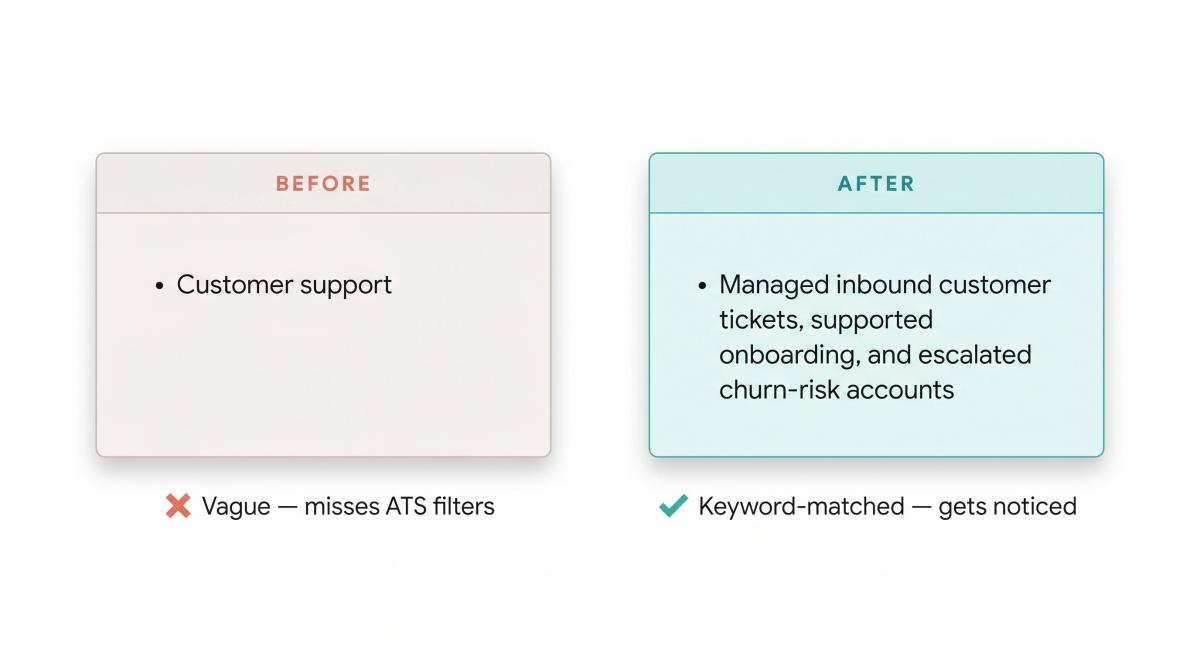
That's the 80/20. Everything else in the resume stays the same. The goal is to mirror the employer's language while accurately describing your experience. You're not inventing skills. You're using their terminology for skills you genuinely have.
Here's what that looks like. If the job description says:
"Experience managing inbound tickets, customer onboarding, and churn risk"
Your resume shouldn't just say:
Customer support
It should say:
Managed inbound customer tickets, supported onboarding processes, and escalated churn-risk accounts to the account management team
Same experience. Same skills. Better match because the language maps directly to what the ATS and the recruiter are looking for. For the customer support, onboarding, and CRM skills that come up most in these roles, make sure your resume uses the exact terms the job description uses. And when the tailored resume is ready, pair it with a cover letter built around that specific role. It reinforces the same keywords and shows the hiring team you've read the job description carefully.
The method that multiplies this approach is networking. And most people get the timing of networking completely wrong.
How to Network During a Job Search (5 Messages a Day)
Networking is a major hiring channel, even if the popular "70-80% of jobs are hidden" claim doesn't hold up. A LinkedIn survey found that 70% of people hired in 2016 joined a company where they already had a connection, and Federal Reserve research reports that about half of US job seekers say a referral was used at some point in their hiring process. That's why most job seekers get this backwards: they treat networking as something to try after applications fail.
Networking should run parallel to applications from day one. Not 50 spam messages to random LinkedIn connections. Five real, specific messages per day to people who are genuinely relevant to your search.
The best people to reach out to:
- Alumni from your school who work in your target industry
- Former colleagues who've moved to companies on your target list
- People who recently joined a company you want to work at
- Recruiters actively hiring for your function
- Hiring managers who are posting about team growth on LinkedIn
Use this approach to open conversations:
Hi [Name], I saw you work on [team/function] at [Company]. I'm exploring [role type] positions and noticed [something specific about the team or company].
One quick question: what does the team usually look for in strong candidates for roles like this?
That question works better than "can you refer me?" because it starts a real conversation rather than making an immediate ask. Referrals often come naturally from conversations that started with genuine curiosity.
The application form gets you into the pool. Networking can move you to the front of it, often before the role is even posted publicly.
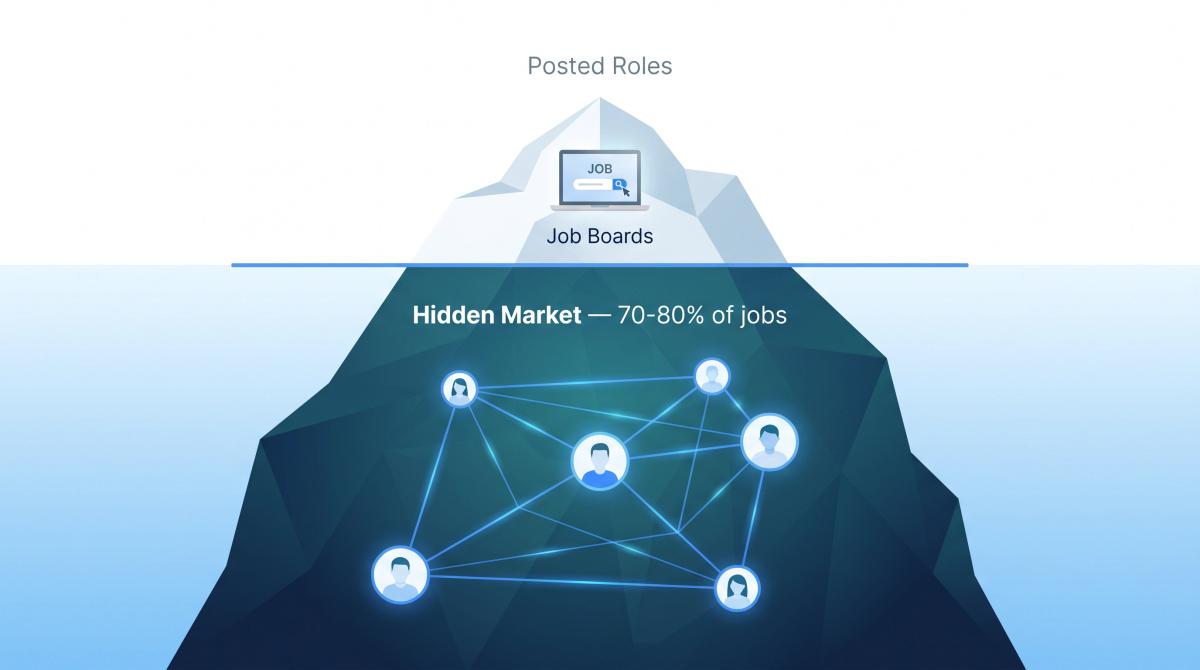
For a structured approach to modern job search techniques that includes both applications and outreach, that guide covers the full playbook.
Not every application you submit is going to a real open role, though. That's the next filter you need.
How to Spot Ghost Jobs Before You Waste an Application
Some job postings aren't real openings. They're either already filled, being kept open for talent pooling, or posted by mistake.
A 2024 ResumeBuilder.com survey found that 40% of surveyed hiring managers said their company had posted a fake job listing that year, and 30% said their company currently had one listed. Because that data is from 2024, treat the specific numbers as a signal rather than a current universal rate. But the signal is meaningful: fake and inactive listings are common enough to filter for.
Red flags to watch for:
- No posting date visible on the listing
- Vague job description with no specific responsibilities
- The role has been listed for 60 or more days
- It's not listed on the company's own careers page
- The recruiter listed doesn't respond to any outreach
- The company keeps reposting the exact same job every few weeks
- Salary, location, and core responsibilities are all unclear
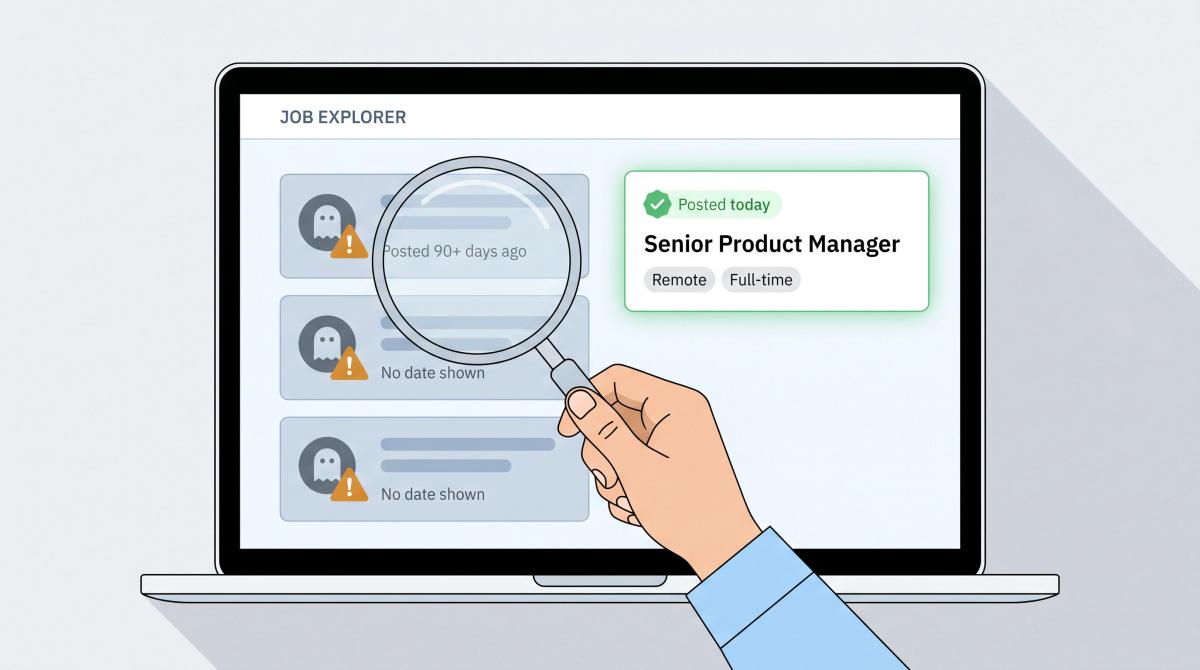
The best filter: prioritize roles that are fresh (within the last 3 days), specific in their requirements, and also listed on the company's direct careers page. If you can find a listing in two places, it's probably real. A job search tracker that logs the source and date of every listing makes this filter automatic. You'll quickly notice which boards surface the freshest postings and which ones recycle old listings.
How to Follow Up on a Job Application and Get a Response
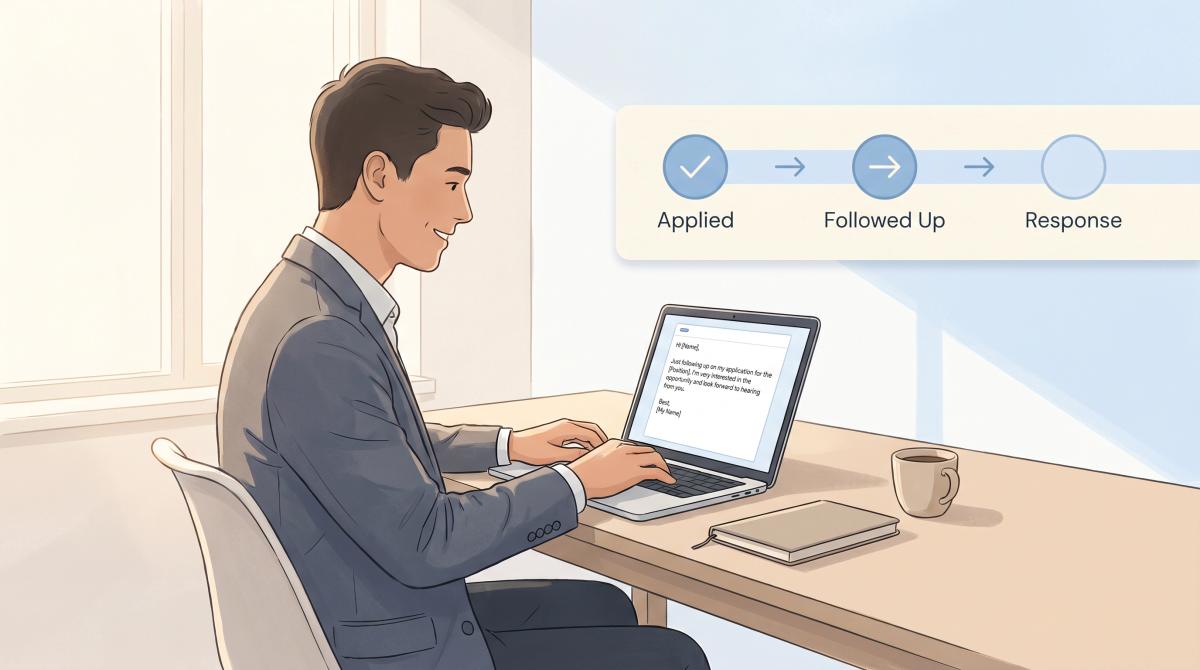
Send one follow-up per application. Time it 3-5 business days after you apply.
Hi [Name],
I recently applied for the [Role] position and wanted to follow up briefly.
I'm genuinely excited about this role because [specific reason], and my experience with [relevant skill or result] seems closely aligned with what the team is looking for.
Happy to share anything else that would be useful.
Best, [Your name]
That's it. Short, specific, confident but not pushy.
If they don't respond, move on. Speed in a job search comes from pipeline volume, not emotional attachment to a single application. The fastest job seekers treat their search like a sales pipeline: some deals close, most don't, and the metric that matters is the rate, not any individual outcome.
The final piece that most aggressive job seekers skip is also the one that kills the most offers.
How to Start Interview Prep Before You Get an Invitation
This is the most common failure mode in an aggressive job search.
Someone applies to 80 jobs over two weeks, finally gets three interview invitations, and then starts preparing. But they haven't practiced in weeks, their answers are rusty, and the gap between their application effort and their interview performance is huge. They lose roles they were qualified for.
The fix is simple: practice every day, even before any invites come.
Daily practice list (rotate through these):
→ "Why this company?"
→ "Why this role?"
→ "Walk me through your resume"
→ "Tell me about a challenge you overcame"
→ "What are your salary expectations?"
→ One or two role-specific technical or scenario questions
You're not memorizing scripts. You're building proof. The goal is to have real examples ready so that when the question comes, you're not constructing an answer from scratch under pressure.
AIApply's Mock Interview Simulator and Interview Buddy are built for this exact phase: the simulator creates role-specific practice sessions with AI feedback on your answers, while Interview Buddy gives you real-time on-screen coaching during live interviews on Zoom, Google Meet, or Teams.
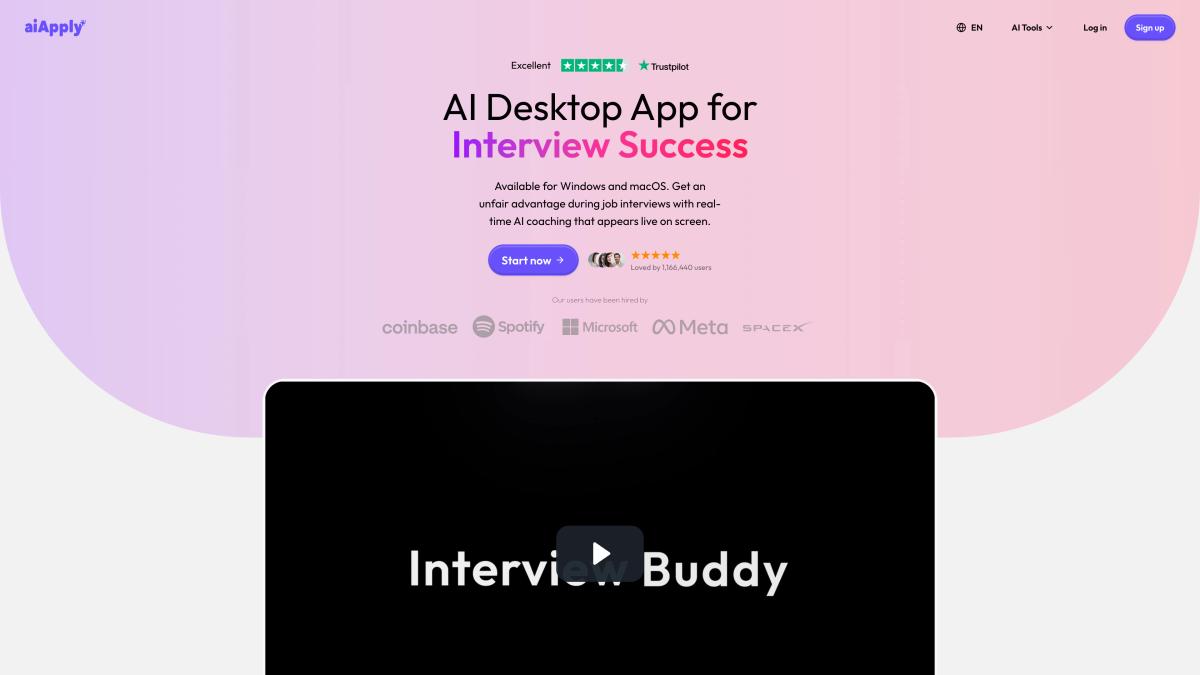
For structuring your answers, use this framework: Claim → Example → Result → Relevance.
Here's what that looks like in practice:
"I'm strong at handling high-pressure customer situations. In my last role, I managed support tickets during a product launch when wait times doubled overnight. I created saved replies for the top 10 issue types and escalated payment bugs directly to the engineering queue, which helped reduce repeat tickets by the end of the week. That's relevant here because this role owns customer satisfaction during product launches."
That answer is specific, credible, and connected back to the job. Practice enough of these and you'll walk into interviews with the confidence that comes from genuine preparation.
You need one more system to know whether your effort is actually working.
How to Track Your Job Search Like a Sales Pipeline
If you're not tracking your applications, you're guessing at what's broken.
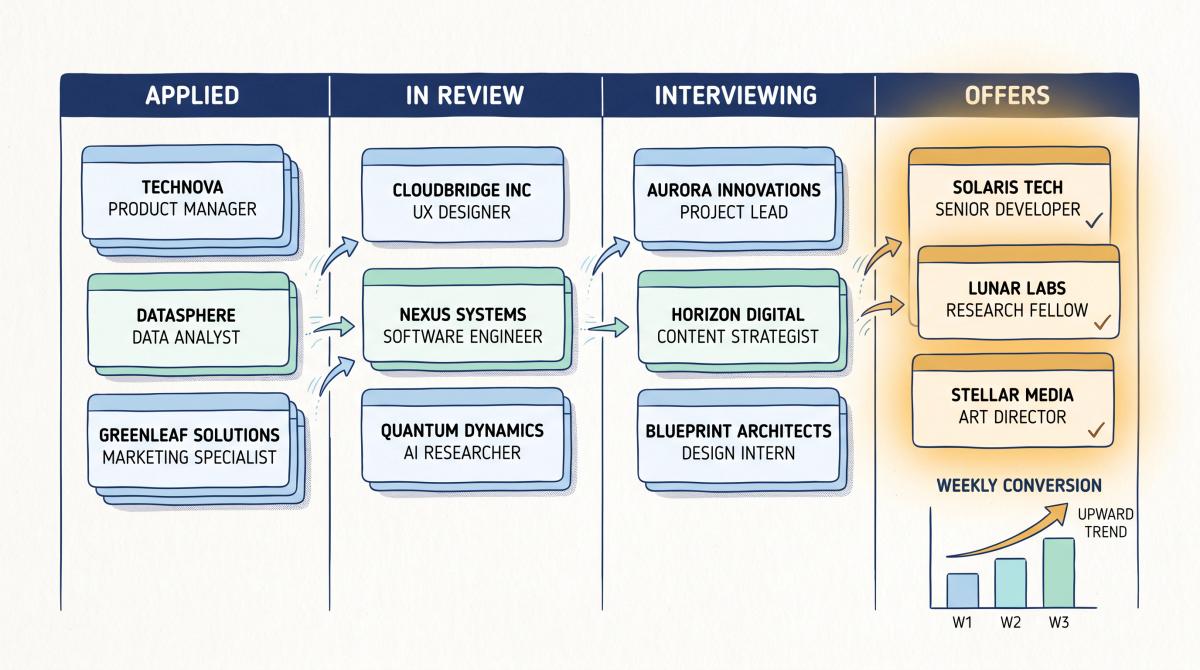
Here's the bare minimum you need to record for every application:
| Company | Role | Date Applied | Source | Resume Version | Contact Messaged | Status | Next Step |
|---|---|---|---|---|---|---|---|
| Notion | Customer Success Associate | May 14 | Company site | cs-v2 | Recruiter | Applied | Follow up May 20 |
And track these metrics weekly:
- Total applications sent
- Recruiter/outreach messages sent
- Replies received
- Interviews booked
- Rejections received
- Offers received
- Application-to-interview rate (this is your most important number)
The diagnostics from your data tell you exactly what to fix. Each scenario below points to a different problem:
| Symptom | Root Cause | Where to Focus |
|---|---|---|
| 80 applications, zero interviews | Targeting, resume fit, or job quality | Resume optimization and targeting |
| Getting interviews, no offers | Interview performance | Practicing interviews online before your next round |
| Recruiter replies, no interviews | Unclear positioning | Job search strategy: sharpen your primary role target |
Each of these diagnoses points to a different fix. Without tracking, you might keep doing the wrong thing for weeks before you notice.
How to Find a Job Fast When You Need Money Now
If you need income this week, run two searches at once: a survival search aimed at quick-hire roles that can move within days, and your career search on the full system above. Quick-hire categories (retail, hospitality, delivery, temp work) often go from application to start date in a matter of days, while professional roles typically take four to eight weeks even with a sharp search. Don't trade one for the other. Run both.
So, in parallel with your career search, apply immediately to the quick-hire categories where response times are much faster:
→ Delivery and logistics
→ Customer support (remote, part-time)
→ Tutoring and teaching assistance
→ Temp agency placements
→ Warehouse and event staffing
→ Freelance work in your skill area
For these roles, having role-specific application materials ready matters just as much as it does in your career search. Our customer support cover letter examples and hospitality management career guides can help you move quickly on applications that actually match what those employers are looking for.
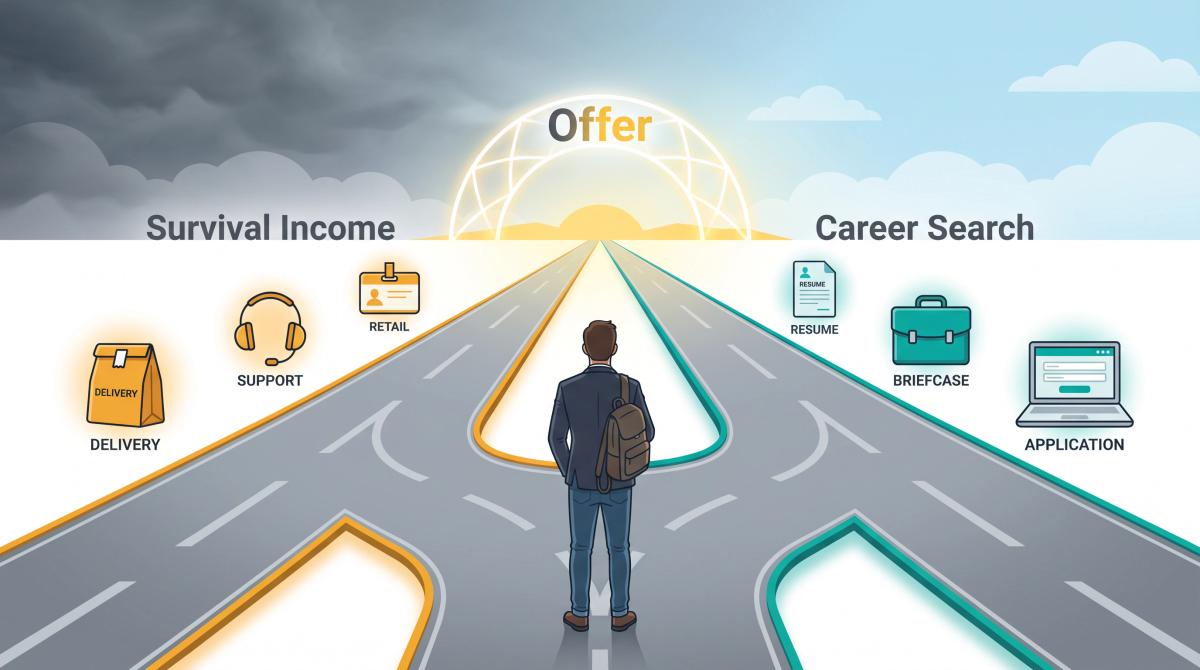
This reduces the panic that comes from financial pressure. And panic, practically speaking, makes people apply poorly. Rushed applications are generic. Generic applications don't match. The parallel strategy lets you run a careful main search while you have income coming in.
How AIApply Speeds Up Your Job Search
The principle worth repeating: don't use AI to become generic faster. Use it to become specific faster.
AIApply accelerates the parts of the job search that are repetitive and time-consuming, without replacing the judgment and personalization that make applications work.
Here's where it fits in the system:
- Resume tailoring: Turn one master resume into multiple tailored versions, each aligned to a specific role
- Cover letters: Generate job-specific cover letters that reflect the language of the job description
- ATS scanning: Scan your resume for keyword gaps before submitting
- Application volume: Use Auto Apply for matched roles so you're not manually filling every application form. The feature applies to matching jobs with a tailored resume and cover letter for each one, and it can handle up to 500 applications per month while you focus on networking and interview prep
- Interview practice: Practice interviews with the Mock Interview Simulator before you get any invites
- Live coaching: Get real-time coaching from Interview Buddy during live interviews when you need a confidence boost or a second brain in the room
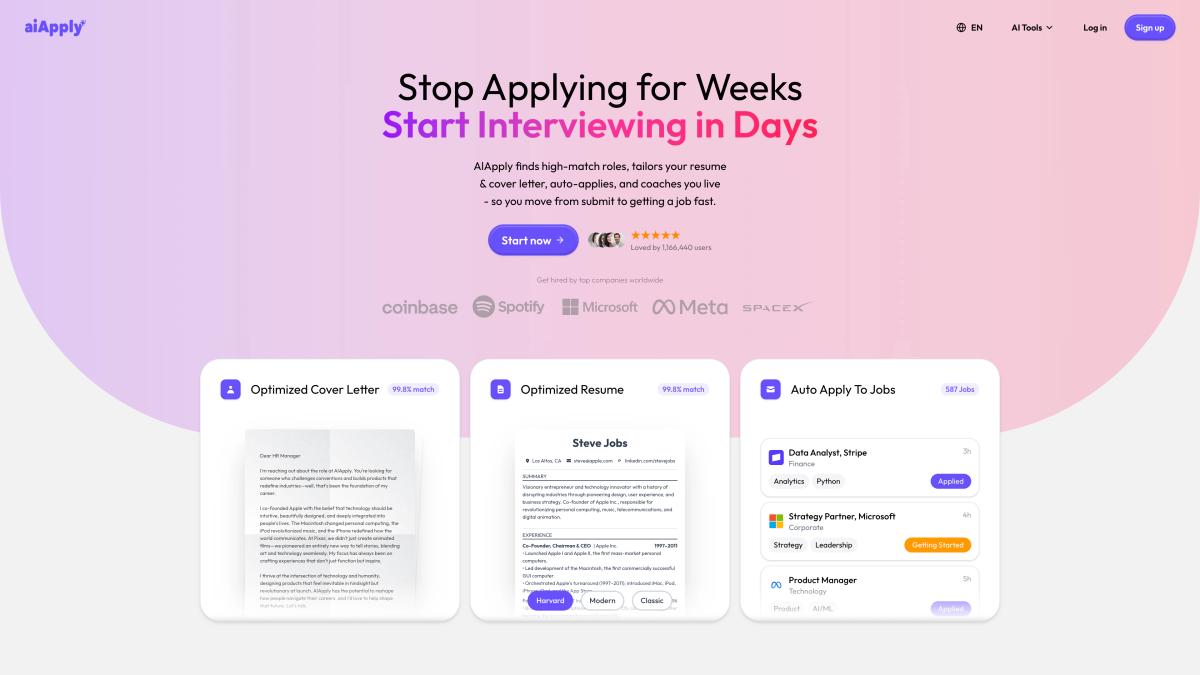
The Resume Builder connects directly with the scanner, Auto Apply, Interview Buddy, and the Mock Interview tools. It's a pipeline, not a toolkit puzzle. You're not bouncing between five different apps. Each tool feeds the next.
6 Job Search Mistakes That Are Slowing You Down
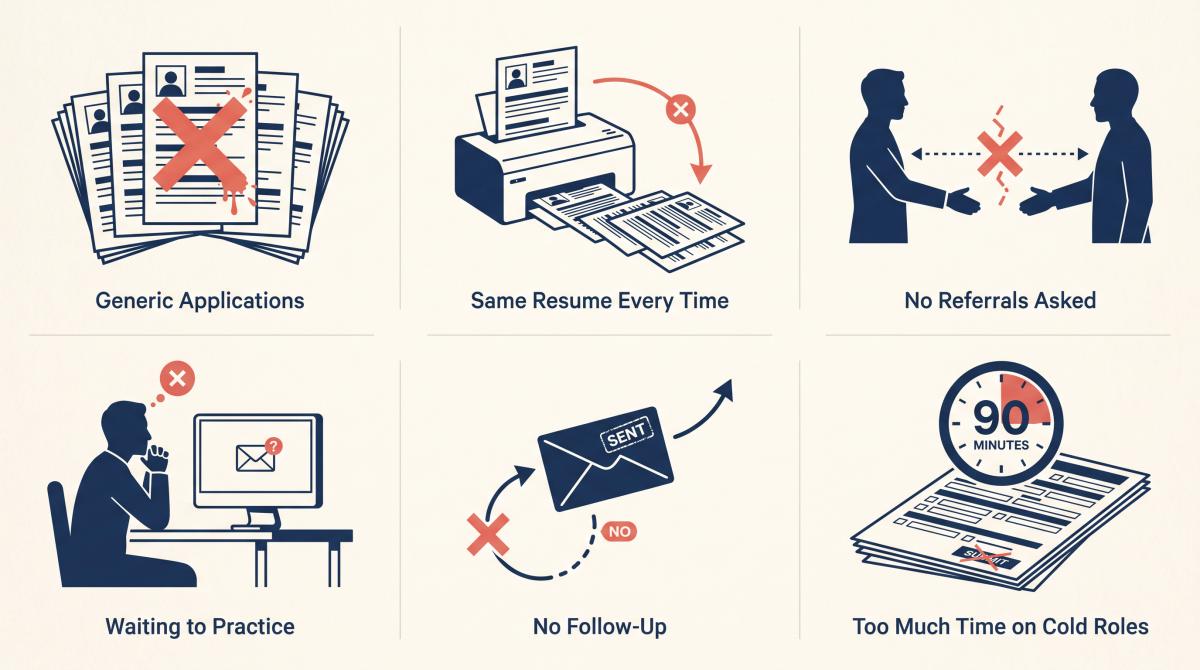
1. Sending High-Volume Generic Applications
More applications only help if the jobs are relevant and your resume is tailored. Sending 200 generic applications to whatever comes up is a reliable way to burn out without results.
2. Using the Same Resume for Every Role
Recruiters hire for fit. Generic resumes hide fit. Even the 80/20 method takes 20 minutes, but those 20 minutes turn a generic application into a relevant one.
3. Not Asking for Referrals
A warm introduction moves you from "one of 400 applicants" to "someone worth checking out." If you have any connection to a company, use it. If you don't, a good networking message can create one.
4. Waiting Until You Have Interviews to Practice
The fastest job seekers often lose offers because they applied well and interviewed poorly. Practice starts now, regardless of where your inbox is.
5. Not Following Up After You Apply
A polite, specific follow-up sent 3-5 days after applying can revive applications that would otherwise sit unread. Most people don't send one. That's your advantage.
6. Spending Too Much Time on Cold Applications
Don't invest 90 minutes in a cold application unless it's a dream role. Build a faster tailoring system and protect your time for the actions that actually pay off.
Your 7-Day Job Search Kickstart Plan
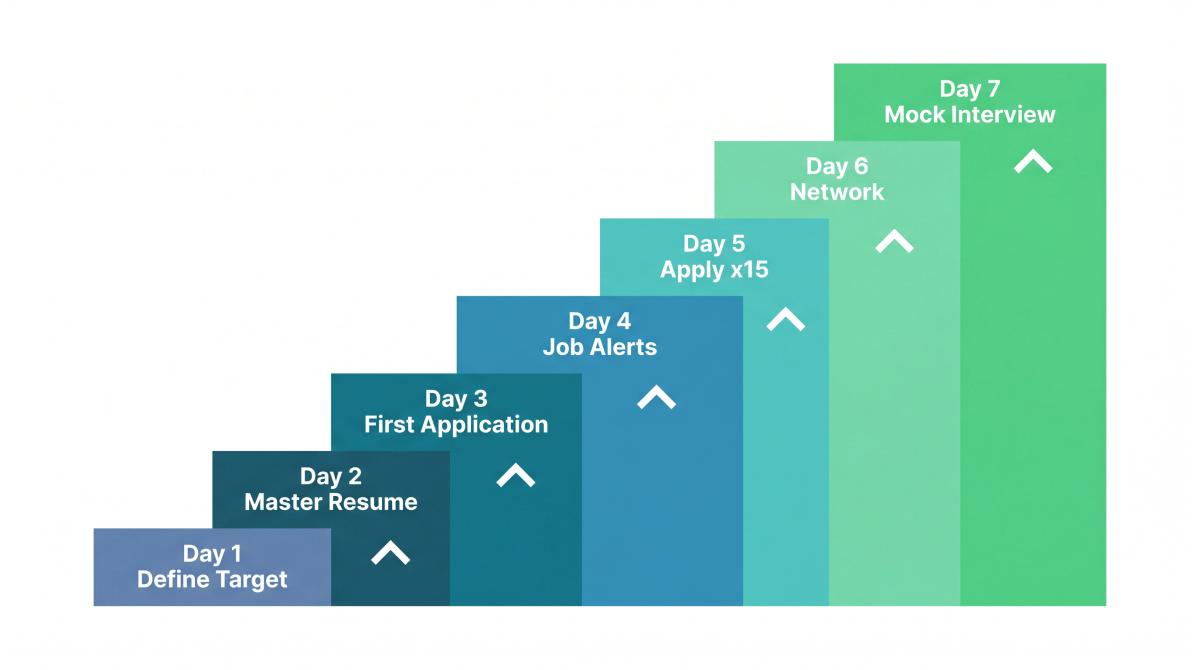
Day 1: Define Your Job Search Target
Choose your primary role, two backup titles, your target industry, 30-50 companies, salary range, location requirements, and the 4-5 proof points that matter most. Write this down. Everything you build this week depends on it.
Day 2: Build Your Master Resume
Collect every role, result, tool, certification, and strong example from your career. Don't filter yet. Get everything in one document. Browse resume examples for your target role to see how other professionals in your field present the same kind of experience.
Day 3: Create Your First Tailored Application
Take your master resume and tailor it to your primary role type using the 80/20 method: headline, summary, top skills, top bullets. Apply resume optimization techniques and run it through the resume scanner before you touch a single application.
Day 4: Set Up Job Alerts on Every Major Board
Set job alerts on LinkedIn, Indeed, your target companies' careers pages, and any niche boards in your field. Add AIApply's job board. The goal is to be notified immediately when a new relevant role posts, not an hour later. Review AI tools for job searching to make sure your alert setup captures every major channel.
Day 5: Apply to 10 to 15 Freshly Posted Jobs
Focus exclusively on jobs posted in the last 24-72 hours. Apply to each one with your tailored resume. For every job you care about, send an outreach message to a human connected to the role. This is the two-channel rule in action.
Day 6: Send 5 Targeted Networking Messages
Use the template from earlier. Contact recruiters, employees at target companies, alumni, or any relevant connections. Ask the question, not the favor. Our guide on how recruiters decide who to call explains what makes a candidate stand out in their inbox.
Day 7: Run Your First Mock Interview Session
Practice your top five most likely interview questions for your target role. Aim for full answers using the Claim-Example-Result-Relevance structure. Write down the examples you used. They're your proof library.
The fastest way to build confidence before an interview is practicing interview answers online with real feedback on your delivery. Do it before any invites arrive.
Repeat for week two with updated data on what's working.
A Controlled Job Search vs. a Desperate One: What Changes
A desperate job search sends everything it can and waits. A controlled one sends the right things early, follows up deliberately, runs networking in parallel, and prepares for interviews before they're booked.
The controlled version is harder to start because it requires resisting the impulse to just do more. But it's shorter, less exhausting, and far more likely to end with an offer you actually want.
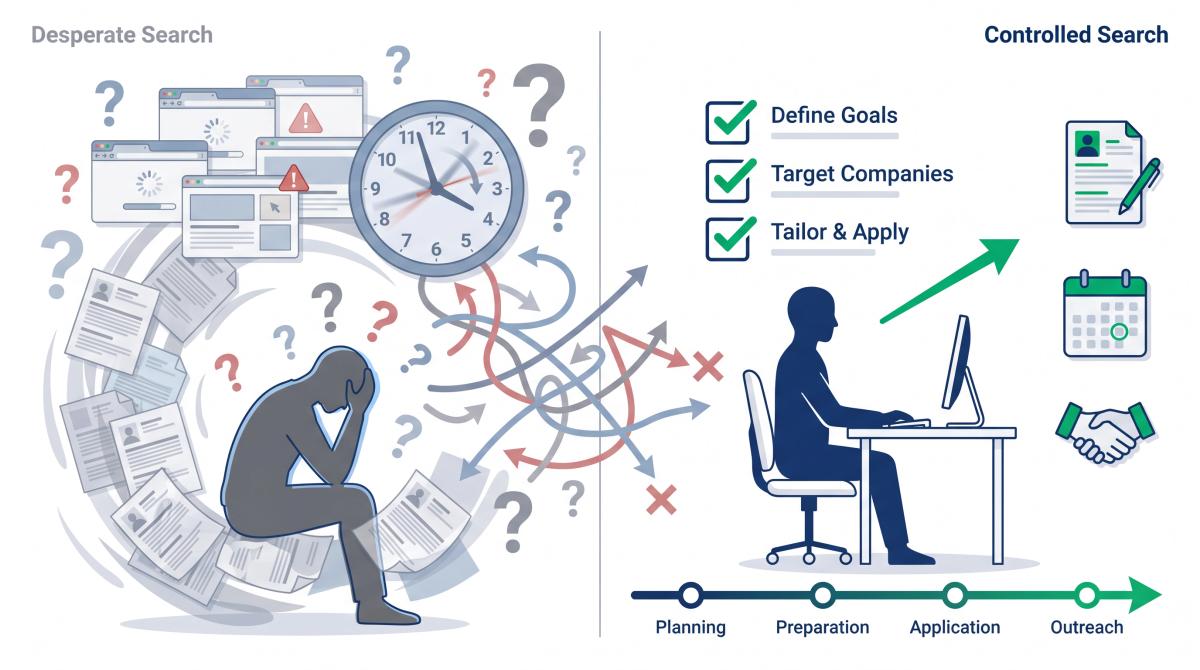
At AIApply, we've watched this pattern play out across more than a million job searches. The fastest ones share a structure: narrow targeting, early applications, human touch on every serious role, pre-built interview answers, and daily tracking. The slowest ones usually have one piece missing. Most often, it's the tracking (so they don't know what to fix) or the interview prep (so they lose opportunities they were qualified for).
Start today with Day 1 of the 7-day kickstart. Define your target. Build your master resume tomorrow. By day 5 you'll be applying to fresh jobs with a tailored resume and a human outreach going out alongside it.
If you want to compress the timeline further, Auto Apply handles the application volume so you can spend your time on the parts of the system that need your attention most.
The difference between six weeks and six months in a job search is usually one thing: doing it systematically, starting now.
Frequently Asked Questions: How to Find Jobs Quickly
How Many Jobs Should I Apply to Per Day?
For an intensive sprint, aim for 10-15 targeted applications per day, plus 5 outreach messages. That number should reflect quality, not volume. Fewer applications is completely fine if every one of them is genuinely tailored and submitted to a fresh, relevant posting. More is fine only if you can maintain the quality. For a deeper look at what the numbers actually mean for your odds, see our breakdown of how many applications lead to interviews.
Should I Apply Even If I Don't Meet Every Requirement?
Yes, if you meet around 60-70% of the core requirements and can credibly demonstrate the most important skills. Most job descriptions are written as wish lists, not strict cutoffs. Self-rejecting because you lack one "nice to have" qualification is one of the most common mistakes job seekers make. Review the key skills your target role actually requires before deciding whether you're genuinely underqualified.
Should I Apply on LinkedIn or Directly on the Company Website?
If possible, apply through the company's own careers page. It's usually closer to the actual recruiter, and some ATS systems receive applications more cleanly through their native forms. Use LinkedIn and other job boards for discovery, then move to the company site to submit. And after you apply, message a recruiter or relevant employee through LinkedIn. We cover exactly how to message a hiring manager in a way that actually gets a response.
How Fast Can I Realistically Find a Job?
Quick-hire work (retail, hospitality, delivery, temp roles) can move within days. Professional roles at established companies typically take weeks to months even with an excellent search. The fastest candidates in professional fields usually combine tight targeting, early applications, referral or warm outreach, and strong interview performance. When all four are present, four to eight weeks is achievable. If you're targeting a customer success role, for example, the market is competitive but active, and tight targeting plus fast applications make a real difference.
Should I Use AI Tools to Apply for Jobs?
Yes, if you use them to tailor applications faster and communicate your experience more accurately. No, if you're using them to blast identical applications at scale. AI works best when it helps you be more specific, not less. A tool that generates a role-specific resume in two minutes is saving you time without sacrificing quality. A tool that sends the same generic letter to 500 companies is just automating applications in a way that produces mediocrity at scale instead of quality at scale.
What's a Ghost Job and How Do I Avoid Wasting Time on One?
A ghost job is a posting that isn't attached to an active, open role. It might be an old listing never taken down, a position already filled internally, or a posting kept live for talent pooling. To filter them out: check that the listing appears on the company's own careers page, verify it was posted within the last 7 days, and check whether the recruiter is responsive on LinkedIn. If none of those signals are present, move it down your priority list. Tracking which applications go quiet helps you spot patterns. Use a job search tracking system to flag listings that never generate a response.
What Should I Do If I'm Not Getting Any Responses After 80+ Applications?
The problem is almost always one of three things: your targeting is too broad (applying to roles where your background doesn't clearly match), your resume isn't reflecting ATS keywords from the job descriptions, or the jobs you're applying to are low quality (old, fake, or too competitive for your current experience level). Run your resume through AIApply's Resume Scanner to check keyword alignment. Also review how ATS systems actually score resumes so you understand what to fix. And review the quality of the jobs you've been applying to: are they fresh, specific, and listed on company career pages?