How to Get Hired Fast in 2026 (Complete Guide)
Recruiters now manage 5x more applications than in 2022. Learn how to get hired fast with a proven 6-step system used by over 1 million job seekers at AIApply.


Getting hired fast isn't about luck, mass-clicking Easy Apply, or rewriting your resume 47 times. It's about building a job search system that works in the actual 2026 market. Not the market from three years ago.
And the 2026 market is not what most job seekers think it is. Greenhouse's 2026 Recruiting Benchmark Report found that applications per recruiter rose from 146 in 2022 to 746 in 2025: a five-fold explosion in four years. At the same time, the average role now takes nearly 60 days to fill. So more people are applying for every job, each application is getting less attention, and the timeline is longer. You're not imagining it. The game actually changed.
What that means for you: the fastest job seekers right now aren't the most qualified people in the pile. They're the clearest, most specific, most relevant candidates who apply early, prove their fit convincingly, and keep humans in the loop throughout the process. We've helped over 1.1 million job seekers through AIApply, and the pattern holds up across every industry and seniority level.
This guide gives you the complete system.
How to Get Hired Fast: 6-Step Summary
| Step | What to Do | Why It Works |
|---|---|---|
| 1 | Pick 1-2 target roles, not 12 random ones | Hiring moves faster when your experience clearly matches the role |
| 2 | Build one strong base resume, then tailor it per serious application | Tailored resumes convert 1.6x better than generic ones |
| 3 | Apply within the first few days of a posting | Older postings often already have a shortlist forming |
| 4 | Use quality volume: enough applications to create momentum, not spam | One perfect application isn't enough; 300 bad ones aren't either |
| 5 | Send a human follow-up after applying | Portals are crowded; people still hire people |
| 6 | Prepare for interviews before you get invited | Speed matters the moment a recruiter replies |
The fastest job seekers are the clearest, fastest, most relevant candidates in the pile.

Why Job Searching Is So Hard Right Now
The labor market isn't frozen. It's selective.
According to the Bureau of Labor Statistics' April 2026 Employment Situation, the US unemployment rate was 4.3%, with 7.4 million people unemployed. Healthcare, transportation, and retail were still adding jobs. And the latest BLS JOLTS data from March 2026 showed roughly 6.9 million job openings and 5.6 million hires. So hiring is genuinely happening. In the UK, the picture is tighter: ONS reported vacancies fell to 711,000 in early 2026, the lowest since 2021, with roughly 2.5 unemployed people competing for each vacancy.
The real problem isn't the number of jobs. It's the volume problem.
Job seekers are often using 2021 tactics in a 2026 market. In 2021, a decent resume and a few applications could sometimes work. Today, every posting attracts a larger pile, many recruiting teams are leaner than they were, 97.8% of Fortune 500 companies use an Applicant Tracking System to filter applicants before a human ever reads anything, and modern ATS optimization techniques have become genuinely critical. The applications-per-recruiter statistic we mentioned above (746 in 2025 vs. 146 in 2022) tells the whole story: recruiters are handling five times as many applications with roughly the same hours in their day.
Your goal isn't to apply more. Your goal is to apply better, earlier, and with more proof.
Why does this matter? Because every piece of advice below is designed to make you visible and compelling before the recruiter's attention runs out. The market is competitive, but it's not closed. The candidates who adapt their approach are the ones landing roles in weeks, not months.

How to Get Hired Faster: The Core Formula
Before we get into tactics, here's the conceptual rule that governs all of them:
Getting hired fast = Strong-fit roles + Tailored proof + Early applications + Human follow-up + Interview readiness
Most job seekers fail because they only optimize one part.
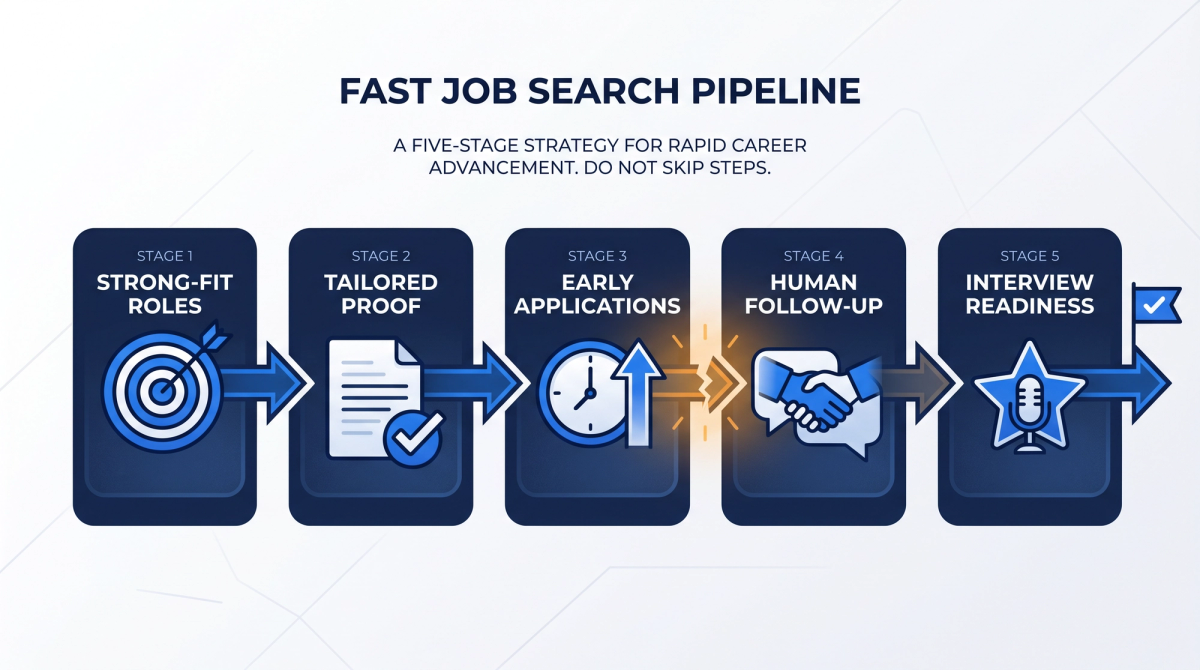
They send more applications but don't tailor them. They tailor their resume but apply too late. They apply early but never follow up. They get interviews but only start preparing after the invite lands. They use AI tools but let the output sound vague and interchangeable. Fast hiring comes from stacking small advantages across all five parts of this formula. Skip one and the others work harder to compensate. And often can't.
Step 1: How to Find the Right Roles to Apply For
The fastest path to a job is usually not "my dream role." It's the role where your experience, skills, proof, location, and availability already match what employers are struggling to fill.
That doesn't mean settling forever. It means being strategic about which battle you're entering.
How to Build Your Target Job List
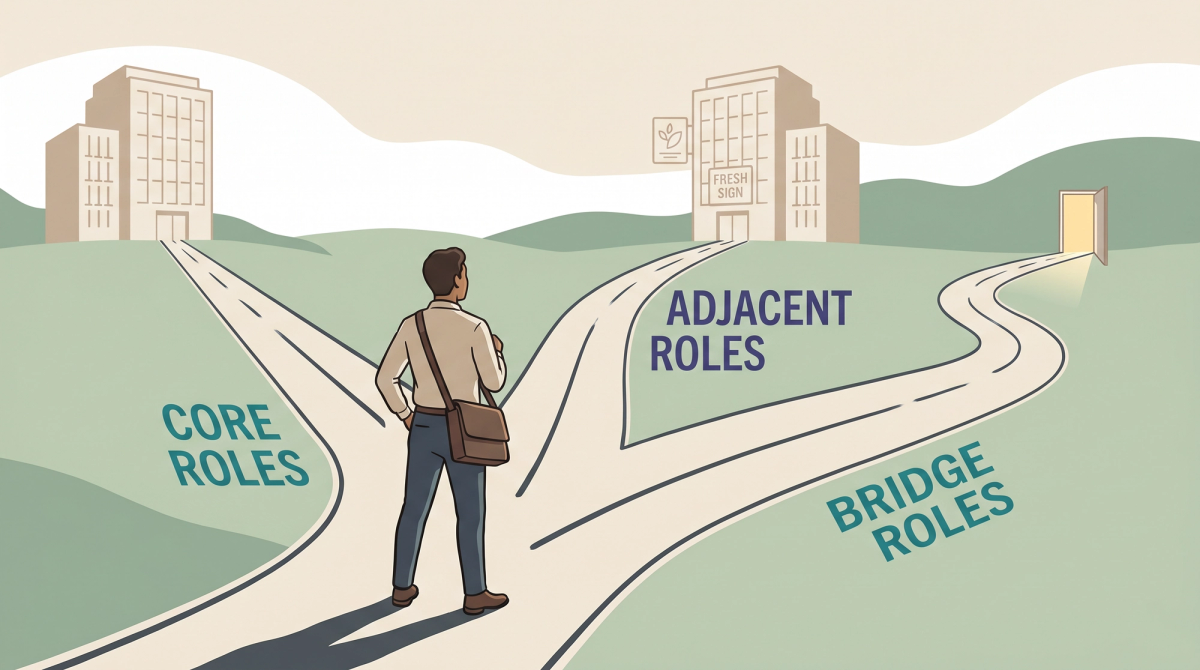
Split your search into three lanes:
| Lane | What It Means | Example |
|---|---|---|
| Core roles | Roles you're already qualified for | Project Manager → Project Manager |
| Adjacent roles | Roles using the same skills in a slightly different context | Project Manager → Program Coordinator |
| Bridge roles | Jobs that get you income, experience, or access fast | Project Manager → Contract Project Coordinator |
Most people only apply to core roles, then panic when nothing moves. Adjacent and bridge roles give you more routes into the market simultaneously. Sometimes those routes are faster. Before applying, review the Project Manager career path guide to understand what progression and transitions typically look like for roles in this cluster.
How to Score Job Postings Before Applying
Before spending time tailoring an application, score the role from 0 to 10. Give yourself one point for each:
- You've done this job or a very similar job before
- You match at least 70% of the skills required for your target role
- Your resume has specific proof for the top 3 responsibilities
- The salary range is acceptable. Check current salary benchmarks for your target role before you apply so you know what to expect
- The location or remote setup works for you
- The company is actively hiring (growing, funded, or stable)
- The posting is recent
- You can explain in one sentence why you want this role
- You can find a recruiter, hiring manager, or employee to reach out to
- You'd accept an interview this week if offered
Apply heavily to roles scoring 7-10. Apply selectively to roles scoring 5-6. Skip most roles under 5 unless you have a strong personal connection inside the company. This one habit alone saves hours every week.
Step 2: What to Prepare Before You Start Applying
Starting from scratch on every application is the biggest time-sink in any job search. You need a reusable asset base you can adapt quickly.
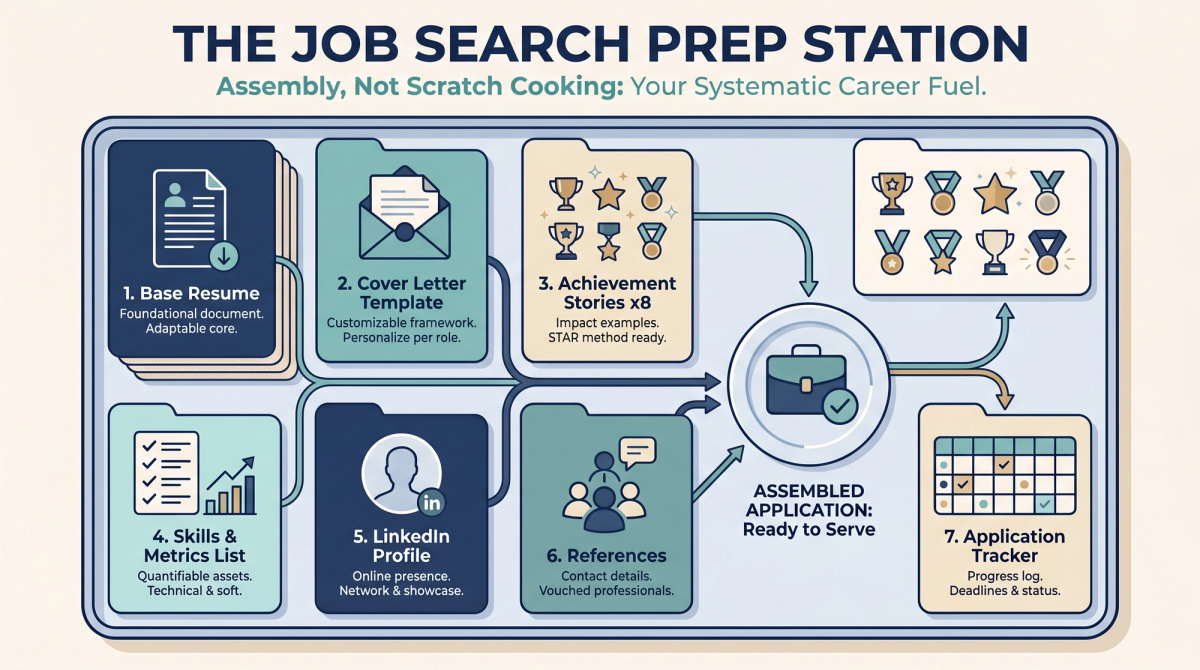
Your job search asset kit should include:
- One strong base resume. Browse resume examples for your target role to understand what strong looks like in your field before you start
- 2-3 resume versions tailored by role type
- One short cover letter template. Check our cover letter examples to see how the best ones are structured
- 6-8 achievement stories (more on this below)
- A list of quantified metrics from your work history, alongside building your skills list so nothing important is missing
- A clean, optimized LinkedIn profile
- 2-3 references or recommendation sources on standby
- A simple application tracker
Think of this like meal prep for your career. You're not cooking from scratch every time. You're assembling from prepared components.
How to Build a Resume Proof Bank
The most valuable thing you can do before you apply to anything is write down 10 things you've done that created measurable value. Use this format:
I did [specific action], using [skill/tool/method], which led to [measurable outcome].
Examples that work:
- Improved onboarding emails using customer segmentation and A/B testing, which increased trial-to-paid conversion by 18%
- Reduced ticket backlog by building a help-center workflow, cutting average first response time from 14 hours to 5 hours
- Managed weekly reporting for a 12-person team, giving leadership faster visibility into churn risks
- Rebuilt a resume screening process, reducing time-to-shortlist by 30%
See strong achievement examples to model if you're not sure how to frame your results. The format matters as much as the numbers.
The goal isn't to sound impressive. The goal is to make your work easy to understand fast. Hiring teams move faster when evidence is clear.
Step 3: How to Tailor Your Resume for Each Job
A resume is not your professional autobiography. It's an argument.
The argument is: "I can do this job because I've already done similar work, used similar skills, and produced similar outcomes."
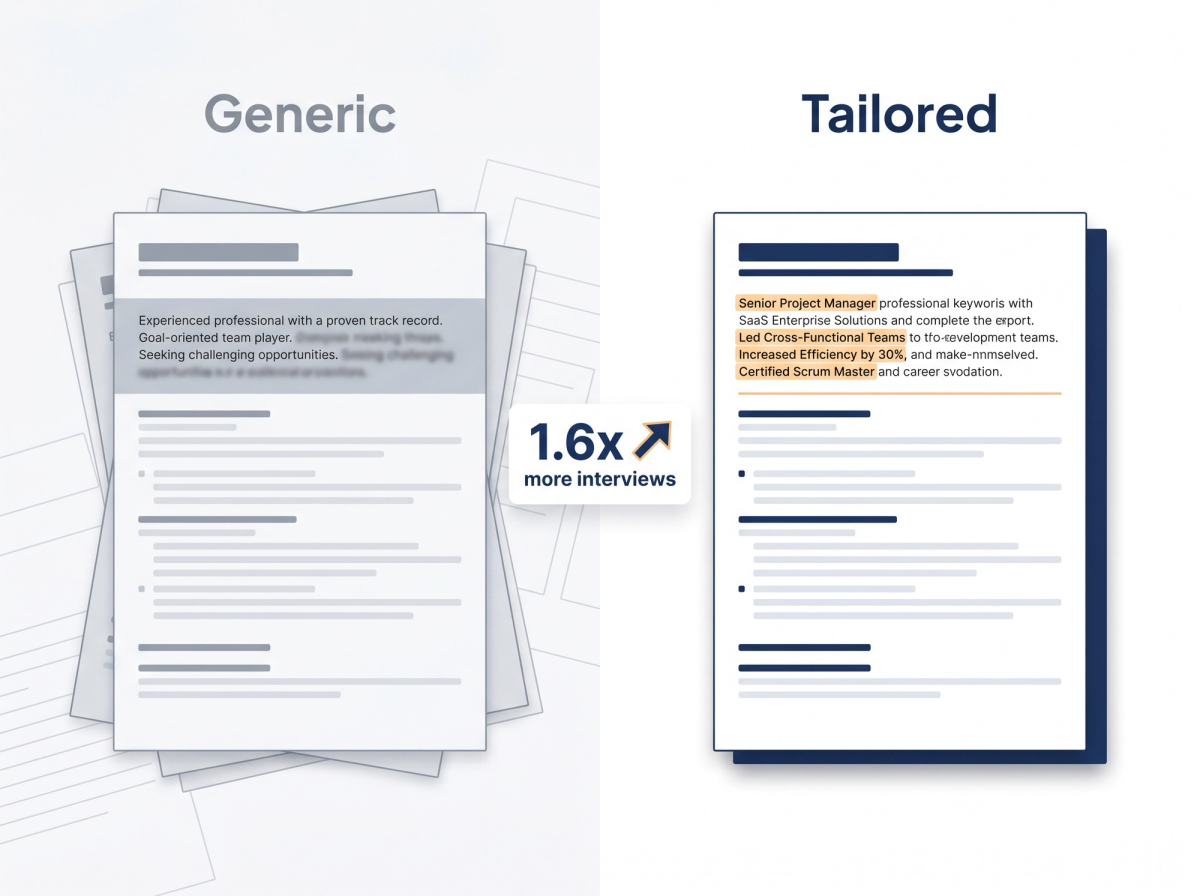
That's why generic resumes underperform. They describe your history but don't answer the employer's specific question. A 2025 job search trends report found that tailored resumes converted to interviews, offers, or hires at 5.8%, compared to 3.73% for non-customized versions. That's roughly 1.6x stronger performance, and it compounds across dozens of applications. Our full guide to tailoring your resume walks through this process step by step for any role or industry.
15-Minute Resume Tailoring Method
For every serious application:
1. Read the job description like a recruiter. Highlight the top responsibilities, repeated keywords, required tools, years of experience, and the business outcomes they're trying to drive. Don't just scan the "requirements" section. The real clues are often buried in the responsibilities.
2. Rewrite your summary for this specific role. Compare these two:
Weak: "Motivated professional with strong communication skills and a passion for growth."
Strong: "Customer success specialist with 3 years of experience onboarding B2B SaaS users, reducing support volume, and improving renewal workflows. Experienced with HubSpot, Intercom, onboarding documentation, and cross-functional customer handoffs."
The second one makes matching easy in seconds.
3. Move the most relevant bullets to the top. Recruiters scan, they don't read. Put the evidence that matters most for this role near the top of each position. Check a role-specific resume example to see how proven performers in your field structure their positions.
4. Mirror the language honestly. If the job says "customer onboarding," use "customer onboarding" if you've done it. Don't relabel it "client activation lifecycle enablement" because it sounds more sophisticated. That just makes matching harder for both ATS systems and humans.
If your experience is in a different industry, translate it into the target industry's terms. An operations manager moving from retail to SaaS should reframe "store inventory and shift scheduling" as "supply planning and workforce capacity," and "regional P&L" as "operational budget ownership." Same work, language the new field recognizes. You're not inventing experience. You're making transferable experience legible to people who don't speak your old industry's dialect.
5. Add any missing proof. If the role cares about reporting, add a reporting bullet. If it cares about SQL, mention SQL if you've used it. Be honest. Don't claim skills you don't have. But don't hide relevant skills either.
Our AI Resume Builder and Resume Scanner are built for exactly this step: generating ATS-friendly tailored resumes, checking keyword alignment against job descriptions, and reducing the chance that a qualified candidate gets filtered out for formatting or relevance issues.
Resume rules that still matter in 2026:
- Keep formatting clean and standard. Use our ATS-friendly resume templates as your baseline
- Use recognizable section titles: "Experience," "Education," "Skills"
- Avoid tiny fonts, heavy graphics, and unusual column layouts
- Add quantified results wherever possible
- Use the job description's exact language naturally (don't stuff keywords)
- Never misrepresent tools, dates, degrees, employers, or results
The goal isn't to trick any system. It's to remove friction so your qualifications are visible immediately.
Step 4: When to Apply for Jobs (The Fresh-First Rule)
Speed matters more than most job seekers realize.
Research shows that most job postings stay active for around 30 days, but "active" doesn't mean the role is still genuinely open. Many hiring teams review applications on a rolling basis and begin interviewing before the official deadline. A strong application sent on day 2 can outcompete a perfect application sent on day 20, simply because the shortlist was already forming.
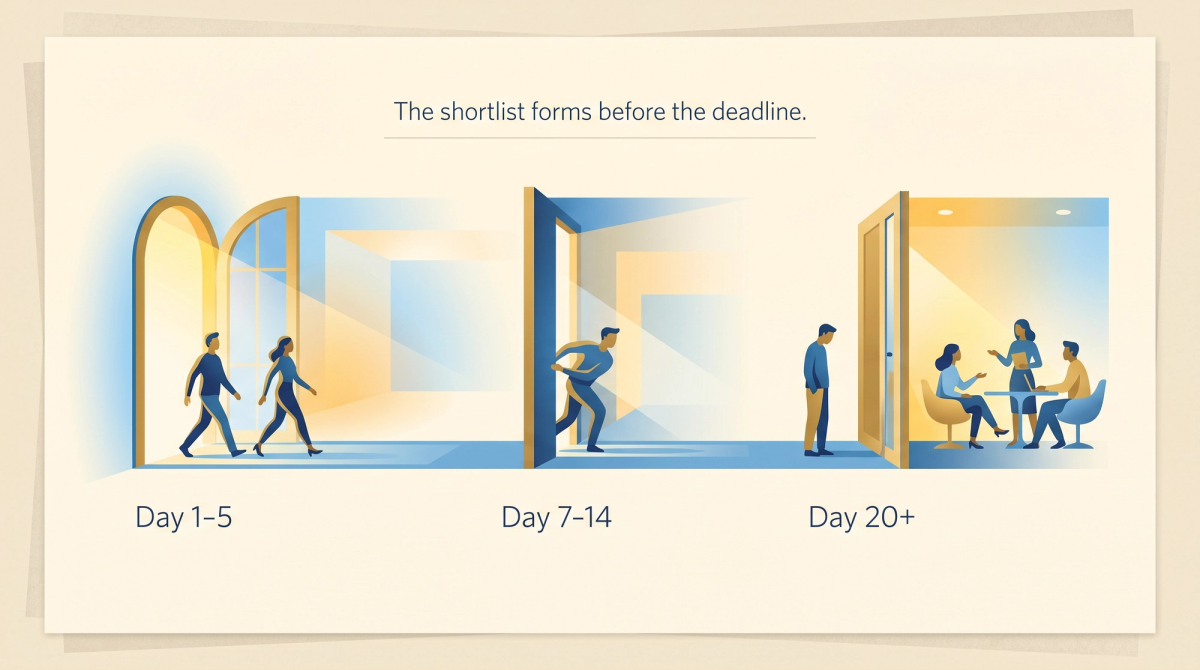
The Fresh-First Rule for Job Applications
Each morning, search in this order:
- Jobs posted in the last 24 hours
- Jobs posted in the last 3 days
- Jobs posted in the last 7 days
- Older jobs only if it's an unusually strong match or you have a contact inside
Set alerts for your exact target role titles. Don't rely on random scrolling. Research on the best day and time to submit applications gives this even more specificity.
How to Apply to More Jobs Without Losing Quality
There are two bad extremes in any job search:
- Applying to 4 jobs per month and wondering why nothing is moving
- Applying to 500 random jobs and wondering why everything is silent
Fast job seekers use quality volume: enough applications to create momentum, while still tailoring and tracking each one.
A practical 30-day target by situation:
| Your Situation | Target |
|---|---|
| Employed, casually looking | 15-30 high-quality applications |
| Actively searching, not urgent | 40-80 high-quality applications |
| Urgent search | 80-150+ applications, with automation and tight filters |
| Career change | Fewer applications, more networking and proof-building |
| Senior/executive search | Fewer applications, more targeted direct outreach |
For a deeper breakdown, see how many applications you actually need to generate consistent interview flow. The exact number depends on your field. The principle is the same: increase volume only after you improve targeting.
Don't depend on one job board. Research has found significant differences in response rates across platforms, and LinkedIn and ZipRecruiter didn't always lead despite their popularity. Use a mix of:
→ Company career pages (often fastest hiring cycles)
→ Niche job boards for your industry
→ Industry Slack groups and communities
→ Recruiter posts on LinkedIn
→ University or alumni boards
→ Google Jobs, Indeed, LinkedIn, ZipRecruiter
→ Government or public sector boards
→ Local employer pages
The best opportunity often isn't on the most popular platform.
Indeed tip box: how to move faster on the biggest board
Indeed gets the most traffic, which means the most competition, so squeeze every speed advantage out of it. Set your profile status to "Ready to work" so it surfaces in recruiter searches. Filter to "Posted: Last 24 hours" and use the "Easily apply" / "Apply now" filter for roles where you can submit in one or two steps, then reserve your tailored effort for the strongest matches. Turn on instant email or app alerts for your exact role titles instead of checking the feed once a day. And keep your Indeed resume current and searchable, since many recruiters source candidates directly rather than waiting for applications to come in.
Step 5: How to Use Auto Apply Without Hurting Your Search
Automated job applications can save you significant time. But there's a right way and a wrong way to use them.
| Auto Apply Done Wrong | Auto Apply Done Right | |
|---|---|---|
| Resume | Same resume sent to every job | Tailored resume per application |
| Fit | Applies to roles you'd never accept | Filters by role, location, salary, seniority |
| Tracking | Creates a chaotic pile you can't manage | Keeps your pipeline organized and moving |
| Materials | Submits outdated or generic content | Role-specific cover letters and resumes |
| Strategy | Ignores filters entirely | Applies only to roles in your target lanes |
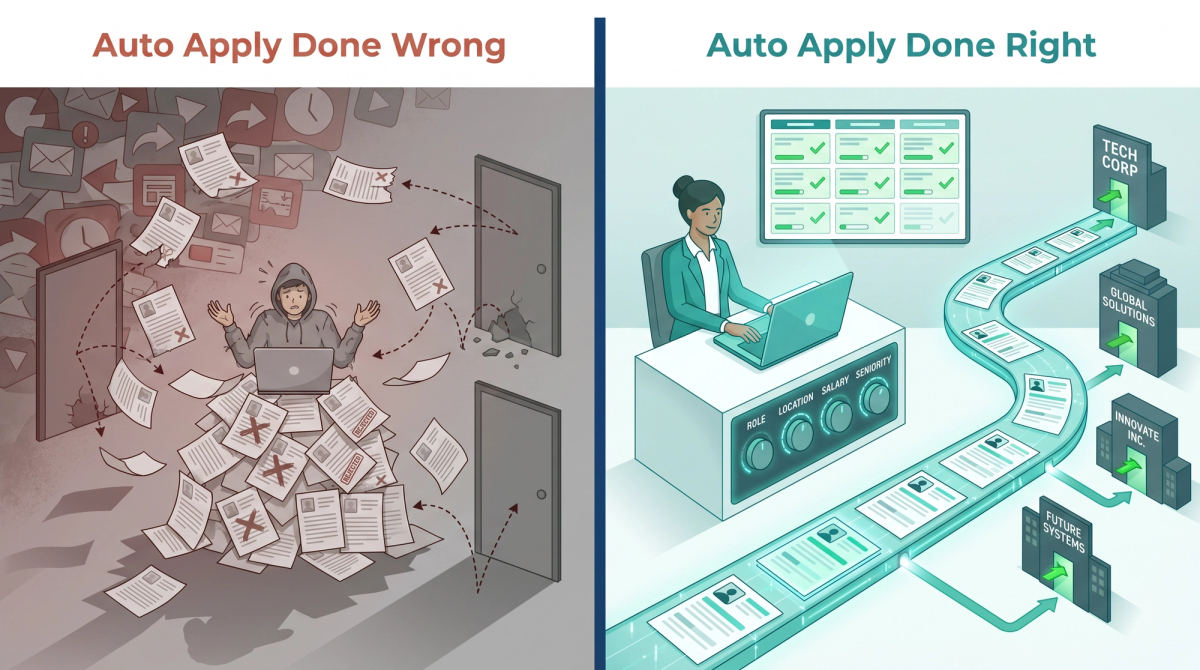
Our Auto Apply is designed around the second model. It scans over 1 million job postings, matches roles to your preferences, and applies with tailored resumes and cover letters. You're not sacrificing quality for volume. It also connects to the rest of the AIApply workflow: resume building, cover letters, ATS scanning, and interview prep all in one system.
The key principle: automation should handle repetitive tasks. You should still control the strategy.
When to automate and when to apply by hand. A simple rule keeps you from over-relying on either approach. Score the role first (the 0-10 framework from Step 1), then decide:
→ Roles scoring 7-8: let automation handle them. Good matches worth a tailored application, but not worth an hour of manual research each.
→ Roles scoring 9-10, or any job at a named target company: apply by hand. These deserve a personal touch, a custom note, and direct outreach to a human.
→ Roles scoring below 7: don't apply at all, manually or automatically. Volume on weak fits is wasted effort.
Use Auto Apply for the roles you've already decided are worth targeting. Set tight filters. Review your target list regularly. No tool can make a bad application strategy work. But the right tool can dramatically accelerate a good one.
The AIApply Auto Apply dashboard shows live application status, match scores, and the full jobs pipeline, so you always know exactly where each application stands:
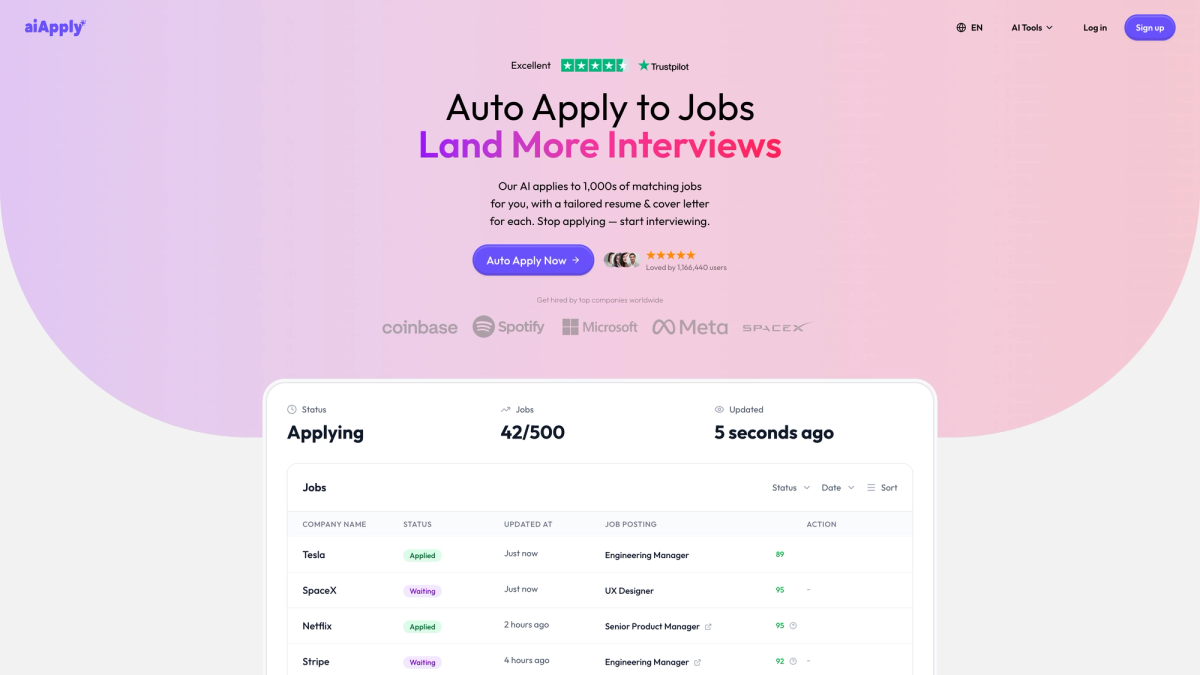
Step 6: How to Stand Out After Submitting an Application
Online applications go into portals. Portals are crowded. A follow-up message after applying can make you visible in ways the portal alone won't.
Not every message will get a reply. That's expected. You're not trying for a 100% reply rate. You're trying to create extra paths into the hiring process. ZipRecruiter reported in January 2026 that candidates who added a short note about their interest and fit were nearly twice as likely to start a conversation with an employer in its internal data. The intent and fit signal makes a difference.
Who to Contact After Submitting a Job Application
Look for these people on LinkedIn:
- Recruiter or talent acquisition partner for this team
- Hiring manager (job title usually in the posting)
- Department head or VP of the relevant function
- Future potential teammate already doing the role
- Alumni from your school who work there
- Mutual connection between you and the company
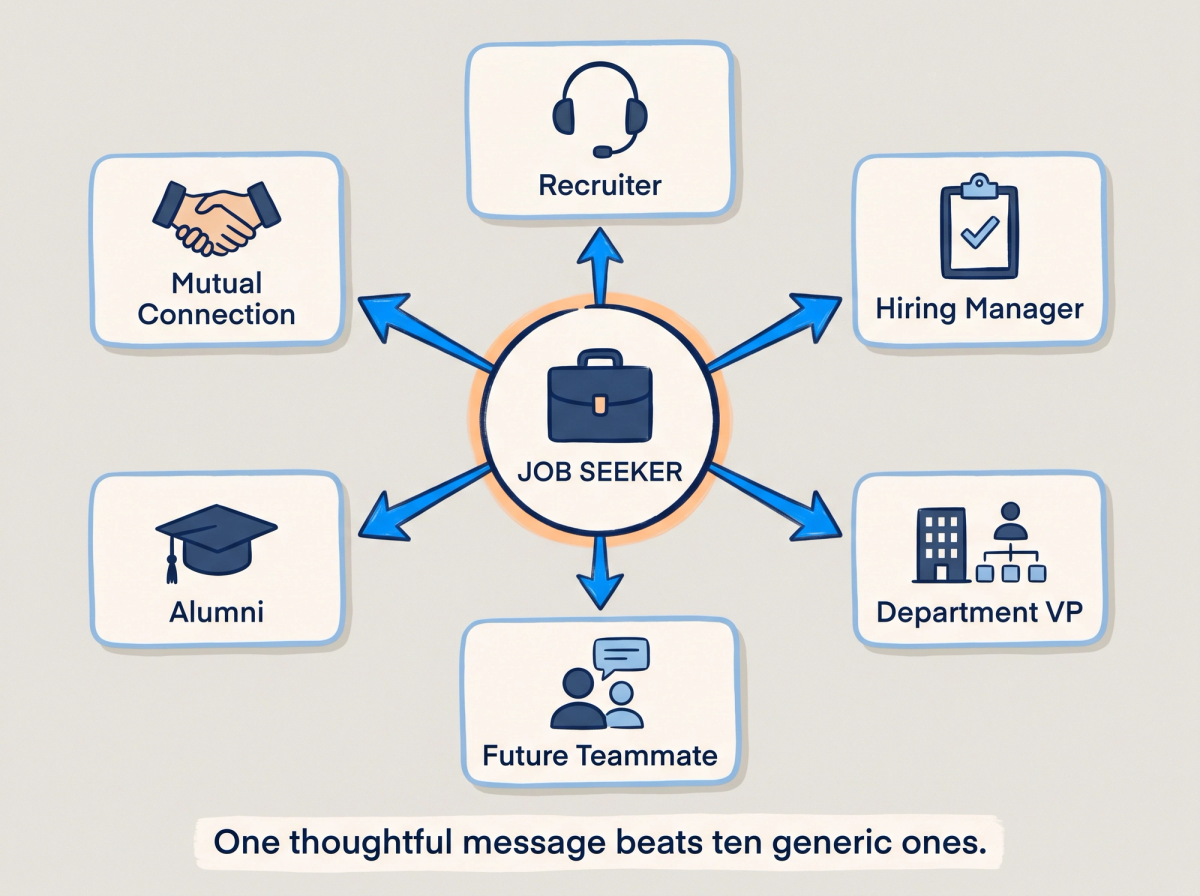
Prioritize genuine fit over mass messaging. One thoughtful message beats ten generic ones. Our guide on how to message a hiring manager effectively has templates for every seniority level and situation. You can also learn what it takes to attract recruiters to your profile so inbound opportunities start flowing alongside your outreach.
Follow-Up Message Template After Applying
Subject: Application for [Role]: [Your Name]
Hi [Name],
I just applied for the [Role] position. I was particularly interested because [one specific reason tied to the company, team, or role, not a generic statement].
My background matches the role in a few concrete ways: [proof point 1], [proof point 2], and [proof point 3].
Happy to share anything additional. Thanks for considering my application.
Best, [Name]
Keep it under 100 words. Nobody wants your full story in a LinkedIn message.
Job Referral Request Message Template
Hi [Name],
I saw [Company] is hiring for [Role] and I'm genuinely interested. [Specific reason here].
My background in [relevant skill/experience] seems well-aligned with the role, particularly [one concrete proof point].
Would you be open to pointing me in the right direction, or letting me know if referrals are accepted? No pressure at all if not.
Thanks, [Name]
The best referral requests are easy to say yes to. They ask for direction, not a favor.
Step 7: How to Follow Up on a Job Application
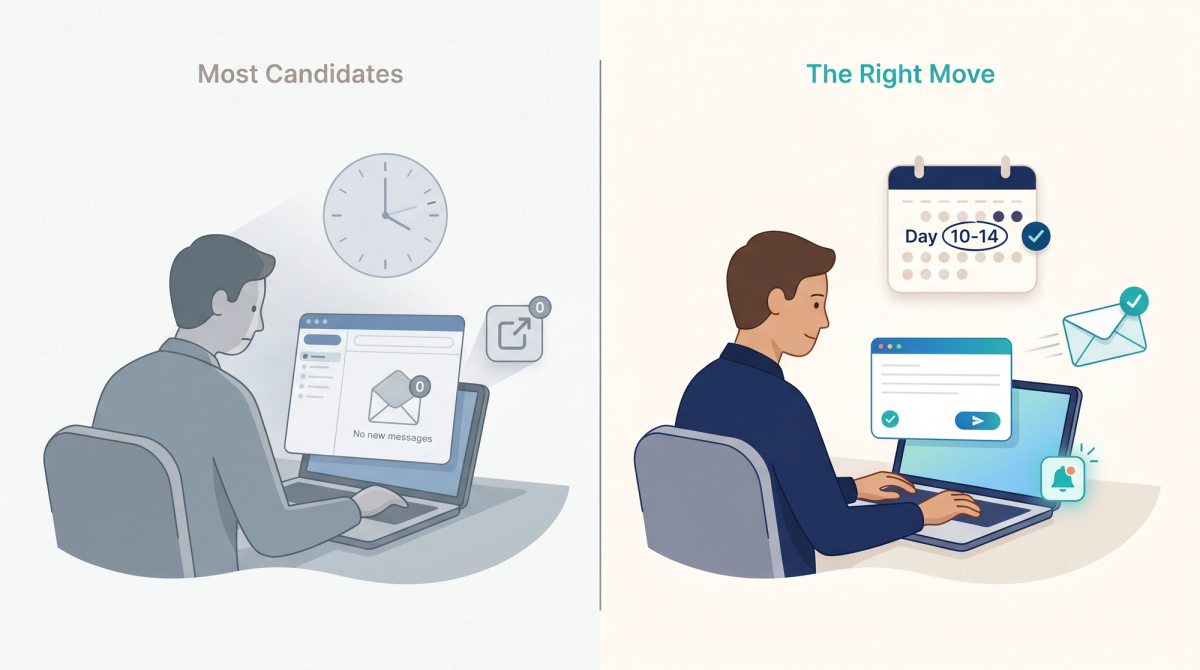
Most job seekers either never follow up or follow up badly. The right follow-up is calm, brief, and adds something specific.
Research suggests that many candidates hear back within one to two weeks and following up after that window if no timeline was given is appropriate professional practice.
When to Follow Up at Each Stage
| Moment | What to Do |
|---|---|
| Day 0 | Apply. Send a short human message to a real person if possible |
| Day 5-7 | Follow up if you contacted someone directly and got no reply |
| Day 10-14 | Send one polite application follow-up |
| Within 24 hours of any interview | Send a thank-you note |
| After the promised decision date passes | Follow up 1-2 business days later |
| After two ignored follow-ups | Move on mentally, keep the pipeline open |
Never pause your entire search for one company. Until you have a signed offer, keep applying. For the full collection of follow-up email templates for every stage, from application through final round, use our complete resource. If you'd rather not write each message from scratch, our free follow-up email generator drafts a polished, role-specific note in seconds that you can personalize before sending.
Job Application Follow-Up Email Template
Subject: Following up on [Role] Application
Hi [Name],
I applied for the [Role] position on [date] and wanted to follow up. I'm still very interested, especially because [one specific reason tied to the company or team].
My experience with [relevant proof point] seems closely aligned with what the team is looking for.
Happy to provide anything else that might be helpful.
Best, [Name]
Thank-You Email Template After an Interview
Hi [Name],
Thank you for speaking with me today about the [Role] position. I really enjoyed learning more about [specific topic from your conversation, not a generic phrase].
The conversation made me even more interested in the role, particularly the opportunity to help with [specific team goal or challenge]. My experience with [relevant proof point] seems well-matched with that.
Thanks again, [Name]
For a deeper dive, read our complete guide to post-interview thank-you notes with templates for every format and relationship type.
Step 8: How to Prepare for Job Interviews in Advance
Most candidates wait until they receive an interview request to start preparing.
That's too late.
When a recruiter asks, "Are you free tomorrow?" you need to already be ready. Greenhouse's May 2026 research found that 63% of job seekers had already been interviewed by AI, up 13 percentage points from six months earlier. And 38% had walked away from a process because of a poor AI interview experience. Whether your next interview is human, AI-assisted, live, recorded, or panel-based, preparation is now part of the speed equation.
How to Build Your Interview Story Bank
Prepare structured answers for these topics before you get any interview invite:
- Tell me about yourself
- Why this role? Why this company?
- Biggest achievement
- Difficult stakeholder or conflict
- A failure and what you learned
- A tight deadline you navigated
- How you used data to make a decision
- How you improved a process
- A customer or client problem you solved
- Your salary expectations
- Why are you leaving your current role?
- Career gaps or changes
- Why should we hire you?
Start with behavioral interview questions with model answers. These overlap with almost every common interview format and give you the structure to handle surprises.
Use this structure for each story:
Situation → Task → Action → Result → What I learned
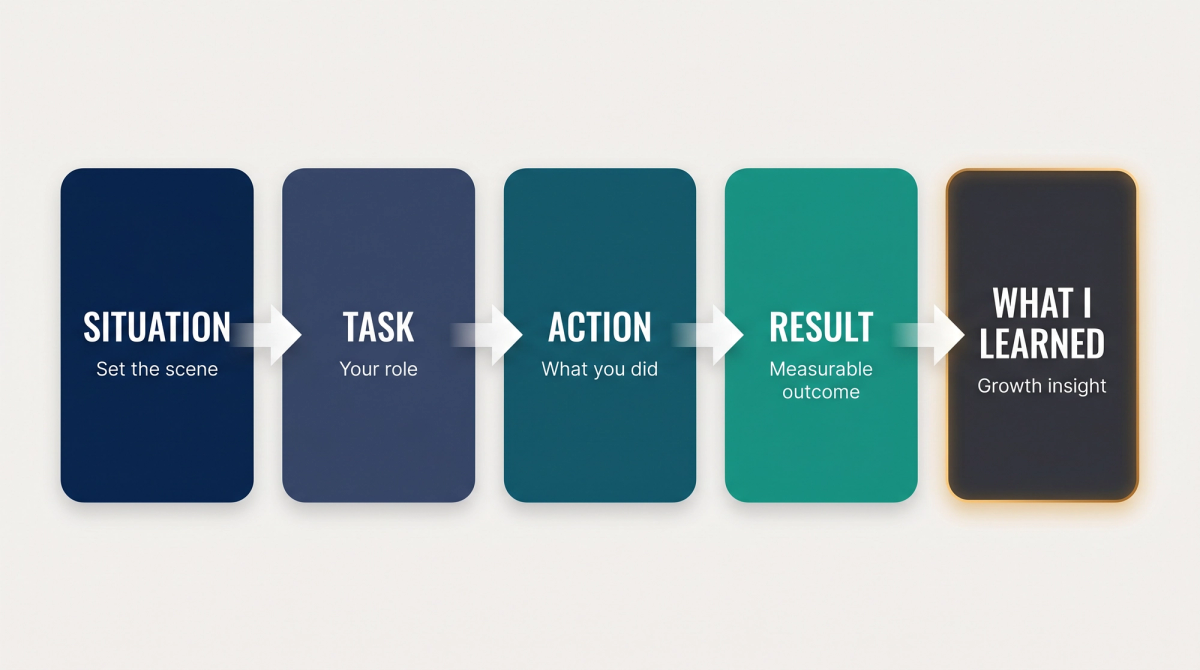
Don't memorize scripts. Memorize the structure. You want to sound like you're telling a story, not reciting one. If you get stuck shaping a messy experience into a clean answer, our free STAR method generator turns a few details about what happened into a structured response you can practice from.
24-Hour Interview Prep Checklist
When an interview is confirmed, do this immediately:
- Re-read the job description and highlight any gaps in your prep
- Write out the 5 most likely questions and your story for each
- Research the company's product, recent news, competitors, and culture. Our guide on how to research a company before an interview covers exactly what to look for
- Prepare 3 smart questions that show you've done the work
- Prepare your salary range with a clear rationale
- Review your resume for anything they're likely to probe
- Test your video, audio, lighting, and internet connection
- Reply with your availability quickly. Recruiters fill schedules fast
Our AI Mock Interview tool lets you practice against a specific role and get immediate feedback on your answers. You can also run free reps in our interview simulator to get comfortable answering out loud before anything real is on the line. And Interview Buddy is designed for real-time support during live video interviews, providing on-screen coaching you can see while the interviewer can't.
How to Prepare for AI Video Interviews
With 63% of job seekers now facing an AI interviewer at some point, the recorded or async format deserves its own prep. It rewards different habits than a live human conversation, and most people get tripped up by the same few things.
Here's what actually moves the needle:
→ Look at the camera, not the screen. On a recorded interview there's no face to make eye contact with, so your instinct is to watch yourself or read the question. Resist it. Talk to the little camera lens. That's what reads as eye contact on the other end.
→ Don't lean on notes. It's tempting to tape a script next to your webcam, but the AI (and any human who reviews the recording) can see your eyes tracking across the page. Know your story-bank structure cold instead, so you're recalling, not reading.
→ Pace yourself for the format. Async questions usually give you a fixed window and sometimes only one take. Pause for a beat before you start, answer in a clear beginning-middle-end, and don't rush to fill silence. A steady 60-to-90-second answer beats a frantic two-minute ramble.
→ Mind the basics the software scores. Even lighting on your face, a quiet room, a plain background, and a stable connection all matter more than usual because the model is parsing your audio and video directly. Frame yourself from the chest up, centered.
→ Practice on camera first. Record yourself answering three common questions and play it back once. You'll catch the filler words, the looking-away, and the rushing far faster than any amount of mental rehearsal.
The goal with any of this isn't to game the algorithm or fake competence. It's to come across as clearly on a recording, or across a table, as you actually are. So you stop freezing when the question lands.
Step 9: How to Make Yourself Easy to Hire
Companies hire faster when there's less uncertainty on their end. So reduce their uncertainty.
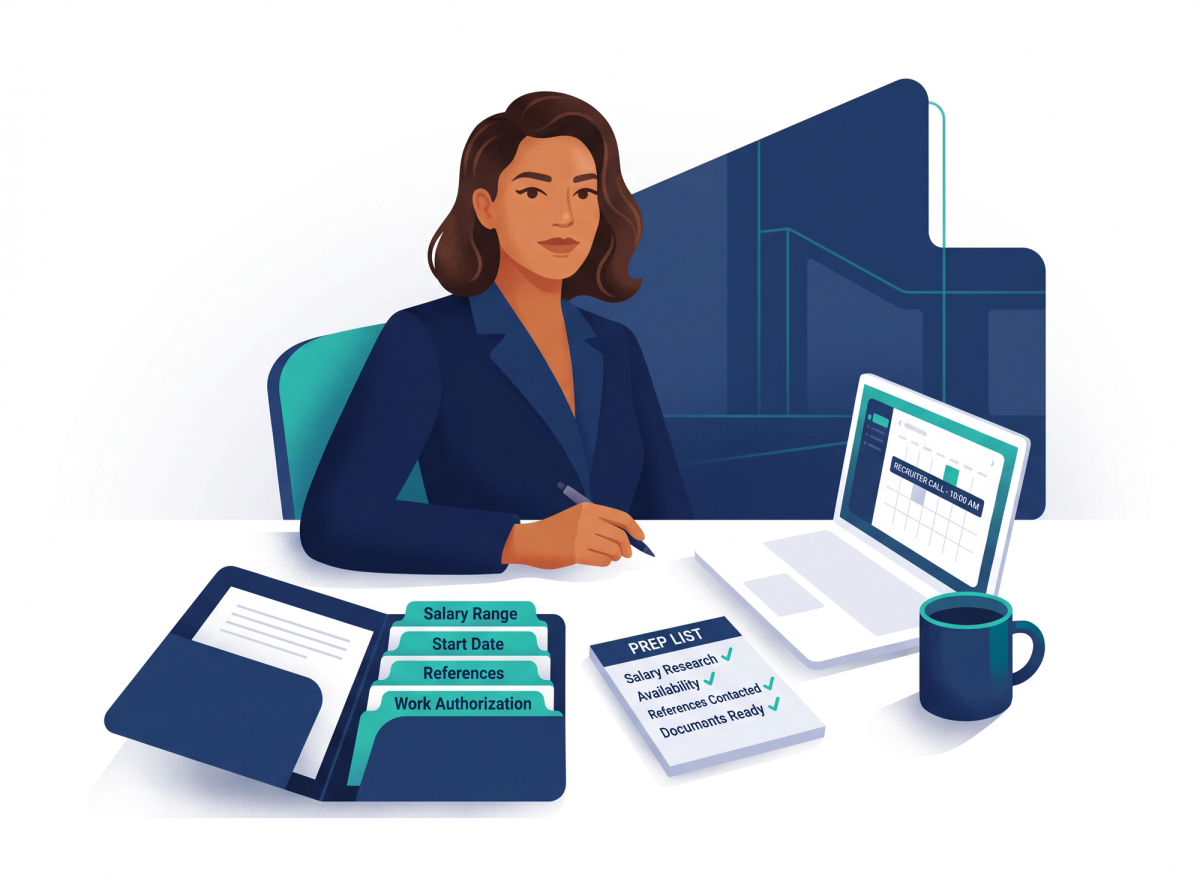
Be clear on these before your first call with any recruiter:
- Your target role and why it makes sense for you
- Your location and remote/hybrid preference
- Your salary range (and your floor)
- Your notice period or start date availability
- Work authorization
- Any portfolio or work samples you can share
- 2-3 references on standby
- Your reason for leaving your current role
- Why you're interested in this company specifically
If you can't answer basic logistics questions, you slow the process down. And slower processes lose candidates.
How to Send Proof Before They Ask for It
Depending on the role, a short proof packet can move you from "maybe" to "worth moving forward":
→ Portfolio or design samples. Our guide on how to build a professional portfolio covers the formats that move fastest in hiring
→ Writing samples or case studies
→ GitHub repos or live demos
→ Sales numbers, campaign results, or dashboard screenshots
→ A one-page 30/60/90 plan for what you'd accomplish in the role
→ Certifications relevant to the role
→ References (pre-formatted with context)
Browse cover letter examples that demonstrate proof effectively to see how candidates in competitive roles frame their strongest evidence up front.
A targeted proof packet signals confidence and reduces the hiring team's guesswork. Many candidates wait to be asked. The ones who send first often move first.
Why You Should Take the Earliest Interview Slot
If you can interview tomorrow, do it. Hiring teams often build momentum around the first strong candidates they meet. Being early in the interview sequence gives you a genuine advantage: the comparison point is established, not diluted by 15 subsequent candidates. You don't need to be reckless about scheduling, but don't make it hard either.
How to Get a Job Fast With No Experience
"No experience" almost never means no evidence. It usually means no formal job title in that exact field yet. Hiring managers aren't really asking "have you held this job before?" They're asking "can you do the work, and will you show up?" You can answer both with proof that has nothing to do with a previous paycheck.
The whole game here is substituting demonstrated ability for job history. That proof comes from a handful of places.
Build a Portfolio of Proof (Not a Resume of Jobs)
A blank work history feels like a wall. It isn't. It's space you fill with things you've actually made and done. Strong substitutes for paid experience, roughly in order of how much weight they carry:
→ Self-directed projects. Build the thing the job does. Want a data analyst role? Pull a public dataset, run an analysis, and write up what you found. Want marketing? Run a small campaign for a local business or your own page and report the numbers. A finished project beats a line on a resume because the hiring manager can see it.
→ Freelance or gig work. Even one or two small paid jobs on a freelance platform proves someone trusted you with real work and you delivered. Screenshots of the work and a one-line client result are enough.
→ Volunteer and community work. Ran the social media for a nonprofit? Coordinated volunteers for an event? Kept the books for a club? That's project management, marketing, and bookkeeping. Frame it by what you did and what changed, not by whether you were paid.
→ Coursework and capstone projects. A class project that produced something real (an app, a research paper, a business plan, a design) counts. Lead with the outcome and the skills, not the course code.
→ Internships and apprenticeships. Even short or unpaid ones give you the vocabulary and a reference. If you don't have one yet, micro-internships and short contract gigs are faster to land than full roles and convert into proof quickly.
→ Leadership and organizing roles. Captain of a team, president of a club, organizer of an event. These show initiative and responsibility, which is half of what entry-level hiring is screening for.
Use Certifications to Close the Credibility Gap
When you have no title, a recognized certification is a fast, cheap signal that you've learned the fundamentals. It won't replace experience, but it tells a recruiter you're serious and have a baseline. A few that move quickly and don't take months:
| If you're targeting | A fast credential that signals readiness |
|---|---|
| Tech / IT support | Google IT Support or CompTIA A+ |
| Data / analytics | Google Data Analytics certificate |
| Digital marketing | Google Ads or HubSpot certifications |
| Project coordination | Google Project Management certificate |
| Bookkeeping / admin | QuickBooks certification |
| Customer support | A product or CRM certification (e.g. a help-desk platform) |
Pick one that maps directly to your target role and finish it. A half-done certification proves nothing. A completed one, mentioned with a specific takeaway, proves follow-through.
Lead With Transferable Skills, Not Apologies
The biggest mistake first-timers make is opening with what they lack. Never write "Although I have no direct experience..." Open with the proof.
Weak: "Recent graduate with no professional experience seeking an entry-level marketing position to gain skills."
Strong: "Marketing-focused graduate who grew a student club's Instagram from 200 to 3,400 followers in one semester and ran two campus events that filled to capacity. Comfortable with Canva, Meta Ads Manager, and email tools."
Same person. The second one is hireable today. Pull every skill you can defend from school, volunteering, side projects, and life, then frame each one the way you'd frame a job. Our guide on what transferable skills are and how to frame them walks through this in detail, and the AI Resume Builder is built to turn projects and volunteer work into clean, recruiter-ready bullets even when you've never held the exact title.
Where to Apply When You're Starting Out
Aim your energy at roles built for people early in their careers, and use the same fresh-first and outreach tactics from earlier in this guide:
- Roles labeled "entry-level," "junior," "associate," "trainee," or "apprentice"
- Companies with structured graduate or early-career programs
- Smaller companies and startups, which often value drive over a perfect resume
- Bridge roles (covered above) that get you in the door, then a track record
- Temp and contract work that converts to permanent once you've proven yourself
One thoughtful message to a hiring manager explaining why you want this role, attached to one piece of real proof, will outperform fifty cold applications that lead with "no experience." Evidence beats apology every time.
The 7-Day Job Search Sprint: Get Momentum Fast
This is the fastest way to go from nothing to momentum in one week.
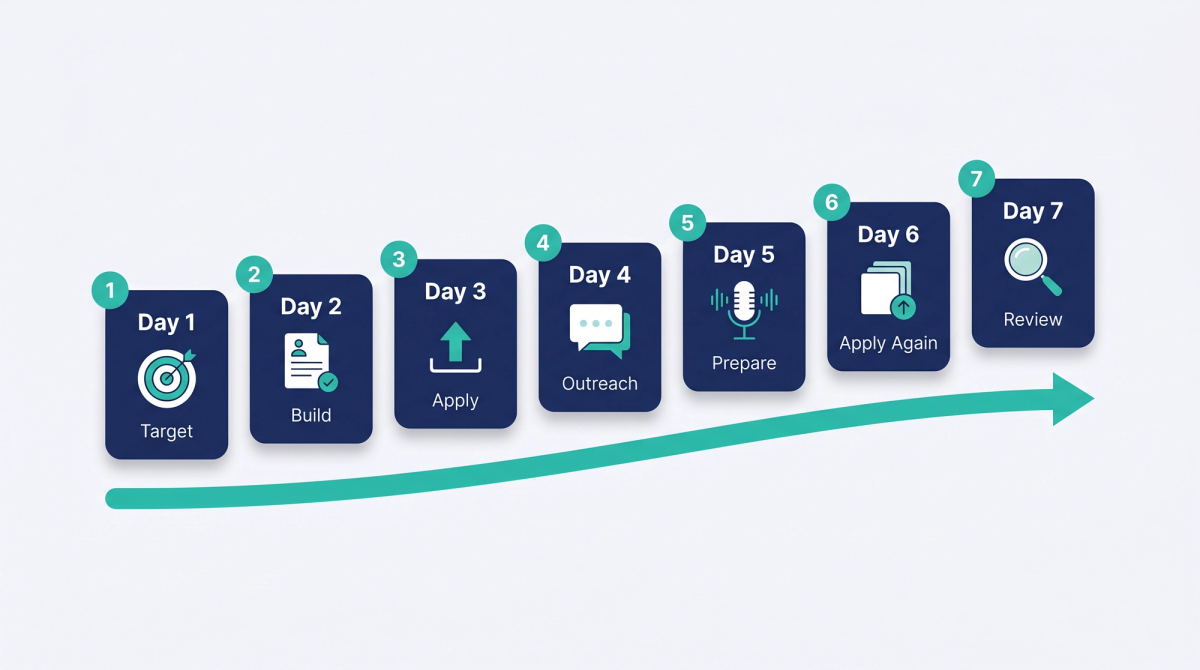
Day 1: Pick Your Target Role and Industries
Make six decisions today:
① Pick 1 primary role you're fully qualified for. Review the career path guide for your target role to understand what progression typically looks like before you commit.
② Pick 1 adjacent role that uses the same skills differently.
③ Pick 1 bridge role for fast income or access.
④ Choose 3 industries you'll focus on.
⑤ Choose 3 job boards you'll use daily.
⑥ List 20 target companies.
Then write your one-sentence positioning statement:
"I help [type of company/team] solve [problem] using [my skills/experience]."
Example: "I help B2B SaaS companies onboard customers faster and reduce early churn using customer success workflows, product education, and support data."
This same sentence becomes your verbal intro on recruiter calls and your LinkedIn headline. If you're struggling to make it land, our free elevator pitch generator can shape a tight 30-second version from your background and target role.
Day 2: Build Your Resume and Cover Letter System
Create or update:
- Your base resume
- One role-specific version
- Your proof bank (10 achievement stories)
- Your skills list
- A cover letter template
- Your LinkedIn profile
- Set up a job search tracker so Day 7's review has real data to work with. Our free job search tracker tool keeps every application, status, and follow-up date in one place
Run your resume against 3 job descriptions and identify obvious gaps. Fix them.
Day 3: Apply to Fresh Jobs
Apply to 8-12 strong-fit roles. For each one:
→ Tailor the resume and cover letter or note
→ Record the application in your tracker
→ Find one human contact at the company to reach out to
Day 4: Send Your Outreach Messages
Send these messages today:
5 messages to hiring managers. Reference the specific role and one thing you know about the team.
5 messages to recruiters. Keep it short: who you are, what role you're targeting, one proof point.
5 referral or alumni outreach messages. Ask for direction, not a favor.
3 warm reconnections with people you already know.
Don't ask people to "get you a job." Ask for direction, context, or whether referrals are accepted. The ask should be easy to say yes to.
Day 5: Prepare Your Interview Story Bank
Before any interviews arrive:
- Write out 10 structured interview stories
- Prepare 5 company-specific answers for your top target companies
- Practice your salary answer
- Run through "Tell me about yourself," "Why this role?" and "Why should we hire you?"
- Run a mock interview (our AI Mock Interview can run a practice session in 15-30 minutes)
Day 6: Submit Your Second Application Batch
Apply to another 8-12 strong-fit roles. Use what you learned from the first batch: which job descriptions feel most aligned, which cover letter angle is landing better, which boards are showing the freshest postings.
Day 7: Review and Adjust
Look at your tracker and ask:
- Which roles look like the strongest matches?
- Which job boards are producing better-quality listings?
- Did any outreach messages get replies? What did those messages have in common?
- What keywords keep appearing in the postings you're most excited about?
- What skill gaps are obvious from the job descriptions you're seeing?
- What should you stop applying to?
Then run the cycle again.
30-Day Job Search Plan: Week-by-Week Guide
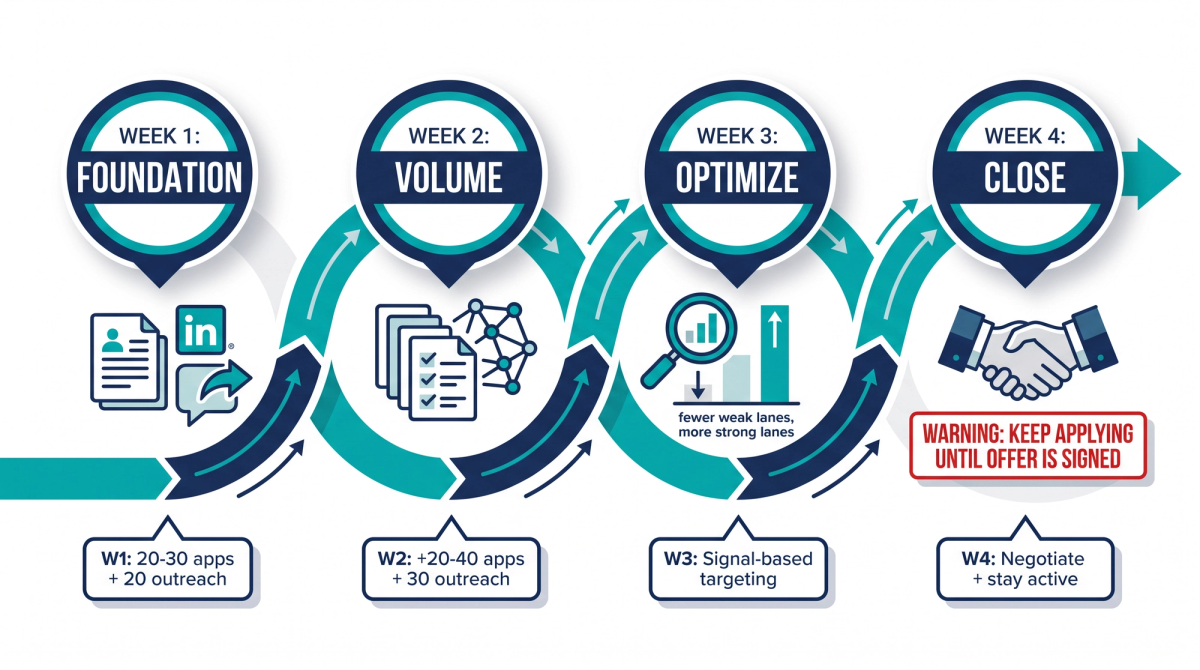
Week 1: Build Your Job Search Foundation
Focus: Role clarity, resume system, proof bank, tracker setup, job alerts, interview prep baseline.
Output:
- 20-30 applications submitted
- 20 outreach messages sent
- 1 mock interview run
- LinkedIn profile polished and searchable
Week 2: Increase Quality Volume
Focus: Fresh postings, tailored applications, referral outreach, recruiter conversations, improving weak resume bullets based on week 1 feedback.
Output:
- 20-40 additional applications
- 30 outreach messages
- 2-3 mock interviews
- 5 conversations with people at target companies
Week 3: Optimize Based on Signals
Focus: Response rate analysis, resume performance, role fit adjustments, salary alignment, interview conversion improvement.
Output:
- More applications in your strongest lane
- Fewer applications in lanes showing no traction
- Better follow-ups using specific language from job descriptions
- Stronger, more specific interview answers
Week 4: Close Open Loops and Negotiate Offers
Focus: Final interview rounds, negotiation preparation, reference check readiness, backup pipeline management.
Output:
- Active interviews in progress
- Consistent follow-up cadence
- Offer readiness (salary research complete, decision criteria clear)
- Continued applications until an offer is signed
The last point is critical. Many candidates stop applying once they enter a final round. Don't. Until there's a written, signed offer, the pipeline stays open.
How to Find a Job Fast When You Need Income Now
If you need income quickly, the strategy shifts without abandoning quality.
Which Roles Have the Fastest Hiring Cycles?
These types of roles often move significantly faster than corporate multi-round processes:
- Temporary and contract roles. Learn how contract and temp roles work before you commit to one so you know what you're signing up for
- Part-time positions
- Shift-based work
- Local businesses and small employers
- Customer support and operations
- Retail and hospitality
- Healthcare support
- Admin and executive support. Explore admin and executive support career paths for a clear picture of what roles exist in this space
- Delivery and logistics
- Tutoring and education support
- Seasonal work
- Staffing agency placements
This doesn't mean giving up on your longer-term career goal. It means separating the immediate income problem from the career problem. Solve survival first. Keep building toward the better role on the side.
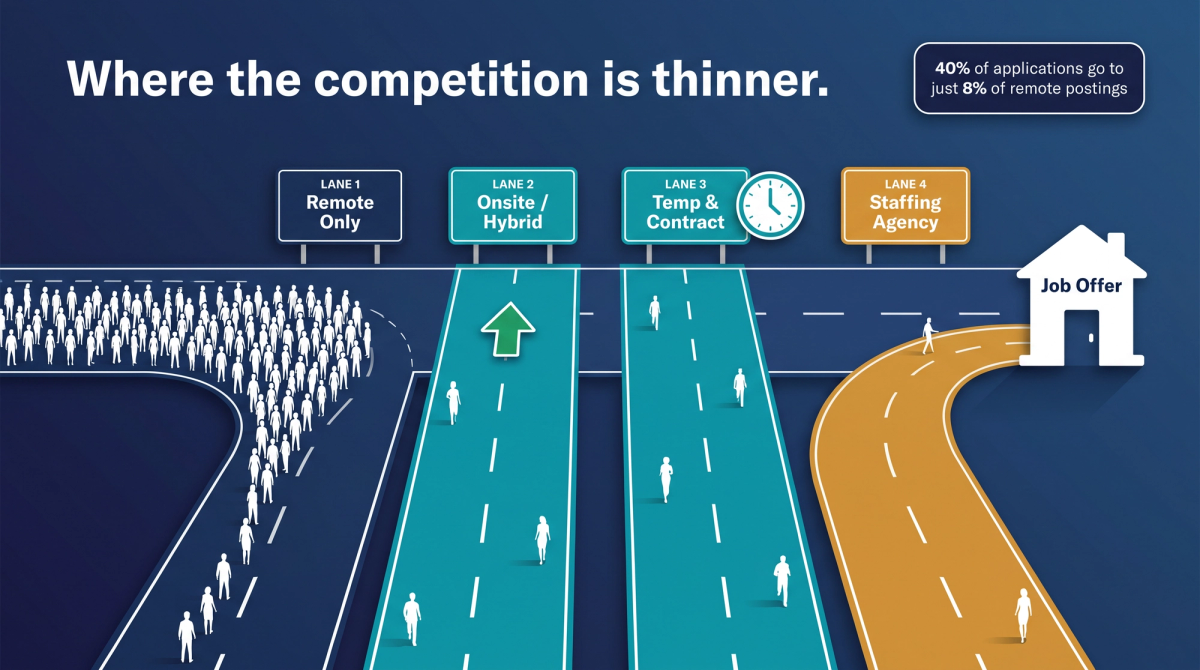
Why Onsite or Hybrid Roles Get You Hired Faster
Remote roles attract enormous applicant pools. Sometimes 40% of all applications go to 8% of remote postings, according to recent market data. If you can work onsite or hybrid, you may face materially less competition. In some markets, this is one of the fastest ways to improve your response rate.
How to Get a Remote Job Fast (When Remote Is Non-Negotiable)
If onsite isn't an option, you're swimming in a more crowded pool, so you have to differentiate harder. The remote applications that move fast do three things the rest don't:
→ Apply where remote is the default, not an exception. Remote-first job boards and companies that were built remote get fewer "I'll relocate later" applicants and screen faster than a big company posting one remote req. Filter aggressively and apply the fresh-first rule even more strictly, since remote postings fill fast.
→ Prove you can work async. Remote managers are screening for people who communicate clearly in writing and don't need supervision. Show it: a tight, well-written application and follow-up message is the work sample. A messy email signals a messy remote employee.
→ Differentiate with a visible portfolio. When the hiring manager can't meet you in person, your work has to vouch for you. A link to real output (a repo, a writing sample, a dashboard, a case study) does more for a remote application than another bullet point. This is where the proof-packet habit from Step 9 pays off most.
Everything else in this guide still applies. Remote just raises the bar on clarity and proof, because that's all a remote employer has to go on.
How Staffing Agencies Can Speed Up Your Search
For time-sensitive situations, contact:
- Local staffing agencies (many specialize by industry)
- Industry-specific or technical recruiters
- Temp-to-perm agencies (companies use these to vet candidates before full-time offers)
- University career offices (even for alumni)
- Workforce development centers
- Local employer groups and chambers of commerce
When reaching out, be specific: send a clean resume, your target role list, your start date availability, and your salary range. Don't make them guess anything.
7 Mistakes That Slow Down Every Job Search
Mistake 1: Applying to Everything
If your application doesn't make sense for the role, more volume won't save it. A poor-fit application is noise. Fifty poor-fit applications are fifty times the noise.
Mistake 2: Using One Generic Resume
A generic resume forces the recruiter to connect the dots between your history and their role. Recruiters don't have time to do that. And increasingly, neither do the ATS systems screening before them. Our guide to resume optimization for ATS systems breaks down exactly how to close that gap before your application goes in, and our free resume ATS checker shows you in seconds where a specific job description and your resume don't line up. Tailoring is the work.
Mistake 3: Waiting Too Long to Apply
Fresh postings matter. The hiring window is often narrower than it looks. If you're consistently applying to one-week-old or two-week-old postings, you're likely arriving to a party that's already over.
Mistake 4: Only Applying Online
Online applications are the start, not the whole strategy. The human touchpoints: messages to recruiters, outreach to hiring managers, referral requests, reconnections. These are what create paths around the crowded portals.
Mistake 5: Not Tracking Anything
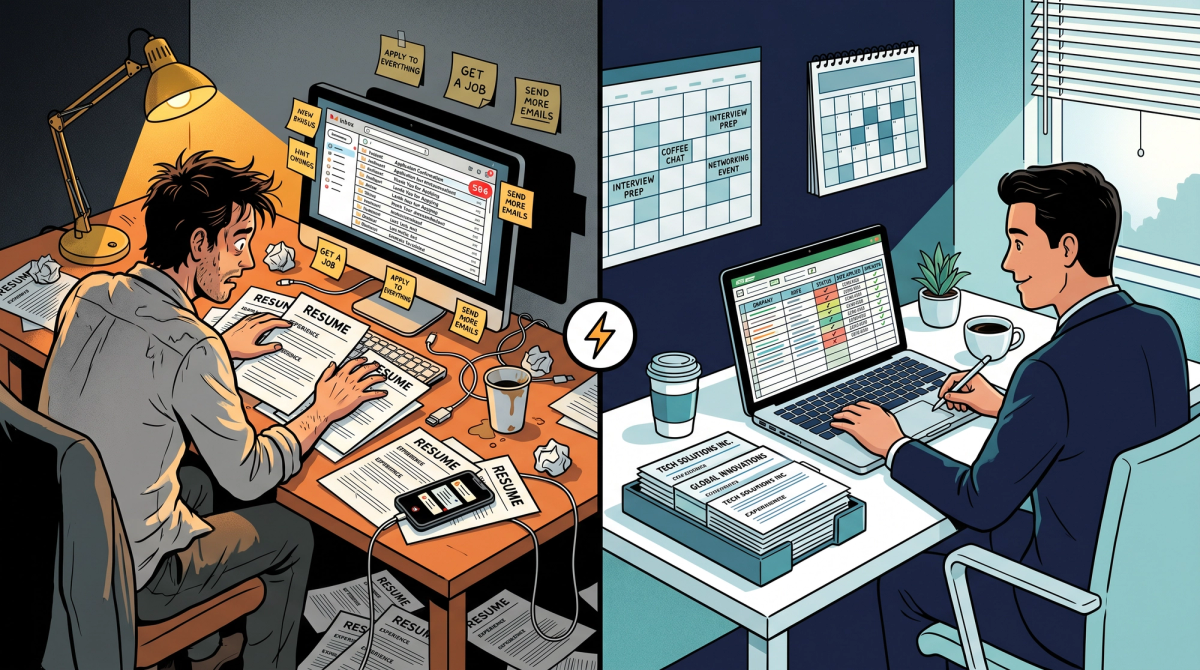
Without a tracker, you can't tell whether the problem is your resume, your role targeting, your timing, or your interview performance. And if you can't diagnose it, you can't fix it. A simple spreadsheet with company, role, date applied, status, and notes is all you need. Or use a dedicated job search tracker with pre-built templates.
Mistake 6: Preparing for Interviews Too Late
The first interview can arrive with less than 24 hours' notice. If you're not already prepared when the invite lands, you're preparing under pressure. And that rarely produces your best work.
Mistake 7: Letting AI Write Everything Without Reviewing It
AI tools can help you draft faster. But vague AI language makes you sound like everyone else.
Weak: "I am passionate about leveraging cross-functional collaboration to drive impactful outcomes."
Strong: "I helped reduce onboarding delays by creating a customer handoff checklist between sales and support that cut the average time from contract to first login by 6 days."
Cover letters fall into the same trap. AI loves to open with a polished sentence that says nothing:
Weak: "I was thrilled to come across this opportunity and believe my dynamic skill set aligns perfectly with your company's mission."
Strong: "I noticed your support team doubled last year, which is usually when response times slip. At my last role I built the macro library that held our first-response time under 4 hours through a similar scale-up."
The fix is a simple habit: read every AI-generated sentence and ask "what specific proof backs this?" If the answer is nothing, cut it or replace it with a real number, a real project, or a real reason tied to this company. Specific beats fancy. Always.
How AIApply Helps You Get Hired Faster
Getting hired fast isn't one task. It's a sequence:
① Find the right jobs
② Build a tailored resume
③ Write a role-specific cover letter
④ Submit applications strategically
⑤ Track your pipeline
⑥ Prepare for interviews
⑦ Follow up and close
Most job seekers lose speed because these steps are scattered across 10 different tools and tabs. We built AIApply to connect the whole workflow.
Here's what the platform looks like in practice. A single dashboard where resume builder, auto apply, cover letter generator, mock interview, and interview coaching all live together:
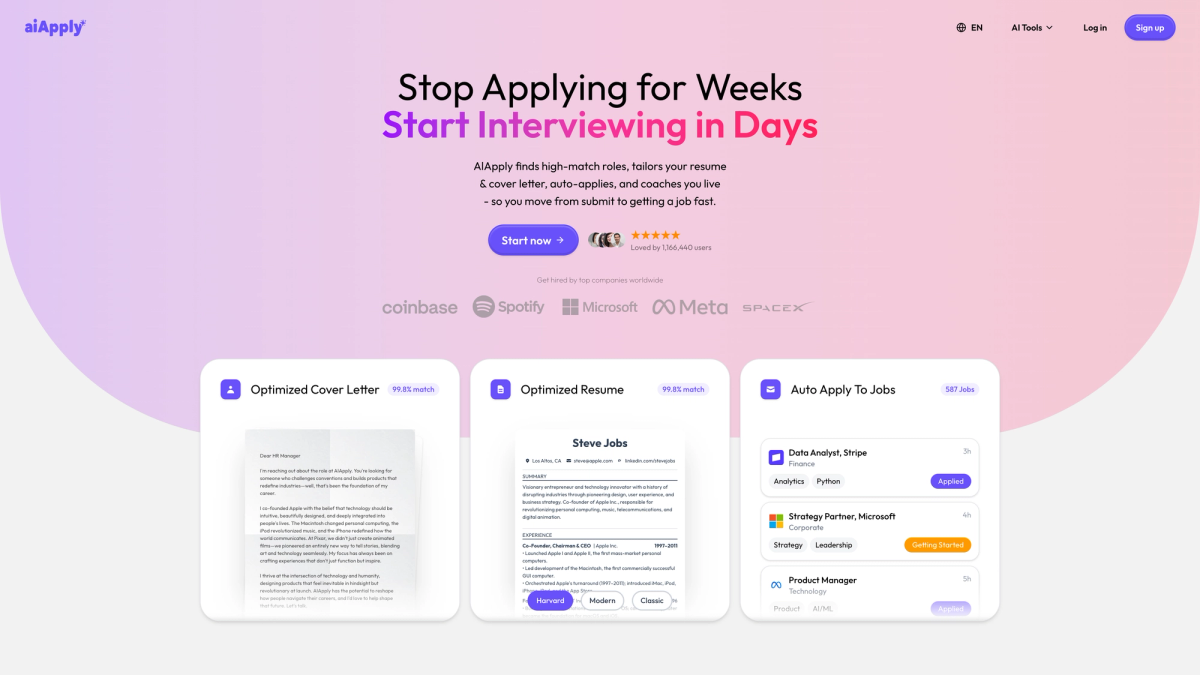
Build your resume foundation. The AI Resume Builder generates ATS-friendly resumes tailored to specific job descriptions in minutes. Harvard-inspired templates, keyword optimization, and real-time editing so you can fine-tune anything the AI generates.
Scan before you send. The Resume Scanner checks your resume against 50+ ATS systems and gives you specific keyword recommendations. Unlimited free scans. Fix the gaps before your application goes in.
Write a cover letter that sounds like you. The AI Cover Letter Generator drafts a role-specific letter in seconds, built around your experience and the job description. The strongest letters still include a real reason for the company, a real proof point, and a real connection to the job. You review and personalize, the AI handles the drafting.
Scale your applications. Auto Apply scans over 1 million job postings and submits up to 500 tailored applications per month on your behalf. Each application is customized to the role. Credits never expire, so you use them when you need them.
Practice until the interview is easy. The AI Mock Interview runs a complete practice session in 15-30 minutes. Paste a job description, answer tailored questions, get instant feedback. It works for any role, any seniority level.
Get real-time support during live interviews. Interview Buddy provides on-screen coaching during video interviews on Zoom, Google Meet, and Teams. Live answer suggestions, real-time transcription, and a one-click hide button before screen sharing. Discreet, instant, and personalized to the role you input.
The data backs it up: AIApply users are 80% more likely to get hired compared to applying without these tools. That's not a marketing claim. It's the pattern we see consistently across 1.1 million job seekers.
AI doesn't replace strategy. It removes the time-consuming parts so you can focus on the things that actually close offers: choosing better roles, proving your fit convincingly, networking, interviewing well, and negotiating confidently.
Job Application Checklist: Before You Hit Submit
Before every application, run through this:
- [ ] I know my target role and this job is a 7/10 match or better
- [ ] The posting is recent (posted within 1-2 weeks), or I have a strong contact inside
- [ ] My resume uses the job description's language honestly
- [ ] My top bullets match the role's top responsibilities
- [ ] I included at least one quantified result
- [ ] My resume format is clean and ATS-friendly
- [ ] My cover letter or application note is specific to this role and company
- [ ] I logged the application in my tracker
- [ ] I found one human at the company to reach out to
- [ ] I know what I'd say about this role in an interview
- [ ] I kept applying to other roles instead of waiting for this one

Getting hired fast isn't luck. It's a repeatable system.
Choose roles where you're already a strong match. Tailor your materials efficiently. Apply early. Follow up like a human. Prepare for interviews before the invite lands. Keep the pipeline moving until the offer is signed. And use tools like AIApply to remove the repetitive work so you can focus on the parts that actually close the deal.
That's how you shorten the search.
Frequently Asked Questions About Getting Hired Fast
How long does a typical job search take in 2026?
It varies significantly by role and approach. Greenhouse's 2026 Recruiting Benchmark Report found average time-to-fill was nearly 60 days in 2025. But many candidates using a focused system (strong-fit targeting, tailored applications, early timing, and consistent follow-up) see first interviews within 2-4 weeks. Temp, contract, and local roles often move significantly faster than corporate multi-round processes.
How many jobs should I apply to per week?
For an active search, a useful baseline is 10-20 high-quality tailored applications per week. Urgent searches may need higher volume with automation. Career changers often benefit from fewer applications and more networking, portfolio development, and referral work. Don't chase a magic number. Track your response rate. If you're sending 50 applications and hearing nothing after 30+, the issue is probably targeting or resume fit, not volume.
Should I use auto apply tools?
Yes, with the right filters and tailored materials. Auto apply works well when you have a clearly defined target role, a strong base resume, and specific filters for what counts as a good match. It works poorly when used to blast every available posting regardless of fit. Our Auto Apply uses tailored resumes and cover letters for each submission. Not a single generic application sent everywhere.
Should I write a cover letter for every job?
Not every application needs one, but write a real one when it can add something meaningful: you're changing careers, you have a gap to explain, you have a specific and genuine reason for this company, or the role explicitly asks for one. When you write one, keep it short (under 200 words), specific (real reason + real proof point), and human. A generic cover letter often hurts more than it helps. Our AI Cover Letter Generator can draft a compelling, role-specific letter in seconds.
Should I apply to jobs posted more than two weeks ago?
Yes, if it's a very strong match or you have a connection inside the company. But prioritize fresh postings. Your odds are typically better earlier in the process before a shortlist begins forming.
What if I have no experience?
Don't lead with "no experience." Lead with transferable proof: projects, internships, coursework, volunteer work, freelance work, certifications, leadership roles, or personal projects. The question recruiters are really asking is "Can this person do the work?" You can answer that with evidence that isn't a formal job title. The no-experience section above walks through portfolio substitutes and fast certifications in detail, and our AI Cover Letter Generator can help frame transferable experience compellingly.
How do I get my first job fast as a teenager or recent grad?
Apply where employers expect people with no track record: retail, hospitality, food service, tutoring, camps, warehouses, and seasonal work all hire fast and don't require prior jobs. For a slightly more career-track first role, look for "trainee," "apprentice," and "junior" titles. Then make yourself easy to say yes to: have a simple one-page resume that lists school activities, volunteer work, sports, clubs, and any projects (a babysitting or lawn-care side hustle counts as responsibility and reliability). Apply in person where it's an option, since for local and shift work a face and a handshake still move things faster than a portal. Line up an adult reference or two who isn't a family member, a teacher, coach, or neighbor you've helped. And reply to any callback within the hour. For a fuller treatment of framing non-job experience, the no-experience section above covers it.
How do I explain an employment gap?
Be direct and brief. Don't over-explain. One line, then move back to proof.
Example: "I stepped away from full-time work for personal reasons and am now ready to return. During that time, I kept my skills current through [course/project/freelance work]."
For a longer explanation framework, see our complete guide to explaining employment gaps in resumes and interviews. Then show why you can do the job. The gap matters much less than the evidence.
How do I explain being fired during a job search?
Keep it short, factual, and forward-looking. Don't volunteer it on your resume or in a cover letter, since neither is the place to litigate it. When it comes up in an interview, use a three-part answer: a neutral one-line account of what happened, one sentence on what you learned or changed, then pivot straight back to why you're a fit for this role. Example: "The role wasn't the right fit and we parted ways. I took it as a signal to move toward work that plays to my strengths in [area], which is exactly why this position interested me." A few rules that keep it clean:
→ Never badmouth the former employer or manager. It reads as a red flag no matter who was right.
→ Match the language to the truth. "Let go," "laid off," and "terminated" mean different things; use the accurate one, because background checks and references can contradict an embellished story.
→ Manage your references ahead of time. Line up people from that job (or adjacent ones) who'll speak well of your work, and give the recruiter their names proactively so the narrative comes from people who like you.
→ Don't disclose early. There's no obligation to raise it before you're asked. Let your proof land first.
The honest version, told briefly and without drama, almost always lands better than candidates expect. What hiring managers screen for isn't a perfect record. It's self-awareness and the absence of blame.
What if I'm overqualified?
Aim your resume at the job you want, not at every job you've ever held. You may need to trim irrelevant senior details, explain concisely why this role makes sense for you now, and make it clear you're not treating it as a temporary fallback. A short cover note addressing overqualification proactively can help.
How do I know if my resume is the problem?
Watch your response rate. If you're applying to genuinely strong-fit jobs and getting no interviews after 30-40 applications, something is wrong. Check: Are you applying early enough? Are your bullets specific and quantified? Are keywords aligned with the job description? Is formatting clean for ATS parsing? Are you following up? Use the Resume Scanner to check keyword alignment and ATS compatibility before spending more time applying.
How do I avoid job scams while searching fast?
The FTC warned in April 2026 about fake recruiter texts, remote-job scams, and messages asking candidates to move to private channels or pay upfront. And LinkedIn's May 2026 Job Search Safety Pulse found that 72% of professionals question whether a job is legitimate before applying, and that 90% of reported scam messages attempt to move the conversation off-platform. Key red flags: any request to pay money, send banking information, or accept a check before working. Always verify the company website, email domain, and recruiter's LinkedIn profile before sharing personal information.
What's the fastest single thing I can do today to improve my chances?
Do these three things today:
- Pick one target role
- Tailor your resume to one fresh job posting that scores 7+
- Apply, then send a short, proof-based message to one relevant human at the company
Repeat that every weekday. That's the core loop.